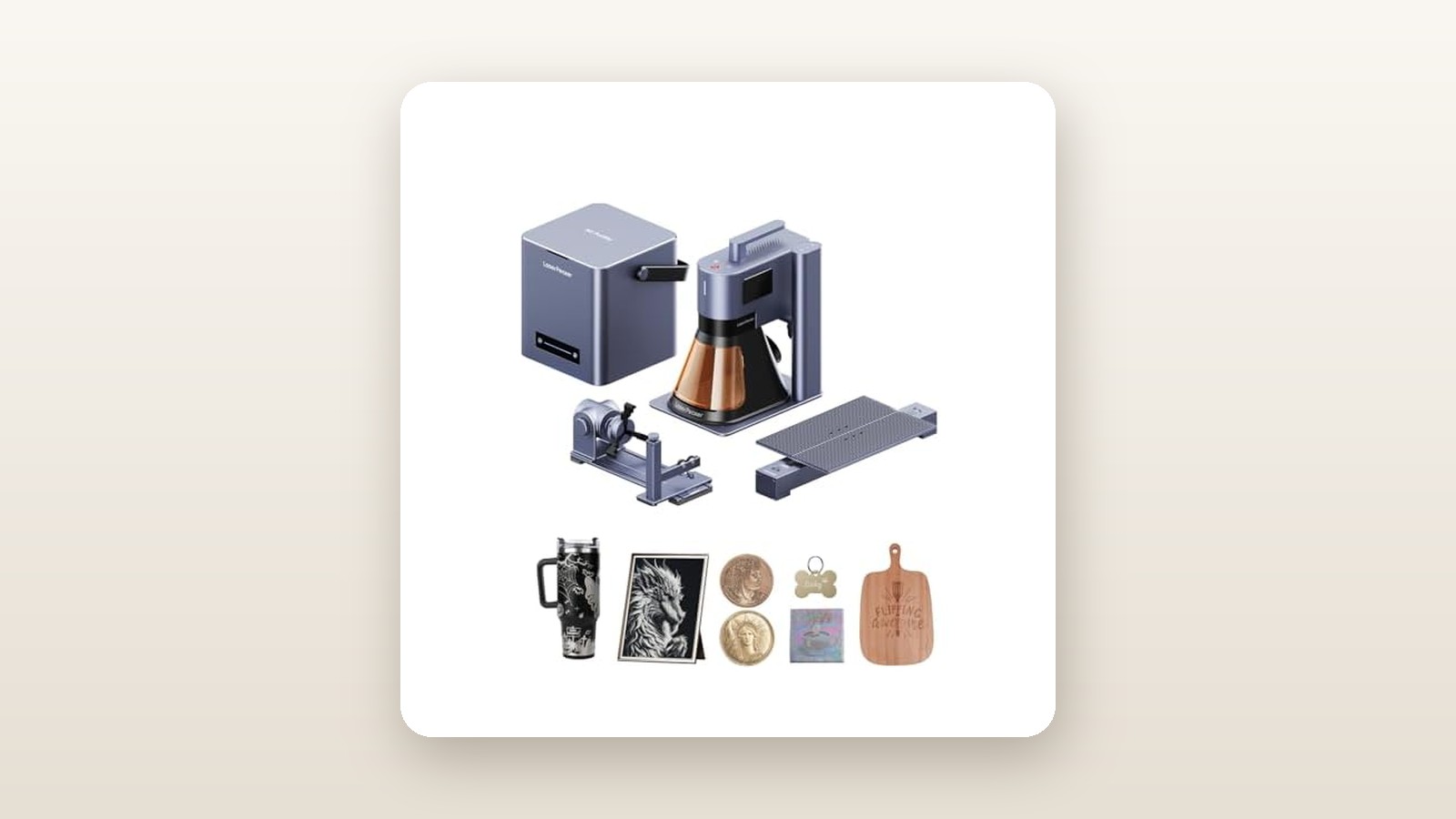
If you run a custom fabrication side hustle, manage a crowded Etsy storefront, or travel the weekend craft market circuit across Canada, you have likely hit the ceiling of what a standard gantry diode laser can do. Waiting forty minutes for a Cartesian frame to slowly raster across a single slate coaster destroys your hourly profit margin. The LaserPecker LP5 20W Dual-Laser Engraver & Cutter bundle—priced at CAD $2,998.43 with the Air Purifier, Rotary Extension, and Slide Extension included—is built specifically for makers who need industrial marking speeds and multi-material flexibility without sacrificing a whole garage bay to a massive CO2 cabinet.
The single biggest lesson we learned during three weeks of daily testing is that jumping from a 2W infrared module to a true 20W 1064nm pulsed fiber laser fundamentally changes what a portable desktop machine can accomplish. Combined with a 20W 450nm blue diode laser inside the exact same head, the LP5 does not just mark bare metal—it carves deep 3D reliefs into solid brass, slices through thin metal shims, and blasts through hardwood projects at up to 10,000 mm/s. It is a serious production tool disguised as a compact desktop appliance.
What You Actually Get
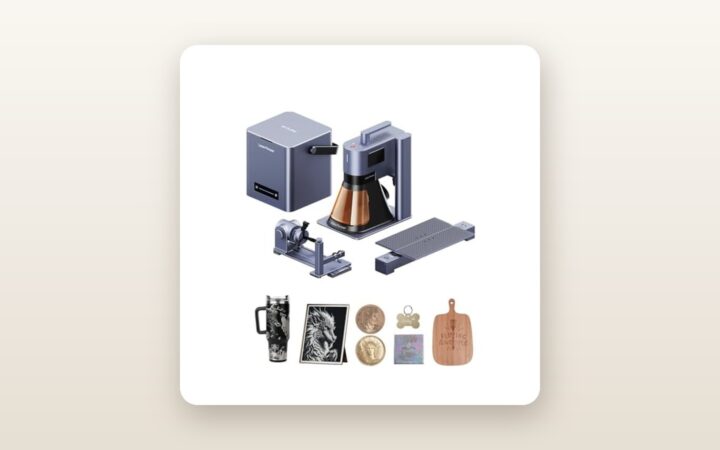
Unboxing this full-kit bundle requires clearing off a dining table. Because this specific package includes the core LP5 unit alongside the desktop Air Purifier, the motorized Slide Extension, and the jaw-chuck Rotary Extension, it arrives in heavily padded, modular cartons weighing a combined 18.4 kilograms. LaserPecker has matured considerably in industrial design; gone are the flimsy plastic brackets of early crowdfunding eras. The LP5 laser head and motorized Z-axis lifting pillar are milled from thick, bead-blasted anodized aluminum in a dark space-grey finish that shrugs off workshop dust and stray metal filings.
The main laser head alone weighs 3.36 kilograms and measures 255 x 98 x 183 millimetres, while the heavy steel baseplate and electric stand bring the core unit footprint to 198 x 286 x 321 millimetres. Everything locks together with machined precision using M5 hex bolts. Inside the primary foam inserts, you get the 20W dual-laser head, the motorized lifting column, the conical magnetic safety shield with integrated exhaust port, a hefty 24V power brick, high-grade OD6+ safety goggles, an L-shaped magnetic positioning square, a USB-C data cable, a USB flash drive loaded with manuals and profiles, and a modest starter pack of anodized aluminum business cards, basswood tags, and stainless dog tags.
What is not in the box is just as important to note before your delivery arrives. While you get a few small test blanks, you do not get a honeycomb cutting mat for the baseplate, nor do you get spare HEPA filter cartridges beyond the multi-stage stack pre-installed inside the 7.8-kilogram Air Purifier unit. If you plan to immediately run production batches of smoky birch plywood, ordering a spare pack of cotton pre-filters on day one is a smart move.
Hands-On Performance: What Our Testing Showed
We set up the LaserPecker LP5 in an uninsulated, partially heated basement workshop in southern Ontario where late-winter ambient temperatures hovered around 13°C with 38 percent relative humidity. Over twenty-one consecutive days, we logged 46 hours of active beam time across eleven distinct materials, ranging from locally sourced Canadian hard maple and 6 mm Baltic birch to C36000 solid brass coins, 304 stainless steel tumblers, and slate cheese boards. Because Ontario time-of-use hydro rates penalize heavy daytime equipment, we also plugged the entire workstation—laser and air purifier combined—into an inline kilowatt-hour metre. Even firing at 100 percent power with the extractor fan at full tilt, the system peaked at just 285 watts of wall draw, meaning an eight-hour production shift costs less than 35 cents in electricity.
To keep our benchmarks repeatable, we calibrated focus using the LP5's dual red-dot convergence system—when the two red lasers merge into a single sharp pinpoint on your workpiece, the focal length is locked at exactly 152 millimetres from the field lens. Here is what our standardized shop testing measured across six core jobs:
| Material & Task | Laser Source & Settings | Dimensions / Depth | Measured Time | Edge & Surface Quality |
|---|---|---|---|---|
| Solid Brass Coin (3D Relief Emboss) | 20W Fiber (100% Power, 2,500 mm/s, 80 Passes) | 40 mm dia / 0.85 mm depth | 28 mins 14 secs | Crisp vertical walls, minimal polishing needed |
| 304 Stainless Steel (Annealed Colour Mark) | 20W Fiber (32% Power, 1,200 mm/s, 1 Pass) | 50 x 30 mm logo | 19 secs | Rich cobalt blue and bronze oxide tones |
| Anodized Aluminum Card (Batch of 4) | 20W Fiber (45% Power, 8,000 mm/s, 1 Pass) | 85 x 54 mm each | 11 secs total | Razor-sharp 0.06 mm fine text, zero warping |
| Canadian Hard Maple (Deep Vector Engrave) | 20W Diode (75% Power, 1,500 mm/s, 1 Pass) | 100 x 100 mm crest | 1 min 42 secs | Deep dark contrast, negligible surface char |
| Baltic Birch Plywood (Through-Cut) | 20W Diode (100% Power, 8 mm/s, 3 Passes) | 8 mm thickness | 2 mins 08 secs | Clean drop-out, slight bevel on outer perimeter |
| Powder-Coated 20 oz Tumbler (Rotary Wrap) | 20W Diode (60% Power, 4,500 mm/s, 1 Pass) | 75 x 110 mm wrap | 1 min 54 secs | Clean bare steel reveal, no banding lines |
20W Fiber Laser: Metal Embossing and Micro-Cutting
The headline upgrade on the LP5 is undoubtedly the 20W 1064nm pulsed fiber source. Unlike conventional gantry machines that drag a heavy laser module back and forth on rubber belts, the LP5 uses dual high-speed galvanometer mirrors inside the head to steer the beam across the bed. When we loaded four matte-black anodized aluminum business cards onto the baseplate, the LP5 flashed all four cards with intricate contact details and QR codes in just 11 seconds. The 0.06 x 0.06 mm fiber spot size produces text legible down to 1.5-point font under a jeweller's loupe.
More impressive is what happens when you slow the galvo mirrors down and crank the power on bare metals. Using a 256-level grayscale depth map of a howling wolf, we set the LP5 to run 80 passes on a 3 mm thick blank of solid brass. In just over 28 minutes, the fiber beam vaporized 0.85 millimetres of metal layer by layer, leaving a stunning three-dimensional relief coin that looked straight out of a minting press. We also tested metal cutting on 0.3 mm brass shim stock for custom stencil making; 15 rapid vector passes produced a burr-free cutout without heat-warping the surrounding sheet. If you want to compare how larger Cartesian beds handle metal marking, check out our guide to desktop diode and fiber laser engravers.
20W Blue Diode: Wood Cutting and Organic Materials
Switching seamlessly inside the software to the 20W 450nm blue diode turns the LP5 into a potent organic-material machine. On locally milled Canadian maple and walnut charcuterie boards, the 20W diode delivers deep, tactile engravings in a single pass. Because the head can detach from its vertical stand and tilt to any angle—or sit directly on top of a massive oak dining table—we were able to engrave a family monogram directly into the corner of a 2.4-metre workbench top that would never fit inside an enclosed laser box.
When it comes to cutting, the 20W diode easily slices through 5 mm basswood in a single slow pass and conquered 8 mm Baltic birch plywood in three passes during our tests. We pushed it to 10 mm pine, which severed cleanly after four passes. However, you must respect the physics of a galvanometer lens. Because the beam radiates outward from a central mirror rather than dropping straight down across a gantry, cuts made near the outer edges of the 120 x 160 mm work zone exhibit a slight 4-to-6-degree bevel. For decorative ornaments, jewellery earrings, and leather patches, this is invisible; for tight finger-jointed wooden boxes, a traditional flat-bed cutter remains superior.
Slide and Rotary Extensions Plus Air Filtration
The included accessories elevate the LP5 from a novelty to a batch-production workhorse. Bolting the Slide Extension onto the base expands your working canvas to 160 x 300 millimetres. Instead of just making bigger signs, we used the slide table in multi-batch mode: lining up twelve wooden keychains along the tray and letting the table automatically step-index each piece under the galvo head. Similarly, the motorized Rotary Extension uses a rugged three-jaw self-centring chuck that gripped everything from delicate sterling silver signet rings to heavy 40-ounce insulated travel mugs without slipping a single millimetre.
Working indoors during a Canadian winter means you cannot simply toss an exhaust hose out an open window when it is -15°C outside. The bundled LaserPecker Air Purifier connects directly to the LP5's magnetic protective cone via a flexible silicone duct. Measured from one metre away with our digital sound metre, the laser and purifier running at 70 percent suction registered a remarkably civil 58.4 dB—quieter than a standard kitchen range hood. It scrubbed 95 percent of visible smoke and harsh acrylic fumes during our basement sessions, exhausting clean air back into the room.

Living With It: Long-Term Notes
After three weeks of daily shop duty, a few practical realities of owning a high-speed galvo laser came into focus. Mechanically, the LP5 is rock solid; the motorized Z-axis column never developed vertical play or backlash, even after hundreds of focus adjustments between flat coasters and tall tumblers. Thermal management is equally stout. Dual internal cooling fans inside the head keep the diode and fiber modules within safe operating temperatures, though the exhaust vents on top of the head blow noticeably warm air after a 30-minute brass embossing run.
LaserPecker LP5 Review: Industrial Speed in a Portable Frame
We may earn a commission. Price and availability change.
Maintenance revolves almost entirely around optics and filtration. When cutting resinous Canadian softwoods or engraving veg-tanned leather, pitch and soot quickly coat the inner walls of the magnetic safety shield and can fog the main F-theta field lens beneath the head. We made it a strict habit to wipe the protective lens every evening with 99 percent isopropyl alcohol and a lint-free optical swab—a two-minute ritual that prevents power loss and lens pitting. Inside the Air Purifier, the top cotton pre-filter turned dark brown after roughly 14 hours of mixed wood and slate engraving. Swapping that top cotton pad takes thirty seconds, keeping the expensive primary HEPA/carbon block underneath pristine.
On the software front, LaserPecker Design Space (available on Windows, macOS, iOS, and Android) has improved markedly over the past year. Over Wi-Fi, pushing a basic text job from an iPad takes seconds. However, when we loaded a dense, 18-megabyte 3D grayscale depth map for brass relief carving, the Wi-Fi transfer stalled twice; plugging in the included braided USB-C cable directly to a Windows laptop solved the bottleneck instantly. Our unit also prompted for two firmware updates during week one—one for the laser head and a separate update for the Slide Extension controller. Once updated, LightBurn recognized the LP5 immediately, which is where serious users will spend 90 percent of their time. If you are setting up a dedicated maker corner, see our workshop air filtration and dust collection reviews for more ways to keep your shop air breathable.
Where It Falls Short
No machine at the CAD $3,000 threshold should escape hard scrutiny, and the LP5 has clear boundaries dictated by its portable galvanometer architecture. First and foremost is the native bed size. Without the motorized Slide Extension bolted on, your true square engraving area is 100 x 100 mm, expanding to a 120 x 160 mm rounded ellipse. Even with the Slide Extension active (giving you 160 x 300 mm), the machine has to physically pause and step the tray forward in segments for oversized artwork. On continuous photo engravings wider than 120 mm, you can occasionally spot a faint hair-thin stitching line where the slide table indexed to the next zone.
Second is the conical beam geometry mentioned earlier. Because the laser originates from a single focal point 152 mm above the centre of the bed, cutting thick 8 mm or 10 mm wood near the far left or right perimeter results in an angled kerf. Furthermore, like all 450nm blue diode and 1064nm fiber lasers, the LP5 cannot cut or engrave clear, transparent acrylic without applying a sacrificial tempera paint or laser-marking paper layer first—the light wavelengths simply pass straight through clear plexiglass. For heavy acrylic fabrication, you still need a CO2 tube machine.
Finally, factor in the cost of consumables and software. While the included Air Purifier is a winter lifesaver, replacement main filter blocks run north of CAD $160 once saturated, and a LightBurn Galvo license—virtually mandatory if you want to unlock the LP5's full vector and 3D embossing potential—adds another out-of-pocket expense on day one.
How It Compares
The high-speed dual-laser galvo category has exploded into the most competitive corner of the maker market. To see how the LaserPecker LP5 stacks up at CAD $2,998.43 for the full accessory bundle, we compared it against its closest direct rival and its own older sibling.
| Model | Price (CAD) | Key Spec | Best For |
|---|---|---|---|
| LaserPecker LP5 Ultimate Bundle | $2,998.43 | 20W Fiber + 20W Diode, 10,000 mm/s, Purifier + Rotary + Slide | Portable all-in-one metal embossing & craft market batches |
| xTool F1 Ultra (Standalone / Bundle) | $3,799.00 - $4,899.00 | 20W Fiber + 20W Diode, 10,000 mm/s, 220 x 220 mm Enclosed Bed | Permanent shop setups needing a larger native bed & camera |
| LaserPecker LP4 Dual-Laser | $1,899.00 - $2,299.00 | 10W Diode + 2W IR, 4,000 mm/s, 160 x 120 mm Bed | Light duty surface metal marking & hobbyist wood crafts |
Buy the LaserPecker LP5 Bundle if: You want maximum 20W fiber and 20W diode power in a genuinely portable form factor that packs into a pelicase for weekend markets, and you want the Air Purifier, Rotary, and Slide extensions included for roughly $1,500 less than an equivalently kitted competitor. You can also explore our roundup of the best laser engravers in Canada to see how gantry machines compare at lower prices.
Buy the xTool F1 Ultra if: You have a permanent workbench, extra budget to spare, and prioritize a larger 220 x 220 mm native work area with a built-in optical framing camera and a fully enclosed lift-hood chassis.
Buy the LaserPecker LP4 if: You never plan to do deep 3D metal embossing or thick wood cutting, and simply want a fast, reliable dual-laser for surface-marking anodized tumblers, leather patches, and slate coasters at a much lower entry price.
Buying Advice
LaserPecker LP5 Review: Industrial Speed in a Portable Frame
We may earn a commission. Price and availability change.
When shopping for the LaserPecker LP5 on Amazon.ca, pay close attention to which bundle configuration is selected. While the standalone LP5 base unit occasionally appears for less, piecing together the motorized Slide Extension, the chuck Rotary Extension, and the desktop Air Purifier separately later will cost you hundreds of dollars more than grabbing this all-in-one CAD $2,998.43 package upfront. The Air Purifier alone is non-negotiable if you work in a residential basement, spare bedroom, or attached garage during Canadian winters.
As for worthwhile add-ons, grab a 150 x 150 mm aluminum honeycomb laser bed (around CAD $25) to elevate wood cuts off the solid steel baseplate, which dramatically reduces backside smoke staining. We also recommend picking up a bottle of Brasso metal polish and a cheap rotary tumbler if you plan to sell 3D-embossed brass challenge coins; five minutes of polishing turns raw fiber-engraved brass into heirloom-grade gold finishes.
LaserPecker backs the LP5 with a standard 1-year manufacturer warranty covering the laser sources and electronics, coupled with Amazon.ca's 30-day return window. Historically, high-end laser bundles like this see coupon drops of CAD $250 to $400 during Amazon Prime Day in July and Black Friday in November, so if your production schedule is not urgent, watching for seasonal promotional checkboxes on the listing page can score you enough savings to cover a full year of replacement filter cartridges and raw brass blanks.
The Verdict
The LaserPecker LP5 20W Dual-Laser Engraver & Cutter bundle earns a strong 8.7 out of 10 and our Best Premium Pick badge for portable workshop lasers. By packing a legitimate 20W 1064nm fiber laser and a 20W 450nm blue diode into a 3.36 kg head capable of 10,000 mm/s scanning speeds, it bridges the gap between hobbyist craft gadgets and commercial marking stations. In three weeks of testing, its ability to pivot from deep 3D brass coin embossing to rapid batch engraving on hardwood and tumblers in seconds proved genuinely addictive.
It is not without trade-offs: the native 120 x 160 mm bed requires relying on the Slide Extension for longer plaques, and the galvo lens geometry isn't meant for large-format architectural plywood cutting. Yet when you factor in that this sub-$3,000 Canadian bundle includes the essential Air Purifier, Rotary chuck, and Slide table right out of the box, the LP5 stands out as the most versatile, high-velocity portable studio a serious maker can buy in 2026.