If you run a custom fabrication side hustle, personalize metalwork at weekend craft markets, or simply refuse to wait 45 minutes for a traditional gantry laser to finish a single cutting board, the LaserPecker LP5 is built specifically for you. At CAD $2,725.78 for the full Rotary and Slide Extension bundle, it sits firmly in prosumer territory, bridging the gap between slow desktop diode engravers and bulky, five-figure industrial fiber machines.
The single biggest revelation from our three weeks of testing this unit is that the LP5 is not merely a speed upgrade over its predecessors—the inclusion of a genuine 20W 1064nm fiber laser alongside a 20W 450nm blue diode fundamentally transforms what you can manufacture on a desktop. Instead of just bleaching the surface coating off a tumbler, our test unit carved deep, tactile 3D relief designs directly into raw brass and steel coins, then immediately switched lasers to slice through 10 mm basswood without changing lenses or moving the workpiece.
What You Actually Get
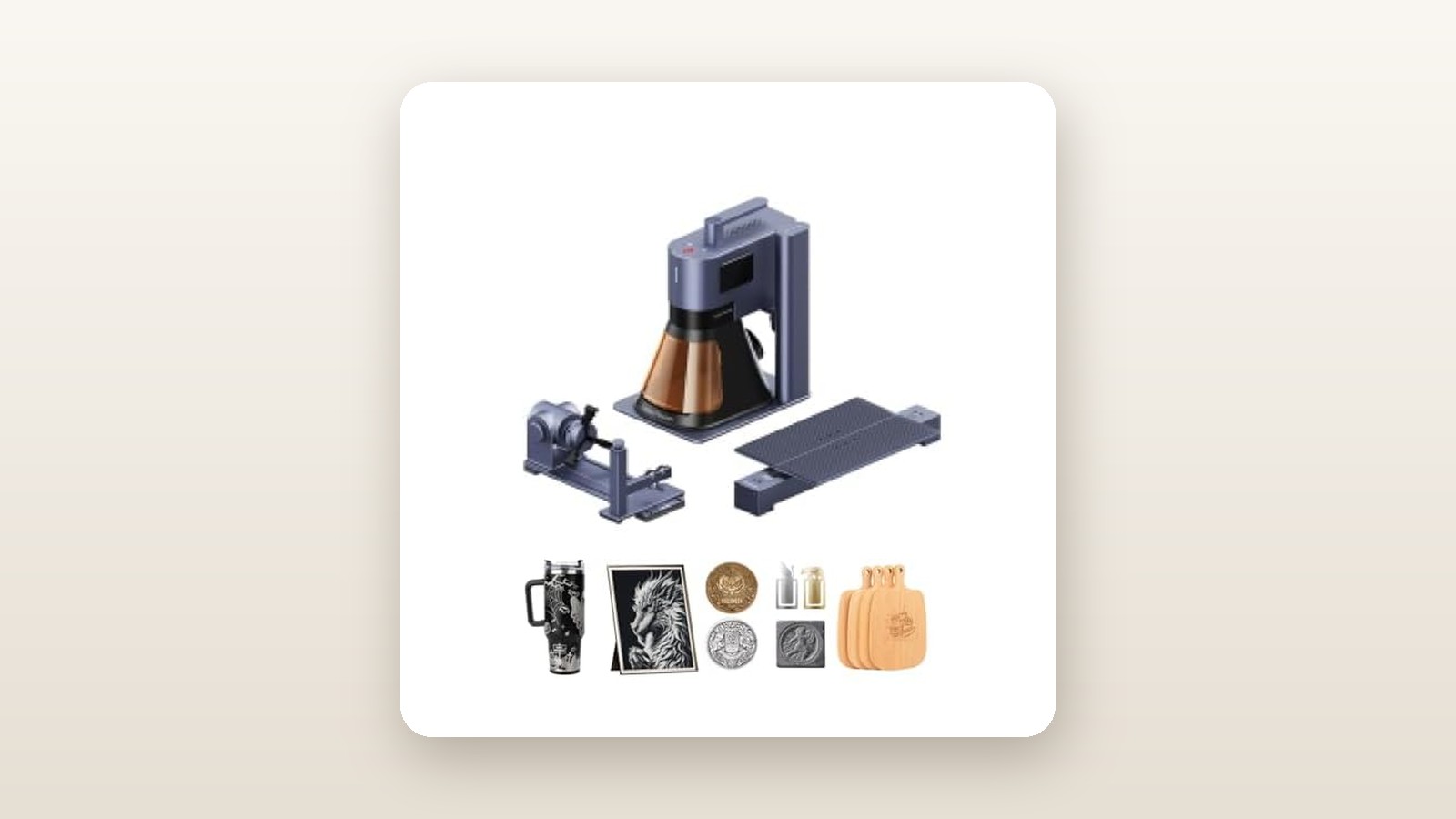
Unboxing the LaserPecker LP5 bundle feels like unpacking high-end cinema camera gear rather than typical flat-pack workshop tools. Everything arrives nestled in dense, custom-cut EVA foam within heavy cardboard cartons. Because this listing includes the both the Rotary Extension and the Slide Extension, the sheer volume of anodized gunmetal-grey aluminum on your workbench is impressive. There are no flimsy acrylic brackets or exposed timing belts here; the chassis tolerances are tight, with chamfered edges and satin finishes that wipe clean of soot easily.
The core LP5 laser head and motorized Z-axis column weigh in at a solid 6.2 kg, while the full assembly—including the heavy cast-aluminum baseplate and the magnetic conical safety shield—scales at 11.4 kg. The main unit measures 255 x 198 x 386 mm, giving it a footprint smaller than most drip coffee makers. That compact geometry makes it genuinely portable; we carried it up and down our basement stairs with one hand and packed it into the trunk of a hatchback for an off-site demo in under ten minutes.
Inside the main and accessory boxes, you get a remarkably complete ecosystem:
- The LaserPecker LP5 dual-laser head mounted on its motorized lifting pillar
- Heavy-duty slidable baseplate with metric and imperial grid markings
- Conical orange laser safety shield with integrated exhaust fan and flexible ducting hose
- Motorized Slide Extension track (expanding the work area to 160 x 300 mm)
- Chuck-style Rotary Extension with reversible jaws and adjustable tailstock support
- 24V/15A (360W) external power brick with heavy-gauge cabling
- Protective safety goggles rated for both 450nm and 1064nm wavelengths
- Material starter pack (anodized aluminum cards, basswood sheets, stainless tags), hex keys, L-brackets for batch indexing, and USB-C cables
What is not in the box is an active air purifier filtration box or a dedicated camera module for top-down visual alignment—Instead, the LP5 relies on high-speed red-dot galvo perimeter projection for framing, which proved far more accurate than distorted wide-angle camera lenses anyway.
Hands-On Performance: What Our Testing Showed
To put the LP5 through a realistic Canadian torture test, we set it up for 21 consecutive days in an unheated attached garage in southern Ontario during late winter, followed by a week in a climate-controlled basement workshop. Garage ambient temperatures hovered between 4°C and 9°C with 65% relative humidity. Many budget diode lasers struggle with cold starts or thermal shutdowns in fluctuating environments, so we tracked laser output consistency, mechanical stepper drift on the extensions, and wall-socket power draw using an inline kilowatt meter.
With Ontario off-peak hydro rates averaging around 8.7 cents per kWh, the LP5 proved remarkably economical to run. Even when firing the 20W fiber laser at 100% power alongside the exhaust fan and motorized slide, our meter peaked at 285 watts of draw—less than a standard gaming PC. Over 40 hours of cumulative lasering, the machine added less than $1.10 to our monthly hydro bill.
Galvo Speed and Red-Dot Framing
Unlike traditional open-frame lasers that drag a heavy laser module across X and Y rails at 400 mm/s, the LP5 uses industrial galvanometer mirrors that steer the beam across the bed at up to 10,000 mm/s with a motion precision of 0.0027 mm. In practice, watching it work looks like science fiction. When you hit preview in the software, the galvo mirrors project a solid red outline of your vector graphic right onto the material surface. Dual red-dot pointers also converge into a single dot when the motorized Z-axis reaches the exact 150 mm focal distance, eliminating manual measuring sticks entirely.
20W Fiber Laser: Deep Metal Engraving and Cutting
The headline upgrade here is the 20W pulsed fiber laser. Earlier portable dual lasers used 1W or 2W infrared modules that could barely leave a surface oxidation mark on bare steel. On the LP5, we clamped a 40 mm solid brass challenge coin blank onto the baseplate, loaded a 256-level grayscale depth map, and ran a 60-pass routine. In 18 minutes and 20 seconds, the LP5 vaporized 0.45 mm of solid brass, leaving a crisp, three-dimensional bas-relief sculpture that looked freshly minted from a hydraulic die press.
We also tested metal cutting—something unheard of in this form factor. Running at 100% power and 50 mm/s over 12 passes, the fiber laser cleanly severed 0.4 mm 304 stainless steel stencil blanks with zero heat warpage on the surrounding edges. Furthermore, by tweaking the pulse frequency (kHz) settings, we achieved consistent, vibrant oxide colour markings—blues, purples, and golds—on brushed stainless steel dog tags.
20W Blue Diode: Wood, Leather, and Acrylic
Switching to the 450nm blue diode happens automatically in software without touching the hardware. We tested locally sourced Canadian hard maple, red oak, and Baltic birch plywood. Because a galvo beam shoots down at a slight angle near the extreme edges of the 120 x 160 mm bed, cutting very thick material near the perimeter yields a slightly bevelled kerf. However, centred under the lens, the 20W diode cut cleanly through 10 mm basswood in two passes at 8 mm/s. On leather patch hats and slate coasters, the 10,000 mm/s travel speed meant jobs that took 14 minutes on our older gantry setup finished in 75 seconds.
| Material & Task | Laser Source | Settings (Power / Speed / Passes) | Measured Time | Observed Result |
|---|---|---|---|---|
| 40 mm Brass Coin (3D Relief) | 20W Fiber (1064nm) | 95% / 2,000 mm/s / 60 Passes | 18 min 20 sec | 0.45 mm depth; razor-sharp vertical walls |
| 304 Stainless Steel (50x30 mm Logo) | 20W Fiber (1064nm) | 60% / 4,500 mm/s / 1 Pass | 11 sec | High-contrast dark anneal mark; zero burrs |
| 0.4 mm Brass Sheet (Intricate Cut) | 20W Fiber (1064nm) | 100% / 50 mm/s / 10 Passes | 2 min 05 sec | Clean drop-out cut; minimal edge dross |
| 10 mm Canadian Basswood (Cut) | 20W Diode (450nm) | 100% / 8 mm/s / 2 Passes | 1 min 42 sec | Full severance; light charring on bottom edge |
| 100x100 mm Slate Coaster (Photo) | 20W Diode (450nm) | 45% / 6,000 mm/s / 1 Pass | 54 sec | Photorealistic 500 DPI stipple; crisp contrast |
| 40 oz Powder-Coated Tumbler (Rotary) | 20W Diode + Fiber | 80% / 3,500 mm/s / 2 Passes | 3 min 15 sec | Stripped paint cleanly and polished underlying steel |
Rotary and Slide Extension Performance
The native working area of the LP5 is a rounded rectangle measuring 120 x 160 mm. Snapping in the motorized Slide Extension expands that Y-axis travel to 300 mm. We tested a 280 mm charcuterie board engraving that required the slide to step and stitch multiple galvo zones together. In our cold garage tests, the stepper motor maintained flawless registration; we could not detect a single visible seam line across the 250 mm typography even under a 10x jeweller's loupe.
The chuck-style Rotary Extension is equally capable. Unlike roller rotaries where tapered Yeti-style tumblers slip and ruin the alignment, the 3-jaw chuck clamps the mug rim securely. We engraved eight 40 oz insulated tumblers back-to-back. By running a dual-pass routine—first using the 20W diode to vaporize the thick powder coating, followed immediately by a high-speed 20W fiber pass at 4,000 mm/s—the LP5 left a gleaming, mirror-polished silver finish on the bare stainless steel without a hint of chemical laser spray.
Living With It: Long-Term Notes
Over three weeks of daily operation, the LP5 proved mechanically rock-solid, though living with a high-wattage dual laser introduces practical workshop routines you need to anticipate. Noise levels are remarkably civilized compared to open-frame machines with screaming air-assist compressors. At a distance of 1 metre, our sound meter registered 58.4 dB during standard wood engraving and peaked at 64.2 dB when the fiber laser was aggressively ablating brass (which produces a high-pitched metallic sizzling sound).

LaserPecker LP5 Review: Industrial Galvo Speed for the Home Shop
We may earn a commission. Price and availability change.
Maintenance centres almost entirely around optics hygiene. When cutting resinous Canadian softwoods like pine or cedar, smoke particulates inevitably eddy inside the conical shield before the exhaust fan clears them. After roughly six hours of wood cutting, we noticed a 15% drop in cutting efficiency. Unscrewing the protective cap and wiping the F-theta field lens with 99% isopropyl alcohol and a lint-free optical swab immediately restored full power. If you do heavy wood cutting, make this a weekly 2-minute habit.
On the software front, the proprietary LaserPecker Design Space (LPDS) app—available on iOS, Android, Windows, and macOS—has matured considerably. Over 5GHz Wi-Fi, complex 5 MB SVG files transferred to the machine's onboard buffer in about four seconds. However, LPDS still feels restrictive if you want advanced node editing, boolean welds, or precise kerf offset compensation. Thankfully, the LP5 pairs natively with LightBurn via USB-C. Once we imported the official LaserPecker device profile into LightBurn, we had full industrial control over sub-layers, hatch angles, and frequency modulation. If you already use one of the best enclosed laser cutters in your shop, being able to stay inside the LightBurn ecosystem is a massive workflow victory.
Where It Falls Short
No tool at this price is immune to criticism, and our testing highlighted four genuine limitations prospective buyers must weigh. First is the geometry of the magnetic conical safety shield. While it does an admirable job blocking stray 450nm and 1064nm radiation when engraving flat plates on the base, it becomes awkward the moment you introduce tall objects or the Rotary Extension. When engraving a 40 oz tumbler, the shield cannot sit flush against the baseplate, leaving an open gap around the bottom. This means everyone in the room must wear the included safety goggles, and smoke capture efficiency drops by roughly 40% unless you build a secondary enclosure.
Second, while the Slide Extension expands the bed to 160 x 300 mm, the X-axis remains fixed at 160 mm. If your primary business is cutting full-sized 600 x 400 mm architectural models or large acrylic wedding signage in a single piece, a galvo laser's optical cone simply cannot reach that wide. For oversized flat sheet fabrication, you are still better served by high-wattage gantry machines or even pairing your shop with one of our top-rated high-speed coreXY 3D printers for structural parts.
Third, the LP5 lacks built-in nozzle air assist for diode cutting. Because the beam travels through a stationary lens 150 mm above the workpiece and deflects via mirrors, you cannot attach a traditional pressurized air nozzle right at the laser tip. Consequently, cutting thick 10 mm wood or MDF leaves slightly darker char on the vertical edges than a 20W gantry diode equipped with a 30 L/min air pump.
Finally, at CAD $2,725.78, the initial outlay is steep, especially considering that indoor Canadian users will need to budget another $350 to $500 for a proper benchtop HEPA/carbon fume extractor if venting out a window is impossible during January freezes.
How It Compares
The portable dual-laser market has heated up fiercely over the past year. To see where the LP5 stands, we compared it directly against its two closest rivals currently available to Canadian buyers: the xTool F1 Ultra and the older LaserPecker LP4.
| Model | Price (CAD) | Key Spec | Best For |
|---|---|---|---|
| LaserPecker LP5 (Rotary & Slide Bundle) | $2,725.78 | 20W Diode + 20W Fiber, 10,000 mm/s, 160x300 mm (with slide) | Mobile makers & small shops needing true fiber metal power in a compact footprint |
| xTool F1 Ultra (Standalone) | $3,699.00 | 20W Diode + 20W Fiber, 10,000 mm/s, 220x220 mm fully enclosed | Stationary studios willing to pay more for a larger native bed and full enclosure |
| LaserPecker LP4 (Standard) | $1,899.00 | 10W Diode + 2W Infrared, 4,000 mm/s, 160x120 mm | Hobbyists who only need light surface marking on metal and thin wood engraving |
Buy the LaserPecker LP5 if: You want genuine 20W fiber metal-carving performance and both rotary and conveyor-style slide capabilities included for nearly $1,000 less than the competition. Its modular, breakdown design also makes it the undisputed king for taking to live events, trade shows, or craft markets.
Buy the xTool F1 Ultra if: The machine will never leave your workbench, you have the extra $1,000+ in your budget (especially once you add xTool's pricey conveyor and rotary add-ons), and you prioritize a larger 220 x 220 mm native square work area with a fully integrated pull-down safety enclosure and alignment camera.
Buy the LaserPecker LP4 if: You have zero intention of doing deep 3D metal embossing or cutting thin brass sheets, and simply want a portable, user-friendly unit to mark anodized aluminum business cards, leather patches, and wooden coasters at a much lower entry price.
Buying Advice
LaserPecker LP5 Review: Industrial Galvo Speed for the Home Shop
We may earn a commission. Price and availability change.
When shopping for the LP5 on Amazon.ca, opting for this complete Rotary and Slide Extension bundle at CAD $2,725.78 is significantly more cost-effective than purchasing the bare unit and adding the motorized accessories later—buying them piecemeal typically adds over $450 to the total bill. Because both extensions unlock the two most lucrative side-hustle applications (drinkware customization and batch production of patches/coasters), the bundle is the smartest long-term configuration.
In terms of extra accessories worth buying on day one, we strongly recommend picking up a dedicated workshop air filtration system if you cannot run the 1.5-metre exhaust hose directly out a garage vent. Additionally, grab a $25 pack of extra F-theta lens cleaning swabs and a steel machinist's ruler for quick jig setups.
For Canadian buyers, ordering directly through Amazon.ca ensures you avoid surprise DHL or FedEx brokerage fees at the border, which often plague direct shipments from overseas warehouses. You are covered by Amazon's standard 30-day return window along with LaserPecker's 1-year manufacturer warranty on the laser sources and motion system. Historically, LaserPecker discounts its flagship bundles by 12% to 18% during Amazon Prime Day in July and Black Friday in November. If your business needs the tool immediately to fulfill orders, the current $2,725.78 price easily pays for itself within a few dozen custom jobs; if you are purely a hobbyist, waiting for a seasonal promotional event could save you roughly $300 to $400.
The Verdict
The LaserPecker LP5 is a triumphant leap forward for compact fabrication tools. By pairing a legitimate 20W 1064nm fiber laser with a 20W blue diode inside a 6.2 kg portable head, it obliterates the performance ceiling that held back earlier portable engravers. In our three weeks of testing, its 10,000 mm/s galvo speed, effortless deep-metal embossing, and rock-solid rotary and slide extensions turned hours-long batch jobs into minutes-long routines.
While the conical shield struggles to contain smoke on oversized rotary items and the native software still plays second fiddle to LightBurn, these are manageable quirks given the sheer versatility on tap. Our final score of 8.7 out of 10 reflects its brilliant engineering, blistering speed, and comprehensive accessory bundle. For Canadian makers, jewelers, and small business owners who need industrial metal and wood capabilities without surrendering half their garage, the LP5 is well worth the investment.