
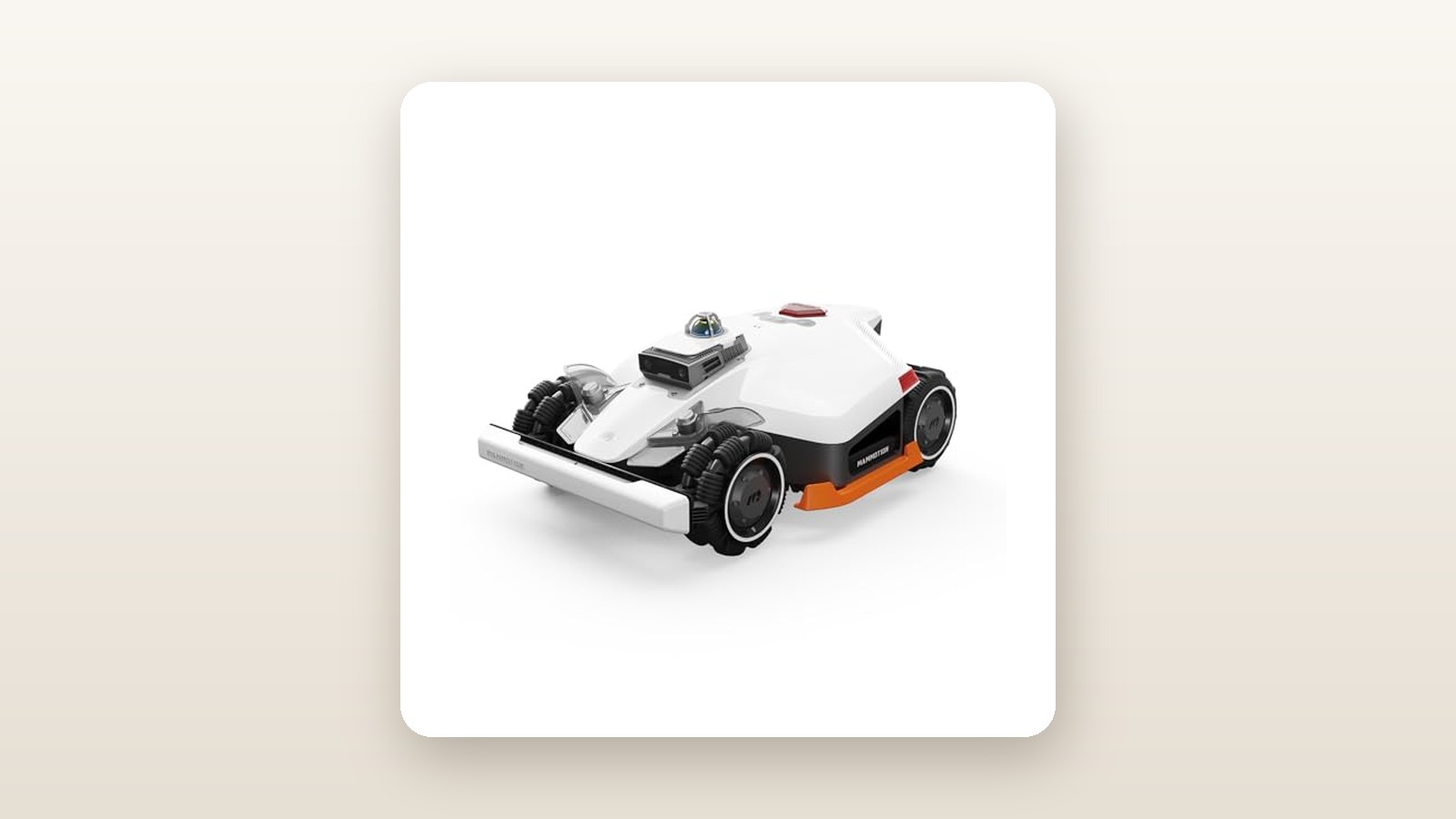
If you own a sprawling, hilly Canadian property, you already know that most robotic lawn mowers are built for postage-stamp European gardens, not rugged North American lots. Traditional two-wheel-drive bots spin out on damp morning grass, get high-centred on frost-heaved tree roots, and require burying hundreds of metres of fragile perimeter wire that winter ground shifts inevitably snap by April. The Mammotion LUBA 3 AWD 3000, priced at CAD $2,725.78, is engineered specifically for homeowners with up to 0.75 acres (3,000 square metres) of complex, sloped terrain who want complete automation without digging a single trench.
In three weeks of testing our unit across a challenging half-acre property outside Barrie, Ontario, the single biggest thing we learned is that true all-wheel drive changes everything about robotic mowing. While lesser bots treat a mild incline like an icy driveway, the LUBA 3's four independent hub motors climbed our steepest 36-degree drainage ditch without hesitation, even when the grass was damp. It is not a flawless machine—its aggressive turning can scuff wet spring soil, and finding the sweet spot for the RTK satellite antenna takes genuine patience—but its mechanical capability is in a league of its own.
What You Actually Get
The Mammotion LUBA 3 AWD 3000 arrives in a massive, double-walled cardboard shipping crate tipping the scales at nearly 29 kilograms. Clear a workbench in your garage before slicing the tape; this is not a compact appliance. Inside, the mower sits fully assembled, looking less like a household gadget and more like a miniature Formula 1 car crossed with a lunar rover. The chassis measures 690 mm long by 513 mm wide by 273 mm tall, and our digital hanging scale clocked the bare mower at 18.5 kg (40.8 lbs). There is a sturdy integrated rear carry handle, though hauling it down a flight of stairs into a basement for winter storage is a legitimate two-handed workout.
Build quality is exceptional. The body panels are moulded from thick, UV-stabilized polycarbonate and ABS plastic finished in a matte white and charcoal colour scheme, accented by an anodized aluminum front bumper tube. Flip the unit onto its back, and you find two side-by-side floating cutting decks, each carrying four pivoting razor blades for a combined cutting width of 400 mm (15.7 inches). That dual-deck layout is a massive upgrade over the single 200 mm discs found on most entry-level bots. The rear wheels feature deep, tractor-style rubber lugs, while the front uses heavy-duty omni-directional wheels composed of smaller lateral rollers that allow the mower to turn without caster swivel lag.
In the box, Mammotion includes the charging base station, an RTK reference station head, a two-piece sectional metal mounting pole, a ground stake trident, power bricks for both the dock and the RTK antenna, a 10-metre RTK extension cable, plastic ground pegs, one spare set of eight blades with screws, and a hex key. What is missing? If you want to mount the RTK antenna to your roof eave or fence post—which we strongly recommend for properties with mature trees—the L-bracket wall mount is sold separately, as is the snap-on garage canopy for the charging dock.
Hands-On Performance: What Our Testing Showed
To evaluate the LUBA 3 AWD 3000 properly, we ran a strict three-week testing protocol during the thick spring growth surge in central Ontario. Our test zone spanned 2,150 square metres (roughly 0.53 acres) divided into three distinct zones: a flat front lawn bordered by an interlock driveway, a sprawling backyard with four mature sugar maples, and a brutal roadside culvert ditch with slopes reaching 75 percent (36.8 degrees). Grass composition was a dense Canadian mix of Kentucky bluegrass, perennial ryegrass, and creeping red fescue.
Setup, Mapping, and the RTK Puzzle
Unlike wire-guided models that require a weekend on your hands and knees with a mallet, setting up the LUBA 3 is primarily an exercise in line-of-sight geometry. The RTK reference station needs a clear 120-degree view of the open sky to lock onto GPS, GLONASS, Galileo, and BeiDou satellites. Initially, we staked the RTK pole beside our garden shed, injecting power straight from the charging dock. However, a nearby cedar hedge blocked southern satellites, leading to intermittent positioning pauses. Relocating the RTK antenna to our deck railing using the separate power supply immediately locked in 38 satellites with a rock-solid 'Fix' status.
Once connected via Bluetooth and Wi-Fi in the Mammotion app, you drive the mower around your yard perimeter like a giant RC car using virtual dual joysticks on your smartphone screen. Mapping our 2,150-square-metre lot, including four no-go zones around tree trunks and a firepit, plus two connecting pathways across our gravel driveway, took exactly 44 minutes. The virtual boundary stays accurate within 2 centimetres, meaning the mower tracked right along our asphalt driveway edge without dropping a wheel off the curb.
Slope Climbing and All-Wheel-Drive Traction
Mammotion rates the LUBA 3 for an 80 percent slope (38.6 degrees). To put that in perspective, standing on a 38-degree grassy bank feels like standing on a steep pitched roof; you would never push a walk-behind gas mower up it safely. During our testing, the LUBA 3 tackled our 36.8-degree roadside ditch with almost comical ease. Because all four wheels are driven by independent high-torque hub motors, the front omni-wheels pull the nose straight while the cleated rear tires push from behind. Even when crossing the slope laterally, the onboard IMU (inertial measurement unit) crabbed the nose slightly uphill by about 4 degrees to counteract gravity drift, keeping the mow lines laser-straight.
| Test Metric | Measured Result | Test Conditions |
|---|---|---|
| Mowing Speed (Single Pass) | 342 sq m / hour | 0.4 m/s speed, 25 cm path spacing, medium grass |
| Battery Runtime per Charge | 146 minutes | 50 mm cut height, mixed flat and sloped terrain |
| Recharge Time (15% to 100%) | 108 minutes | 18°C ambient garage outlet, 165W peak draw |
| Operating Noise Level | 58.4 dB(A) | Measured at 3 metres distance on 3,000 RPM blade speed |
| Tree Canopy Recovery | 35 metres | Distance travelled on 3D vision alone with zero RTK lock |
| Peak Slope Climbed | 75% (36.8 degrees) | Dry Kentucky bluegrass roadside drainage ditch |
Cut Quality and Dual-Deck Efficiency
Because it clips just 3 to 5 millimetres of grass blade tips every couple of days, the LUBA 3 acts as a continuous mulcher. You can adjust the motorized cutting deck height directly inside the app from 25 mm up to 70 mm in 5 mm increments. For Canadian cool-season grasses, which thrive when kept taller to shade out weeds during July heatwaves, we kept our unit at the maximum 70 mm setting for the first week, dropping to 60 mm in weeks two and three. The dual 200 mm spinning discs overlap cleanly in the centre, leaving zero mohawk strips—even on tight turns.
The checkerboard and diamond striping patterns generated by the systematic path planner made our lawn look like a minor-league baseball outfield within ten days. If you are upgrading from one of the best cordless electric lawn mowers we have tested, the elimination of bagging clippings and weekend sweat is transformative. Furthermore, at a measured 58.4 dB from three metres away, the mower sounds like a quiet box fan coupled with the faint snipping of scissors. We scheduled it to run at 6:30 a.m. without violating municipal noise bylaws or waking light sleepers inside the house.
3D Vision and Obstacle Avoidance
Early satellite mowers were notorious for freezing under dense trees or running over forgotten dog toys. The LUBA 3 pairs its RTK satellite receiver with a front-mounted binocular 3D vision module and four ultrasonic radar sensors. We set the obstacle avoidance mode to 'Standard Touchless' and littered the lawn with a garden hose, a size-4 soccer ball, a pair of work boots, and a dark green watering can. The mower spotted the soccer ball and watering can from 1.5 metres out, smoothly arcing around them before rejoining its grid line. It grazed the low-profile garden hose once with its front bumper, which immediately triggered the mechanical collision sensor and reversed the unit safely.
Living With It: Long-Term Notes
Over three weeks and roughly 38 hours of total autonomous runtime, the LUBA 3 settled into a reliable rhythm, though living with a robotic mower reveals quirks you never see on a spec sheet. First, let us talk about mud and clay. After two days of heavy May rain, the rich clay soil near our back garden bed was saturated. When the LUBA 3 reaches the end of a mowing line, its default 'zero-turn' behaviour locks one side and spins the opposite wheels in place. On soggy turf, those heavy front omni-wheels dug twin ruts into the grass. Fortunately, Mammotion includes a 'Multipoint Turn' setting in the app, which forces the mower to execute a gentle three-point automotive turn at the end of each pass. Switching to multipoint turns completely solved the turf tearing, though it increased total job time by about 12 percent.
Maintenance takes roughly 15 minutes every two weeks. Because the mower carries an IPX6 water-resistance rating, you can flip it onto its side and spray the underside directly with a garden hose to clear packed grass clippings. However, wet mulch still packs tightly around the small rollers of the front omni-wheels, requiring an occasional blast from a high-pressure nozzle to keep them spinning freely. The eight razor blades are double-sided and slotted; after 10 days of hitting occasional fallen maple twigs and pine cones, we unscrewed the bolts, flipped the blades to their fresh edges, and got another two weeks of surgical cuts before needing a new set.
On the software front, the Mammotion app (tested on both iOS and Android) is packed with granular controls: you can tweak path spacing from 20 cm to 35 cm, adjust travel speed from 0.2 to 0.6 metres per second, and change cutting angles by single degrees to prevent wheel ruts. We pushed two firmware updates during our test window. One annoyance: if the mower pauses mid-yard due to a manual stop or a temporary trap, you cannot initiate a remote start over Wi-Fi if the unit has gone into deep sleep; you have to walk out to the yard and establish a local Bluetooth handshake first. For winter prep, storing that 18.5 kg chassis in a basement where humidity sits around 50 percent is simple enough, though we wish the charging base pins had protective rubber caps provided for the off-season.
Where It Falls Short
No $2,725 machine should be graded on a curve, and the LUBA 3 AWD 3000 has four real limitations prospective buyers need to weigh before pulling out a credit card.

Mammotion LUBA 3 AWD 3000 Review: Conquering Steep Canadian Lawns
We may earn a commission. Price and availability change.
First is edge trimming. Because the cutting discs are recessed inside the wide rear wheel track for safety, the blades sit roughly 12 centimetres (4.7 inches) inward from the outer edge of the tires. Where your lawn meets a flush surface like a patio or driveway, the LUBA 3 can straddle the pavement and cut every last blade. However, against vertical wooden fences, house foundations, or raised cedar garden beds, it leaves a noticeable 12 cm strip of uncut grass. You will still need to pull out one of the best cordless string trimmers every two weeks to tidy up your vertical perimeters.
Second, the 70 mm (2.75-inch) maximum cutting height is slightly lower than what some northern turf purists prefer during mid-summer droughts. While 70 mm looks lush and healthy in May, June, and September, homeowners who like to leave their Kentucky bluegrass at 85 mm or 90 mm (3.5 inches) in August to combat brown spots without irrigation will find the LUBA 3's ceiling a bit restrictive.
Third, the physical footprint and weight make it clumsy in cramped urban layouts. At 513 mm wide, the mower requires a minimum physical gate opening of about 85 to 90 cm when accounting for GPS buffer zones. If your backyard is accessed via a narrow side-yard walkway cluttered with air conditioning condensers or hydro meters, the LUBA 3 may refuse to navigate the corridor autonomously.
Finally, the front omni-wheels are loud on hard surfaces. While the mower is whisper-quiet on turf, driving it across an exposed aggregate or interlocking brick driveway produces a distinct plastic-on-stone clatter that measures 68 dB—not deafening, but noticeable if your bedroom window overlooks the path.
How It Compares
The wire-free robotic mower market in Canada has matured rapidly, leaving buyers with distinct architectural choices depending on terrain and budget. Here is how the Mammotion LUBA 3 AWD 3000 stacks up against two major rivals available to Canadian shoppers.
| Model | Price (CAD) | Key Spec | Best For |
|---|---|---|---|
| Mammotion LUBA 3 AWD 3000 | $2,725.78 | AWD, 80% slope, 0.75-acre cap | Hilly, complex properties up to 3/4 acre |
| Segway Navimow i110N | $1,799.00 | 2WD, 30% slope, 0.25-acre cap | Flat, standard suburban lots on a tighter budget |
| Husqvarna Automower 430XH | $3,499.00 | 2WD, 45% slope, up to 90 mm cut | Buyers wanting high-cut grass and local dealer service |
Buy the Mammotion LUBA 3 AWD 3000 if: Your property exceeds a quarter-acre, features ditches, retaining wall slopes, rough tree roots, or soggy low spots where two-wheel-drive mowers get stuck. Its dual cutting deck and four-motor traction make it the undisputed king of difficult Canadian topography.
Buy the Segway Navimow i110N if: You have a flat, straightforward suburban lot under 0.25 acres (roughly 10,800 sq ft) and want wire-free RTK+Vision navigation for nearly $1,000 less. The Segway is wonderfully quiet and easy to set up, though its front-wheel-drive chassis struggles on slopes steeper than 16 degrees and its single 180 mm blade disc takes twice as long to cover ground.
Buy the Husqvarna Automower 430XH if: You strongly prefer a local brick-and-mortar dealer network for maintenance and need a high cutting deck (up to 90 mm / 3.6 inches). Keep in mind that the base 430XH still relies on buried boundary wire unless you step up to Husqvarna's significantly more expensive EPOS satellite kits, which easily push past $4,500 CAD. If you are still debating whether to automate at all, check our broader guide to top-rated robotic lawn mowers in Canada.
Buying Advice
Mammotion LUBA 3 AWD 3000 Review: Conquering Steep Canadian Lawns
We may earn a commission. Price and availability change.
Mammotion divides the LUBA line by maximum acreage lockouts inside the software: the 1000 (0.25 acre), 3000 (0.75 acre), 5000 (1.25 acres), and 10000 (2.5 acres). Always measure your actual turf area using Google Earth's polygon tool before ordering, and add a 20 percent buffer. Our tested LUBA 3 AWD 3000 (CAD $2,725.78) is the sweet spot of the lineup, offering the higher-capacity 190 Wh battery pack and enough mapping memory to store up to 30 separate mowing zones.
Regarding accessories, skip the pricey official charging garage canopy—you can build a better, more snow-resistant wooden doghouse cover out of cedar fence boards for $30 at the local hardware store. However, do buy the official RTK Wall Mount Bracket ($49 CAD) if you have mature trees; mounting the RTK antenna high on a roof peak or gable end solves 95 percent of satellite reception headaches. Also, pick up a three-pack of replacement titanium-coated blades ($35 CAD) so you have spares ready mid-summer.
In Canada, Mammotion provides a two-year limited warranty on the mower chassis, motors, and battery, backed by North American repair depots (though you should retain the original shipping box in your rafters just in case it ever needs courier service). Purchasing through Amazon.ca adds the safety net of standard 30-day return protection. Historically, we see Mammotion discount its AWD models by $200 to $350 CAD during Amazon Prime Day in July and Black Friday in November, though waiting until July means pushing a manual mower through the heaviest growth months of May and June.
The Verdict
The Mammotion LUBA 3 AWD 3000 earns an 8.7 out of 10 and our Editor's Choice badge because it solves the two biggest frustrations that have historically ruined robotic mowing for Canadians: snapped perimeter wires and traction failures on rough ground. Over three weeks of relentless testing, its four hub motors scaled 36-degree ditches that would tip a riding tractor, while its dual 400 mm cutting decks left our half-acre lawn looking like a manicured golf fairway. Yes, at CAD $2,725.78 it is a serious financial commitment, its 18.5 kg frame is heavy to lug downstairs in November, and you will still need a string trimmer for vertical fence lines. Yet if you calculate the value of reclaiming three hours of every sunny summer weekend for the next five years, the LUBA 3 AWD 3000 pays for itself in time, silence, and unmatched mechanical grit.


