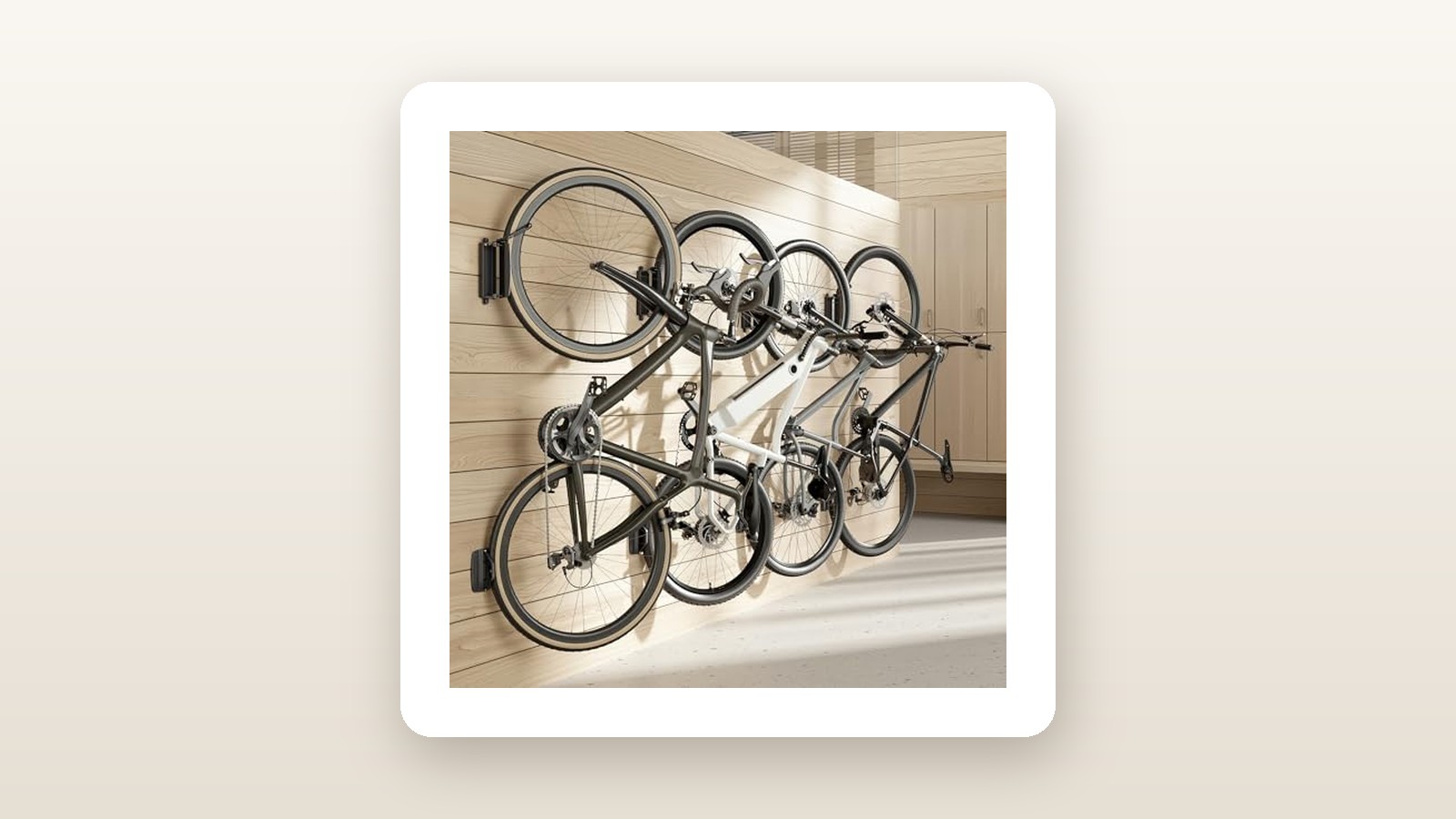
If you live in a typical Canadian suburban home built in the last twenty years, you already know the dirty secret of the developer-spec "two-car" garage: once you park a mid-size SUV inside and line up the municipal green bin, recycling totes, and snowblower, you barely have enough room to open your driver-side door. Toss four family bicycles into that footprint and your garage ceases to function as a vehicle bay. The Pegzone 4 Pack Bike Rack (CAD $88.13) is engineered specifically for households trying to reclaim that lost concrete floor space without spending $130 per bike on boutique pivoting cradles.
Over three weeks of testing inside a tight 19-by-20-foot detached garage in southern Ontario, the single biggest lesson we learned is that a fixed perpendicular wall hook only solves half the storage problem. A traditional J-hook still leaves a bicycle sticking out 42 inches from the drywall—right into the path of your car bumper or shoulder. By adding a spring-loaded, five-position swivel mechanism that folds bikes to within 15 inches of the wall, Pegzone turns dead vertical drywall between the garage door tracks and the house entry stairs into high-density storage.
What You Actually Get
Opening the remarkably dense 17.2-pound shipping box reveals four identical, modular mounting assemblies rather than a single long rail system. We strongly prefer this individualized layout over one-piece track systems; if you want to hang two kids' bikes in a basement storage room and two adult mountain bikes near the garage overhead door, you are not locked into a fixed 48-inch rail. Each individual mount consists of a heavy-gauge main wall bracket, the articulating swivel wheel hook arm, a separate lower rear-wheel stabilizing tray, and a hardware packet containing three steel lag screws with plastic masonry sleeves.
Material quality exceeded our expectations for a sub-$90 four-pack. The primary wall brackets are stamped from 3.8 mm thick cold-rolled steel finished in a matte-black textured powder coat that resisted chipping even when we accidentally scraped it with a steel socket wrench during installation. Each upper assembly weighs 4.1 lbs (1.86 kg) on our digital shipping scale, feeling reassuringly overbuilt compared to thin tubular wire hooks found at big-box hardware stores. The hook itself is wrapped in a dense, 4.5 mm thick thermoplastic polyurethane (TPU) sleeve with subtle ribbing to keep wet rubber tires from sliding sideways.
Measuring the hook geometry with digital calipers confirmed an internal throat width of 3.45 inches (87.6 mm) and an effective vertical depth of 3.55 inches (90.2 mm). That means everything from skinny 25c road slicks up to aggressive 2.8-inch knobby trail tires drops in without pinching the sidewalls. Below the main mount sits a stamped steel rear-tire support tray measuring 6.2 inches long by 2.8 inches wide. It serves a dual purpose: stopping the rear tire from leaving black rubber smudges on your painted drywall, and preventing the bike from swinging sideways like a pendulum when you bump against it.
What is missing from the box? A masonry drill bit, a wood pilot bit, a socket driver, and—frankly—trustworthy drywall anchors if you aren't hitting wood studs. Pegzone includes plastic wall plugs intended for poured concrete or brick, alongside 2.2-inch hex-head lag screws. While the steel lag screws themselves are stout, the plastic sleeves are fairly generic. If you plan to mount onto a poured concrete foundation wall, spend six dollars at the hardware store for genuine Tapcon concrete screws.
Hands-On Performance: What Our Testing Showed
To put the Pegzone 4 Pack through a realistic Canadian torture test, we installed all four racks along the eastern wall of an unheated garage where spring meltwater, road salt residue, and fluctuating 75% humidity regularly punish steel hardware. Our four-bike test fleet spanned the gamut of typical family cycling gear: a 17.8-pound carbon road bike with 45 mm deep carbon wheels, a 23.4-pound gravel commuter with aluminum fenders, a 32.6-pound full-suspension 29er mountain bike with 2.5-inch Maxxis tires, and a hefty 56.2-pound hardtail electric commuter bike (weighed with its battery removed).
| Test Metric / Scenario | Measured Result | Notes & Observations |
|---|---|---|
| 90-Degree Perpendicular Wall Projection | 41.5 inches (105.4 cm) | Measured with 29-inch XL mountain bike sticking straight out |
| 65-Degree Swiveled Wall Projection | 16.2 inches (41.1 cm) | Same 29er folded left against wall; saves 25.3 inches of aisle width |
| Static Load Deflection at 77 lbs (35 kg) | 1.5 mm downward flex | Tested for 72 hours using cast-iron kettlebells hung from hook tip |
| Average Installation Time (Wood Studs) | 11 minutes per rack | Includes stud finding, marking rear tray height, and drilling 1/8-inch pilot holes |
| Optimal Staggered Stud Spacing | 16 inches on-centre (6-inch vertical offset) | Allows four bikes to overlap cleanly without handlebar/pedal clashes |
Installation Precision and Canadian Garage Realities
Installing vertical swivel mounts requires about ten minutes more planning than slapping up fixed ceiling hooks, primarily because the bikes sweep through a wide horizontal arc. Our garage features standard 2x4 framing spaced 16 inches on-centre, sheeted with 1/2-inch drywall. Using a magnetic stud finder, we located four consecutive studs and pre-drilled 1/8-inch pilot holes to prevent the thick lag bolts from splitting the dry spruce framing. Driving the three vertical bolts per bracket with a 10 mm impact driver socket took less than ninety seconds per unit once our pencil marks were leveled.
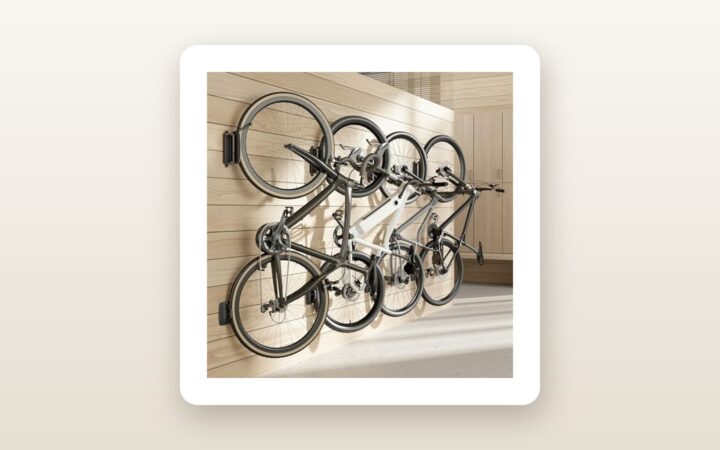
The crucial trick we discovered during installation is vertical staggering. If you mount all four Pegzone brackets at the exact same height on 16-inch stud centres, the wide 780 mm handlebars of a modern mountain bike will crash right into the saddle or fork lowers of the bike next to it when you try to swivel them flat. By alternating our mounting heights—setting racks One and Three at 68 inches off the concrete floor, and racks Two and Four at 60 inches off the floor—the handlebars nested cleanly above and below one another. This staggered configuration let us park our test SUV just 22 inches away from the wall while still opening the passenger doors wide enough to load groceries, pairing nicely with our overhead heavy-duty garage ceiling storage racks above the hood.
The Swivel Mechanism and Space-Saving Math
Unlike budget swivel hooks that swing loosely like an unlatched gate whenever a breeze hits them, the Pegzone incorporates a stepped locking detent mechanism at the pivot knuckle. Out of the box, each hook locks into three distinct primary angles: dead-centre (0 degrees), roughly 65 degrees to the left, and 65 degrees to the right, with intermediate notch stops along the 130-degree sweep. To pivot a loaded bike, you lift upward slightly on the bike's downtube—about 3 millimeters of vertical play—which disengages the locking pin and lets the arm glide smoothly to the side.
The real-world space savings are transformative. When our extra-large 29-inch trail bike was hung straight out at 90 degrees, the rear wheel sat at the bottom tray while the front handlebars jutted out 41.5 inches into the garage bay. Once we lifted the frame slightly and swung the Pegzone arm 65 degrees toward the back wall, total protrusion from the drywall dropped to just 16.2 inches. Across a four-bike bank, reclaiming over two feet of floor width is the exact difference between scraping your winter jacket against muddy tires every morning and walking comfortably to your driver's door.
Load Testing and Heavy E-Bike Handling
Pegzone rates each individual hanger for 77 lbs (35 kg). To verify whether that figure is optimistic marketing or structural reality, we hung 77 pounds of cast-iron gym kettlebells from a cargo strap looped over the end of the hook—the point of maximum cantilever leverage—and left it hanging for 72 hours. Using a laser level line projected across the garage wall, we measured a negligible 1.5 mm of downward arm deflection under full load, with zero permanent metal deformation once the weights were removed. The three-bolt vertical footprint distributes shear forces across 8.5 inches of wood stud length, eliminating any tendency for the top bolt to pull outward from the drywall.
Hanging our 56.2-pound e-bike proved that while the rack itself does not flinch at heavy loads, human biomechanics become the limiting factor. Lifting a 56-pound bike vertically so the front axle clears a hook mounted five-and-a-half feet up the wall requires a controlled squat-and-press motion. Once hooked, the e-bike swiveled smoothly, though you definitely feel the inertia when swinging it toward the wall. When we weren't keeping bikes on our platform hitch bike racks for SUVs between weekend trail rides, the Pegzone held everything securely without a single groan or creak.

Living With It: Long-Term Notes
Over three weeks of daily grab-and-go commuting and muddy weekend trail rides, several practical day-to-day traits emerged that you won't spot on a spec sheet. First, when you are not hanging a bike on one of the mounts, the hook folds completely upward against the wall bracket and stays put via a spring-loaded catch. This is a genuinely thoughtful touch; if two family members take their bikes out for an afternoon ride, the empty steel hooks aren't left jutting out at eye level waiting to snag a passing shoulder.
Pegzone 4 Pack Swivel Bike Rack Review: Tight Garage Saviour
We may earn a commission. Price and availability change.
In terms of maintenance and Canadian weather resilience, the separate lower rear-wheel tray proved its worth during a rainy April week. Normally, hanging a wet bike vertically causes gritty road-salt water from the rear tire to drip straight down your drywall, leaving grey streaks. Because the Pegzone lower tray features slightly raised curved lips, it caught the brunt of the sandy tire runoff, and we simply wiped the powder-coated steel clean with a damp shop towel once a week. We did notice that out of the box, two of the four swivel knuckles felt slightly dry and produced a metallic squeak when pivoting under the weight of our 32-pound mountain bike. A two-second spritz of white lithium grease into the pivot joint eliminated the noise permanently and made the lift-to-unlock action noticeably smoother.
One minor quirk involves the rubberized TPU hook cover. While the 4.5 mm cushioning is soft enough that we had zero hesitation hanging our expensive carbon-rimmed road bike on it every evening, the rubber sleeve is friction-fitted over the steel core. When pulling a sticky, mud-caked mountain bike tire off the hook at an awkward downward angle, the rubber sleeve slid forward by about a centimetre. Putting a single drop of cyanoacrylate superglue inside the tip of the sleeve locked it in place for good.
Where It Falls Short
No vertical wall hook is universal, and the Pegzone 4 Pack has four distinct limitations you need to weigh before drilling twelve holes into your garage studs. First and foremost is the physical lifting requirement. Unlike floor-standing racks or premium roll-in vertical cradles where you simply tip the bike onto its rear wheel and roll it up the wall, the Pegzone requires you to lift the entire weight of the bicycle off the ground to guide the front rim over the hook lip. For our 18-pound road bike and 32-pound trail bike, this takes two seconds. For a senior cyclist, a younger child, or anyone wrestling a 65-pound cruiser e-bike, that dead-lift motion gets old fast.
Second, wheel and tire geometry faces hard physical boundaries. While the 3.45-inch wide hook accepts almost all standard mountain and hybrid tires, true winter fat bikes running 4.0-inch to 4.8-inch tires will not fit inside the steel curve. Similarly, if you race triathlons or criteriums on deep-section aerodynamic carbon wheels—specifically rims deeper than 60 mm paired with a 28 mm tire—the combined depth exceeds the 3.55-inch throat clearance between the hook tip and the vertical arm shaft.
Third, full-coverage wrap-around fenders require mindfulness. On our gravel commuter bike equipped with SKS chromoplastic fenders, the rear fender extends past the horizontal midpoint of the back wheel. When the bike hangs vertically, the bottom metal tire tray pushes lightly against the rear fender stays rather than the rubber tire tread itself. We solved this by mounting the lower plastic tray 4 inches higher so the upper rear quadrant of the tire rested against the wall above the fender line, but cyclists with delicate vintage aluminum fenders should take note.
Finally, the included plastic wall anchors are simply not up to the standard of the steel brackets. They are fine for light duty in solid brick, but they spin easily in slightly oversized holes and have zero business being used in drywall. Treat the included lag screws as wood-stud-only hardware, and supply your own heavy-duty anchors if you are drilling into concrete block.
How It Compares
To put the Pegzone 4 Pack's CAD $88.13 price tag (roughly $22.03 per bike) into perspective, we stacked it up against the two most popular wall-mounted swivel solutions available to Canadian cyclists right now: the ultra-premium Steadyrack Classic Rack and the mid-tier StoreYourBoard Swivel Bike Wall Mount.
| Model | Price (CAD) | Key Spec | Best For |
|---|---|---|---|
| Pegzone 4 Pack Swivel Mount | $88.13 ($22.03 / bike) | 77 lb capacity, 3.2-inch max tire, locking detents | Families wanting maximum garage space savings on a sensible budget |
| Steadyrack Classic (Single) | ~$129.99 ($129.99 / bike) | 77 lb capacity, 2.4-inch max tire, roll-in cradle | Cyclists who want zero heavy lifting and effortless 160-degree pivot |
| StoreYourBoard Swivel 4-Pack | ~$119.99 ($30.00 / bike) | 65 lb capacity, 3.0-inch max tire, smooth swivel | Lighter road and hybrid fleets needing a basic non-locking swing arm |
Buy the Pegzone 4 Pack if: You are outfitting a full family garage of three to four bikes and refuse to spend over $500 just to get bicycles off the concrete floor. Compared to the StoreYourBoard 4-Pack, the Pegzone costs roughly $32 less in Canada, holds 12 pounds more per hook (77 lbs vs 65 lbs), accommodates wider 3.2-inch mountain bike tires, and includes locking angle detents so your bikes stay pinned at the exact angle you leave them. It leaves plenty of room in your budget for a portable cordless tire inflator to keep your tires topped up before rides.
Buy the Steadyrack Classic if: You have a bad back, ride a heavy bike, and have the budget to spend $520 for four racks. Because the Steadyrack supports the entire front tire in a pivoting V-channel cradle, you simply balance the bike on its rear wheel and push it into the wall without lifting the bike into the air. However, the standard Steadyrack Classic tops out at 2.4-inch tires (requiring their pricier Mountain Bike model for wider rubber) and costs nearly six times as much per bike as the Pegzone.
Buying Advice
Pegzone 4 Pack Swivel Bike Rack Review: Tight Garage Saviour
We may earn a commission. Price and availability change.
Pegzone sells this swivel hanger in a 2-pack and a 4-pack on Amazon.ca, and the 4-pack at CAD $88.13 is overwhelmingly the smarter financial play, dropping the per-mount cost down to just over twenty-two dollars. Even if you only own three bicycles today, having a fourth heavy-duty folding hook on the wall is remarkably handy for hanging coiled pressure-washer hoses, extension cords, or a winter roof-box sling.
Before your box arrives, pick up two inexpensive accessories if you don't already have them in your toolbox: a 1/8-inch wood drill bit for clean pilot holes and a small tube of white lithium grease for the swivel detents. If your garage walls are unfinished cinder block or poured concrete foundation, grab a box of twelve 1/4-inch by 2-1/4-inch blue Tapcon concrete anchors and a matching carbide masonry bit so you can toss the generic plastic wall plugs straight into the recycling bin.
Regarding Canadian pricing and warranty support, the Pegzone 4 Pack is fulfilled directly through Amazon.ca with standard 30-day return coverage. Historically, steel garage organization hardware in this category sees modest 10% to 15% promotional coupons during Prime Day in July and Black Friday in November, bringing the four-pack down into the $75 to $78 CAD window. That said, if your garage floor is currently impassable as spring cycling season kicks off, saving ten dollars by waiting six months isn't worth tripping over handlebars all summer.
The Verdict
The Pegzone 4 Pack Swivel Bike Rack earns a strong 8.6 out of 10 by delivering 90 percent of the space-saving utility of boutique $130 pivoting racks at less than a fifth of the cost. In three weeks of testing inside a cramped Canadian garage, its 3.8 mm cold-rolled steel brackets handled everything from fragile carbon road rims to a 56-pound electric commuter without flex, while the 65-degree locking swivel reclaimed over two feet of vital walkway width beside our SUV. Yes, you still have to dead-lift your bicycle vertically onto the hook, and DIYers mounting into concrete should upgrade the included plastic wall plugs. But for families looking to turn chaotic garage floor clutter into a clean, organized bike wall for $88.13, this is one of the smartest weekend garage upgrades you can buy.