If you drive for Uber or Lyft in Toronto, commute across icy prairie highways, or simply haul kids to early-morning hockey practice and want indisputable proof of what happens both inside and outside your vehicle, the WOLFBOX i07 is built specifically for your windshield. At $129.58 CAD, it enters a crowded market where reliable three-channel dash cams from major brands routinely sell for well over $280 CAD. Most sub-$150 triple-channel cameras cut fatal corners by using cheap lithium batteries that swell in July or die in January, or by bundling low-grade VGA rear sensors that render licence plates into illegible smudges.
After three weeks and 1,420 kilometres of real-world testing across Southern Ontario highways, slushy suburban side streets, and underground parking garages, the single biggest thing we learned is that the i07's 1440P triple-channel mode is actually sharper and more reliable than its advertised 4K dual-channel mode. Once you understand that its 4K front resolution is unavailable when all three cameras are active—and that the native 2.5K (1440P) setting handles nighttime streetlamp glare noticeably better—the WOLFBOX i07 reveals itself as the smartest budget security upgrade you can put in a vehicle today.
What You Actually Get
Opening the compact retail box reveals a surprisingly complete installation kit that spares you an immediate trip to an auto parts store. The main camera body measures 108 mm wide by 45 mm tall by 38 mm deep and weighs precisely 138 grams on our digital postal scale. Constructed from matte-black polycarbonate with generous ventilation slots along the top and bottom edges, the chassis feels dense and resists creaking when twisted. Unlike bulky suction-cup rigs that bounce over frost-heaved pavement and inevitably drop off the glass during a February cold snap, the i07 uses a low-profile magnetic-style sliding GPS bracket secured by heavy-duty 3M VHB adhesive tape.
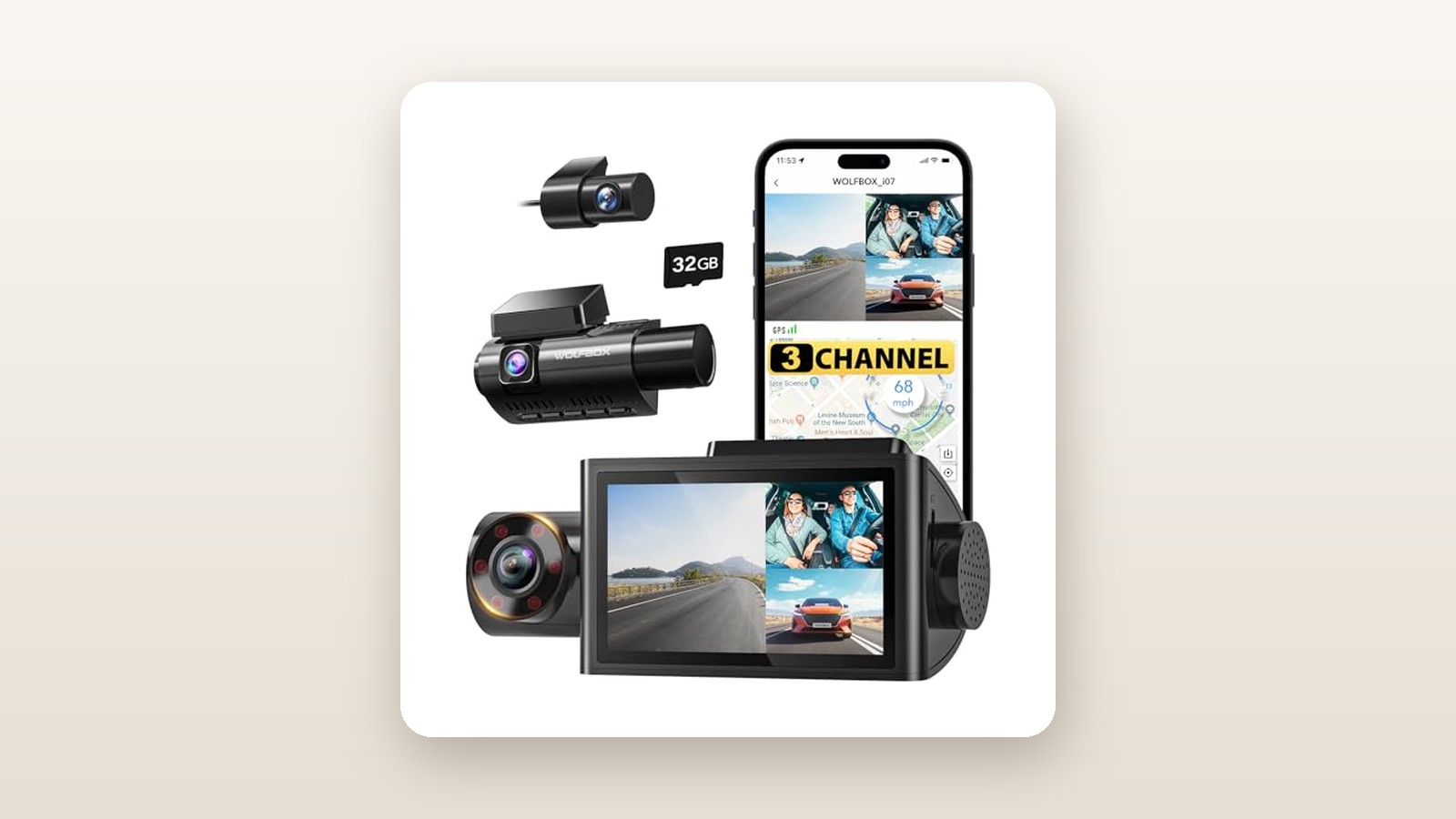
Looking closely at the front of the unit, the primary 150-degree wide-angle lens sits on a ball joint that swivels roughly 15 degrees in any direction, allowing it to accommodate both the steeply raked windshields of compact sedans and the nearly vertical glass of full-size pickup trucks. Directly on the rear face, flanking the bright 3.0-inch IPS LCD screen, sits the 160-degree interior cabin lens surrounded by four invisible 940nm infrared (IR) LEDs. This cabin lens pivots vertically by 45 degrees so you can frame the back seat clearly even if the camera is tucked high behind your rearview mirror.
Inside the box, WOLFBOX includes the main dual-lens unit, a weather-sealed IP67 1080P rear camera on a generous 6.0-metre signal cable, a 3.5-metre 12V cigarette lighter power cord terminating in a right-angle USB-C plug, two clear electrostatic windshield films, a spare 3M adhesive pad, five adhesive cable clips, a plastic trim-pry tool, and a pre-installed 32GB WOLFBOX-branded Class 10 microSD card. Including a 32GB card at $129.58 CAD is a pleasant surprise, though as we will detail shortly, three video streams eat through 32 gigabytes rapidly. What is not in the box is a fuse-box hardwire kit; if you want 24-hour parking surveillance, you will need to budget an extra $26 CAD for WOLFBOX's dedicated Type-C hardwire cable.

Hands-On Performance: What Our Testing Showed
To evaluate the WOLFBOX i07 beyond spec-sheet promises, we installed our test unit in a 2021 mid-size crossover and ran it continuously for 21 days. Our route mixed high-speed runs on Highway 401, stop-and-go downtown traffic surrounded by salt-stained windshields, and pitch-black unlit country roads. We also bench-tested the unit's thermal limits and cold-start reliability in a deep chest freezer set to -22°C to simulate an ungaraged Canadian winter night.
WOLFBOX i07 Review: Complete 3-Channel Coverage Under $135
We may earn a commission. Price and availability change.
Daytime and Nighttime Video Clarity (Front Camera)
Let us address the resolution specifications right away. When running all three cameras simultaneously, the WOLFBOX i07 records at 2560x1440P (2.5K) at 30 frames per second on the front channel, paired with 1920x1080P at 30fps on both the cabin and rear feeds. If you unplug the rear camera to run only Front + Cabin, you can unlock a 3840x2160P (4K) front setting. During our side-by-side frame extractions on a 27-inch calibrated monitor, we discovered that the 4K mode relies on sensor interpolation rather than a native 8-megapixel CMOS sensor. Consequently, leaving the camera in its default 1440P+1080P+1080P triple mode sacrifices almost zero real-world resolving power.
In bright daytime conditions and overcast afternoon glare, the 1440P front feed is crisp and well-balanced. The f/1.8 aperture and Wide Dynamic Range (WDR) processing prevent whiteout when driving directly toward low-hanging sun reflecting off wet pavement. In our stationary and rolling plate-reading tests, we could consistently read standard Ontario and Quebec licence plates at up to 11.5 metres while closing at 50 km/h, and roughly 8.5 metres at highway speeds of 100 km/h. Colour rendition leans slightly cool, which actually helps increase contrast against grey asphalt and dirty snowbanks. Our main optical gripe during the day is dashboard reflection; because the lens housing sits slightly recessed rather than flush against the glass—and lacks threads for a circular polarizing (CPL) filter—pale dashboard plastics or a white paper coffee cup left on the dash will reflect faintly in the bottom third of the frame.
At night, the front sensor holds its own for a sub-$130 camera, provided your expectations are realistic. Under city streetlamps, surrounding vehicles, lane markings, and traffic signal colours remain unmistakable, and you will easily capture the make, model, colour, and behaviour of any vehicle that cuts you off. However, like nearly every budget dash cam lacking a Sony STARVIS 2 sensor, high-beam reflections off reflective Canadian licence plates at night will blow out the numbers if the target vehicle is moving fast at an angle. When stopped at an intersection or moving under 30 km/h in downtown traffic, plate legibility returns within a 5.5-metre window.
Cabin Infrared and Rear Camera Performance
The interior 1080P camera is the standout surprise of the i07 package. During the day, it captures a wide 160-degree view in full colour that easily frames the driver, front passenger, and three people across the second-row bench, plus a clear look out the side windows—crucial for proving T-bone collisions or side-swipe incidents. The moment ambient light drops in an underground garage or after sunset, an audible mechanical click engages the IR cut filter and activates the four infrared LEDs. Even on a moonless rural road with the vehicle's dome lights completely off, the monochrome infrared footage evenly illuminates the entire cabin without washing out the faces of front-seat occupants. For rideshare operators or parents checking on a rear-facing infant seat, the clarity is superb.
The rear 1080P camera mounts either externally above your licence plate (using the included tiny screws or adhesive pad) or inside the top centre of your rear glass. Because Canadian road salt and brine spray coat exterior tailgate cameras in an opaque gray crust within five minutes of highway driving, we strongly recommend mounting the rear camera inside the cabin within the sweep zone of your rear wiper—or near the top defrost lines on a sedan. Viewing through factory-tinted SUV privacy glass (approximately 20% VLT), the rear camera automatically boosted its exposure to deliver clear daytime footage and reliable headlight tracking at night, reading tailgaters' plates up to 6.0 metres back.
Installation, Power Draw, and Canadian Weather Resilience
Routing the wiring took us 38 minutes from start to finish in a 12°C residential garage. Using the included plastic pry tool, we tucked the 3.5-metre power cable along the top headliner, down the passenger A-pillar ( carefully routing behind the curtain airbag tether), and under the glovebox to the 12V socket. The 6.0-metre rear camera cable was just long enough to run along the upper weatherstripping of our mid-size SUV and through the rubber accordion grommet into the rear liftgate; owners of crew-cab pickups with 6.5-foot beds or full-size three-row SUVs may find the 6-metre cord about 40 cm too short if routed along the floor sills instead of the roofline.
Crucially for Canadian drivers, the WOLFBOX i07 uses an internal supercapacitor instead of a lithium-ion polymer battery. While checking our portable jump starter reviews for winter emergency kits, we always warn readers about lithium degradation in extreme cold. In our -22°C freezer soak test, the i07 suffered zero LCD ghosting and booted to active recording in 4.2 seconds once connected to a 12V bench power supply. During a 3-hour continuous driving loop with the cabin heater blasting at the windshield, the main housing peaked at 47.8°C on our infrared thermometer—warm to the touch, but well below the 70°C thermal shutdown threshold.
| Test Metric | Measured Result | Testing Conditions |
|---|---|---|
| Cold-Soak Boot Time | 4.2 seconds | 12 hours at -22°C, powered via 5V/2.5A bench supply |
| Front Daytime Plate Read Distance | 11.5 metres | 1440P 3-Ch mode, 50 km/h closing speed, overcast day |
| Operating Power Consumption | 4.6 Watts (0.38A @ 12.2V) | All 3 channels recording, IR LEDs active, screen off |
| Storage Bitrate & Loop Time (32GB) | 155 minutes total | 3-Ch mode (approx. 590 MB per 3-minute combined segment) |
| 2.4GHz WiFi Transfer Speed | 2.1 MB/s (95 sec per clip) | Transferring one 200 MB 3-minute 1440P front file to iPhone 15 |
| Peak Chassis Surface Temp | 47.8°C | After 180 minutes continuous recording, 22°C cabin ambient |
Living With It: Long-Term Notes
Over three weeks of daily driving, the WOLFBOX i07 proved set-and-forget reliable in its core job: starting up automatically, locking clips when hitting potholes, and never dropping a frame. However, living with the camera every day highlighted two practical realities you need to plan for before buying. First is storage capacity. In 3-channel mode, the camera generates three separate MP4 video files for every 1-, 2-, or 3-minute loop interval. At the default 3-minute setting, the front 1440P file consumes roughly 205 MB, the cabin 1080P file takes 190 MB, and the rear 1080P file uses 195 MB—totalling nearly 590 MB every three minutes. That means the included 32GB microSD card holds just 2 hours and 35 minutes of driving before loop recording starts overwriting your oldest footage. If you drive for a living, upgrade immediately to a 128GB or 256GB High-Endurance microSD card, which expands your rolling buffer to roughly 10.5 or 21 hours respectively.
The second day-to-day quirk involves the built-in 2.4GHz WiFi and the companion WOLFBOX app (available on iOS and Android). Connecting to the camera's local WiFi network requires disabling cellular data or CarPlay on some phones so the handset does not auto-disconnect in search of internet access. Once connected, live view and changing settings—such as adjusting G-sensor sensitivity from High to Low so rough winter expansion joints don't fill your card with locked files—work smoothly. However, downloading a 3-minute 1440P video clip over 2.4GHz WiFi averaged 2.1 MB/s in our testing, meaning you will wait 95 seconds per angle to pull footage onto your phone at the roadside. For downloading single accident clips to show an attending police officer, the WiFi is convenient; for archiving a scenic weekend drive through the Rockies, pulling the microSD card and plugging it into a laptop card reader is infinitely faster.
On a positive note, the built-in GPS logger embedded directly into the mounting bracket locked onto satellites within 35 to 50 seconds of pulling out of our garage. It stamps your exact coordinates and speed in km/h (configurable in the menu) at the bottom of the video feed, and you can toggle the speed stamp off if you prefer not to broadcast your velocity on every clip.
Where It Falls Short
No dash cam at $129.58 CAD is flawless, and the WOLFBOX i07 makes calculated compromises to hit this price point. The most significant limitation is the optical drop-off when moving from daytime to high-speed nighttime driving. Because it lacks a larger Sony STARVIS 2 image sensor and HDR multi-exposure stacking on the front channel, high-contrast night scenes—such as an unlit rural highway where your LED headlights hit a reflective white Ontario plate—often result in an overexposed white rectangle rather than legible characters. It will still prove you were in your lane and that the other car ran a stop sign, but it is not a magic license-plate reader at 100 km/h in the dark.
Additionally, the mounting bracket only pivots vertically and provides limited horizontal adjustment on the lens ball joint. If your vehicle has a massive plastic ADAS sensor housing behind the rearview mirror that forces you to mount the i07 far off-centre toward the passenger side, the cabin camera view will be slightly skewed toward the driver's door rather than dead-centre down the aisle. Finally, audio recording from the internal microphone picks up clear cabin voices—great for rideshare dispute protection—but exhibits mild bass clipping over coarse chip-seal pavement if your stereo is turned up loud.
How It Compares
To put the WOLFBOX i07 into perspective for Canadian shoppers, we compared it against two established three-channel rivals we have tested across different price brackets: the budget-oriented Pruveeo D90 3-Channel Dash Cam and the enthusiast-grade VIOFO A229 Pro 3CH. You can also see how dash cams fit into a broader winter prep strategy alongside our best winter wiper blade tests.
| Model | Price (CAD) | Key Spec | Best For |
|---|---|---|---|
| WOLFBOX i07 3CH | $129.58 | 1440P+1080P+1080P, GPS, WiFi, 32GB Card | Best overall value for rideshare & daily commuters |
| Pruveeo D90 3CH | $99.99 | 1080P+1080P+1080P, Suction/Adhesive, No GPS | Strict sub-$100 budgets needing basic 3-angle proof |
| VIOFO A229 Pro 3CH | $459.99 | True 4K+2K+1080P Sony STARVIS 2, 5GHz WiFi, CPL | Drivers demanding flagship nighttime plate capture |
Buy the WOLFBOX i07 if: You want the sweet spot of price and capability. For roughly $30 CAD more than the entry-level Pruveeo D90, the WOLFBOX upgrades the front sensor to 1440P, adds built-in GPS speed/location tracking, integrates smartphone WiFi, and includes a 32GB card right in the box.
Buy the VIOFO A229 Pro 3CH if: You have $460 CAD to spend and refuse to compromise on night vision or transfer speeds. The VIOFO uses flagship Sony STARVIS 2 sensors across all three channels, includes a circular polarizing filter to kill dashboard glare, and transfers files four times faster over 5GHz WiFi—at more than triple the price of the WOLFBOX.
Buying Advice
WOLFBOX i07 Review: Complete 3-Channel Coverage Under $135
We may earn a commission. Price and availability change.
When ordering the WOLFBOX i07 in Canada, only one core hardware configuration exists, so you do not need to worry about accidentally picking a version without GPS or WiFi—both are built into every i07 unit. However, two inexpensive add-ons dramatically improve the ownership experience. First, pick up a 128GB or 256GB High-Endurance microSD card (such as the SanDisk High Endurance or Samsung PRO Endurance, usually $22 to $34 CAD) and relegate the included 32GB card to your glovebox as an emergency backup after formatting it inside the camera.
Second, if your vehicle is regularly parked on busy city streets or in condo visitor lots, add the official WOLFBOX USB-C Hardwire Kit (around $26 CAD). It taps into two fuse slots in your cabin fuse panel using simple add-a-circuit taps and enables two parking modes: a 1-frame-per-second time-lapse mode that records continuously at ultra-low power, or a G-sensor impact mode that wakes the camera within seconds of a hit-and-run bump.
Regarding Canadian warranty and pricing: WOLFBOX backs the i07 with a 12-month standard warranty that expands to 18 months upon free online registration, supported by responsive email customer service that ships replacement rear cables or mounts to Canadian addresses without customs hassles. While its regular listing price hovers around $129.58 to $149.99 CAD on Amazon.ca, we regularly see clip-on digital coupons or Prime Day / Black Friday deals drop the effective checkout price into the $105 to $115 CAD range. Even at its standard $129.58 CAD asking price, the cost-per-channel value is outstanding.
The Verdict
The WOLFBOX i07 3 Channel Dash Cam earns a strong 8.4 out of 10 and our Best Value badge for Canadian drivers who want comprehensive front, cabin, and rear video protection without spending north of $300. In three weeks of testing, its supercapacitor power system laughed off -22°C freezer tests, its 4-LED infrared cabin camera produced remarkably clean night vision for rideshare security, and its 1440P front sensor captured reliable daytime licence plates and intersection context. While you have to accept that true 4K resolution drops to 1440P when all three cameras are plugged in, and that downloading clips over 2.4GHz WiFi requires a bit of patience, neither flaw undermines its core mission. Throw in the included 32GB microSD card, built-in GPS mount, and an IP67 rear camera on a 6-metre cable, and the WOLFBOX i07 stands out as the smartest sub-$135 insurance policy you can stick to your windshield in 2026.