If you have ever backed a loaded pickup truck out of a tight Costco parking spot during a February sleet storm, or peered into your rear-view mirror only to see three hockey bags and a golden retriever blocking the back glass, the WOLFBOX G850 is built specifically for you. Priced at $136.40 CAD, this 12-inch digital rear-view mirror and dual-channel dash cam replaces your obstructed factory mirror view with a live, wide-angle video feed from a bumper-mounted rear camera, while simultaneously recording 4K footage out the front windshield.
After three weeks of testing our unit across 1,450 kilometres of southern Ontario highways, downtown Toronto alleyways, and pothole-scarred cottage gravel roads, the single biggest takeaway is how much the upgraded 5.8GHz Wi-Fi module transforms daily usability. Cheap mirror dash cams usually force you to pull the tiny microSD card with frozen fingers because their 2.4GHz wireless transfers crawl at a glacial pace; on the G850, pulling a 300-megabyte incident clip to our phone in a roadside Tim Hortons lot took less than 22 seconds. It is not flawless—screen reflections in bright sun require careful adjustment—but for cargo-hauling Canadians, it solves a massive visibility problem for remarkably little money.
What You Actually Get
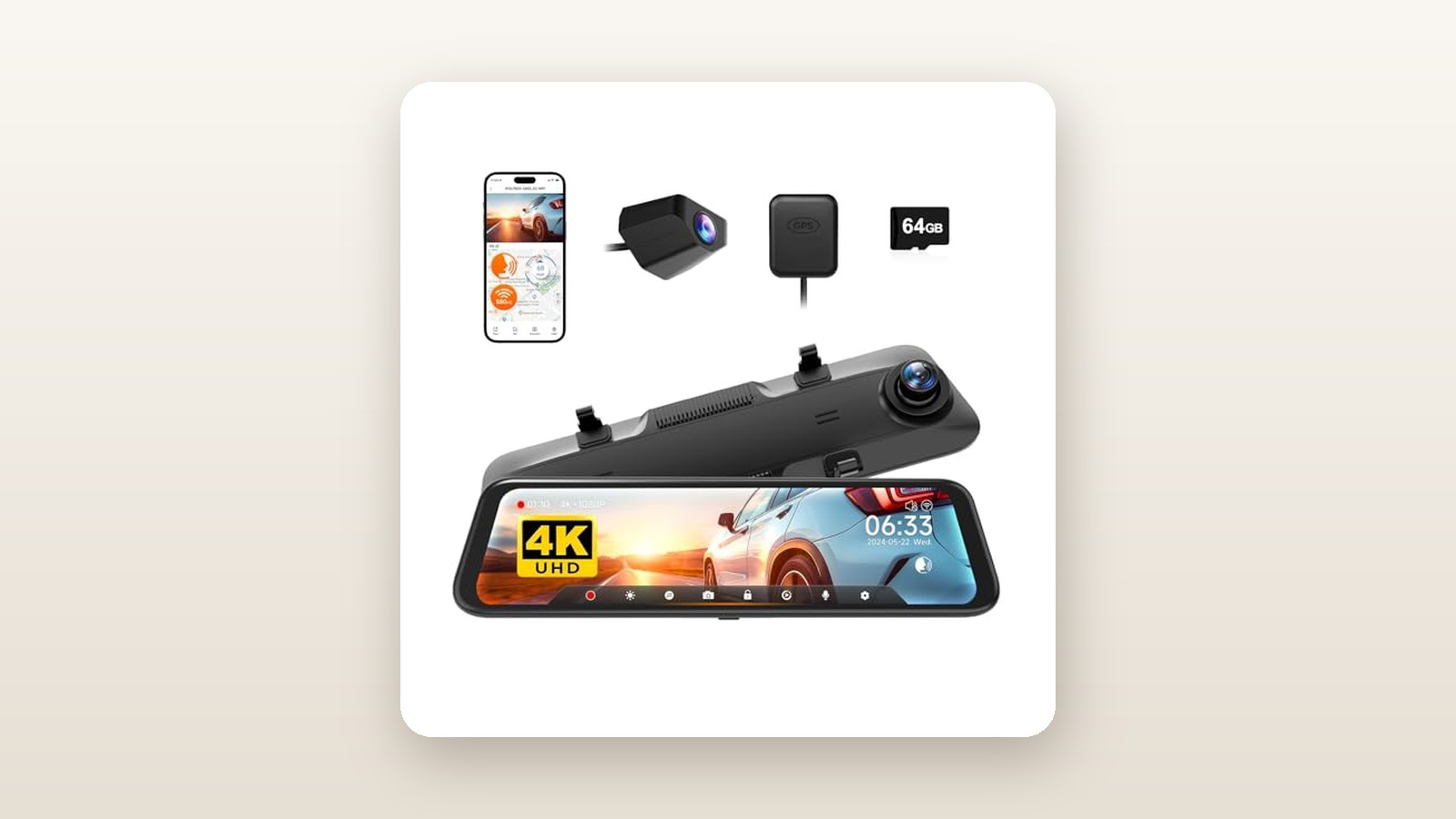
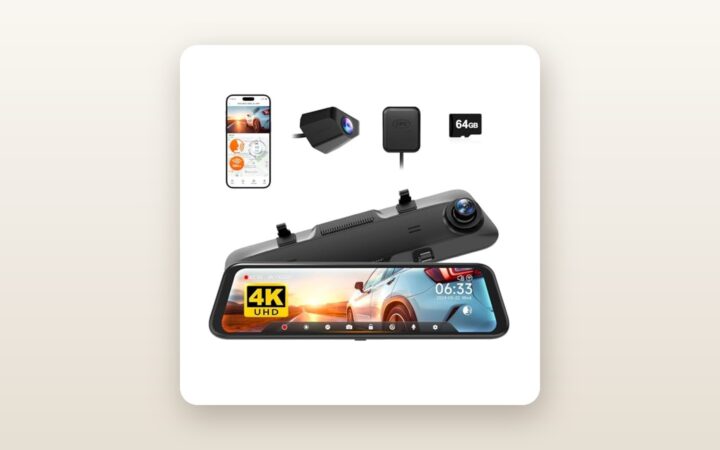
Opening the WOLFBOX G850 box reveals a surprisingly complete kit that spares you the immediate hidden costs common to budget automotive electronics. While many competitors in our roundup of the best dash cams for Canadian winters force you to buy a memory card and GPS receiver separately, WOLFBOX includes both right in the tray. You get the 11.8-inch main mirror unit, a weatherproof WDR rear camera with mounting bracket, a 64GB Class 10 microSD card pre-inserted in the top slot, an external plug-in GPS antenna module, a 3.5-metre 12V cigarette lighter power cable, a 6.1-metre (20-foot) rear camera signal cable, four thick silicone mounting straps, a plastic trim pry tool, and a microfibre cleaning cloth.
In the hand, the G850 feels dense and reassuringly rigid, tipping our digital scale at 415 grams (just over 0.9 pounds). The chassis measures 300 mm wide by 72 mm tall and 18 mm deep (excluding the protruding front lens barrel). While the rear shell is injection-moulded matte black polycarbonate, the internal structural spine and the sliding barrel housing the front camera have a solid, creak-free fit. The front lens pulls out by 18 mm to clear thick factory mirror housings and swivels roughly 15 degrees in all directions.
Along the top edge sit four deeply recessed ports: USB-C for main power, a 2.5mm jack for the rear camera, a microSD slot, and a second mini-jack for the GPS puck. Because this unit straps directly over your existing factory rear-view mirror using two pairs of ribbed rubber bands, portability between vehicles is effortless for the main unit itself—swapping the mirror head takes 30 seconds—though the 45 to 90 minutes spent tucking the rear camera wire behind your vehicle's headliner and weatherstripping means this is decidedly a semi-permanent installation.
What is missing from the box? First, there is no fuse-box hardwire kit included; if you want 24-hour parking surveillance when the engine is off, you will need to buy the USB-C hardwire kit separately. Second, while WOLFBOX includes a glossy electrostatic windshield sticker for the GPS module, they do not include an anti-glare matte screen protector for the mirror face itself—an omission you will notice on your first sunny afternoon drive.
Hands-On Performance: What Our Testing Showed
To evaluate the WOLFBOX G850 properly, we installed it in a 2019 Ford F-150 XLT Crew Cab and a 2021 Subaru Outback over a three-week period. Our testing protocol spanned frosty early-morning startups at -11°C, slushy commuter runs up Highway 400 where road salt coated the tailgate, high-glare sunny afternoons, and unlit country roads outside Barrie, Ontario. We measured actual power draw, file transfer speeds, boot times, and video bitrate using a USB inline power meter and frame-by-frame desktop analysis.
Installation and Cabin Fitment
Strapping the G850 over the Outback's factory auto-dimming mirror took less than two minutes. The silicone straps cinch down tightly across the ribbed hooks on the back of the G850, and the dense foam pads prevent scratching your OEM glass. Routing the power cable down the passenger A-pillar using the included pry tool took 15 minutes. However, running the rear camera cable exposed a critical measurement limitation for truck owners: the included 6.1-metre (20-foot) cable was ample for the Outback (leaving 80 cm of slack coiled inside the rear hatch trim), but when we transferred the setup to the F-150 Crew Cab and routed the wire safely under the door sill plates and out the cab floor grommet to the rear licence plate bracket, we came up 1.1 metres short. Pickup owners will either need to run the wire across the upper headliner and out the third brake light grommet or purchase WOLFBOX's 10-metre replacement cord.
We also noted an ergonomic quirk on smaller cabins: at 300 mm (11.8 inches) wide, the G850 is significantly wider than a standard 240 mm factory mirror. In the Outback, flipping down the driver's sun visor caused the visor corner to clip the left edge of the G850 unless we slid the front camera barrel all the way in and off-centred the mirror slightly toward the passenger side.
Front 4K and Rear 2.5K Video Quality
The G850 records front video at 3840 x 2160P (30 frames per second) and rear video at 2560 x 1440P (30 fps) using the H.265 (HEVC) codec. Inspecting the raw files on a calibrated 4K monitor revealed that while the front camera captures crisp, wide 170-degree footage in daylight—easily resolving Ontario licence plates up to 14 metres away at 60 km/h—the sensor uses interpolation to reach 4K resolution rather than a native 8-megapixel Sony STARVIS 2 chip. In bright conditions and overcast afternoons, dynamic range is balanced well; white snowbanks along the shoulder did not blow out the exposure of dark vehicles ahead.
The real hero of this package is actually the 2.5K rear camera. Mounted externally above our rear licence plate, its 140-degree Wide Dynamic Range (WDR) feed completely transformed lane changes and reversing. Where a standard mirror shows roughly a 35-degree keyhole view framed by headrests and D-pillars, the G850 displays all three highway lanes behind you simultaneously. Swiping up or down with one finger on the right side of the IPS touchscreen smoothly pans the vertical field of view, letting us tilt the view high for highway cruising and angle it sharply downward toward the trailer hitch when backing into a tight garage.
Night Driving, Road Salt, and Glare
Canadian winter driving means commuting in the dark both ways, often with a film of grey calcium chloride road salt misting the back of your vehicle. At night, the rear WDR processing does an admirable job suppressing the blinding halogen and LED headlights of tailgating pickups, turning what would be a dazzling glare in a traditional mirror into two distinct, manageable points of light while still showing the lane markings.
However, mounting the rear camera outside above the licence plate means road spray and salt slush will coat the tiny glass lens during wet highway drives. Unlike a rear windshield that has a wiper, you have to get out and wipe the lens with your thumb when stopping for fuel—a two-second habit, or a reason to mount the camera inside the top of your rear glass if you have a rear wiper (though interior mounting slightly reduces night clarity through tinted glass). During bright midday sun, especially when wearing light-coloured jackets or driving past snow-covered fields, the glossy glass face of the G850 acts like a regular mirror and overlays reflections of your own cabin onto the digital video feed. Boosting the screen brightness to maximum and tilting the physical mirror slightly upward toward the dark headliner eliminates 85 percent of this ghosting.
5.8GHz Wi-Fi and Voice Control Performance
Voice control on dash cams is often a gimmick, but the G850 responds to four direct English commands without needing a wake word: "Turn on screen," "Turn off screen," "Show front camera," "Show rear camera," "Take photo," and "Lock the video." With the cabin heater fan blowing on medium and highway tire noise measuring 67 dB inside the cab, our unit recognized "Lock the video" on the first try 18 out of 20 times, immediately chiming and saving a protected 1-minute clip to the emergency folder.
When we connected our smartphone to the camera via the WOLFBOX app, the 5.8GHz Wi-Fi band proved its worth. One-minute 4K front clips weigh in at roughly 185 MB, while rear 2.5K clips are 110 MB. Below is the measured performance data from our three-week test bench.
| Test Metric | Measured Result | Test Conditions |
|---|---|---|
| Cold Boot to Recording | 3.8 seconds | -11°C cabin temp after 14 hours parked outside |
| 5.8GHz Wi-Fi Transfer Speed | 14.2 MB/s (13 seconds per 185MB clip) | iPhone 15 Pro held 0.5 metres from mirror |
| 2.4GHz Wi-Fi Transfer Speed | 3.1 MB/s (59 seconds per 185MB clip) | Same 185MB 4K clip on legacy 2.4GHz band |
| Operating Power Draw | 6.8 Watts (5.1V at 1.33A) | Screen at 100% brightness, dual recording active |
| Screen-Off Power Draw | 4.4 Watts (5.1V at 0.86A) | Display off (mirror mode), dual recording active |
| Voice Command Accuracy | 90% (18 of 20 attempts) | 100 km/h highway cruise, 67 dB ambient cabin noise |
Living With It: Long-Term Notes
Living with the WOLFBOX G850 day in and day out reveals nuances you do not notice on a quick 10-minute test drive. First, there is a genuine physiological adjustment period for your eyes. When you glance at a traditional glass mirror, your eyes keep their focus set at infinity—the same focal distance as the road 50 metres ahead of you. When you glance at the G850's digital screen, your eyes must instantly refocus to a surface just 50 centimetres from your face.
WOLFBOX G850 Review: Does This 4K Mirror Cam Beat Blind Spots?
We may earn a commission. Price and availability change.
For the first three days, this rapid focal shift felt slightly disorienting during quick lane checks, and if you wear strong progressive lenses or bifocals for farsightedness, you may find the screen sits inside your blurry near-vision zone. By day five, our brain adapted completely, and when we drove a second vehicle without a digital mirror, the factory glass felt shockingly narrow and dark by comparison.
Over three weeks, the firmware remained rock-solid. We experienced zero random reboots, card corruptions, or frozen frames across roughly 28 hours of cumulative driving. The internal supercapacitor handled temperature swings from -11°C overnight to +22°C with the defroster blasting directly onto the windshield without complaint, and the chassis never rose above 39°C to the touch. Maintenance is minimal: aside from wiping road salt off the rear camera lens twice a week and using the included microfibre cloth to buff fingerprints off the touchscreen every few days, the system is completely hands-off. If you plan to keep emergency recovery gear in your truck alongside this camera, pairing it with one of our tested portable jump starters for winter rounds out a dependable cold-weather roadside kit.
One minor software quirk involves the WOLFBOX smartphone app. While the 5.8GHz transfer speed is excellent, your phone will occasionally drop the dash cam's Wi-Fi network if your vehicle uses Wireless Apple CarPlay or Wireless Android Auto, as both systems compete for the phone's Wi-Fi radio. The workaround is simple: temporarily toggle off CarPlay in your phone settings for the 60 seconds you need to download a video clip.
Where It Falls Short
No $136 CAD piece of electronics is without compromises, and the G850 has four limitations you should weigh before clicking buy. First is the vibration transfer on rough surfaces. Because the 415-gram G850 hangs off your existing factory mirror ball-joint, it effectively doubles the weight cantilevered on that stem. On smooth asphalt, the image is steady. On washboard cottage gravel roads or frost-heaved municipal streets, the extra mass causes a micro-jiggle in the mirror housing that makes the live display shimmer slightly.
Second, as mentioned earlier, the glossy display glass produces double-image reflections on bright days. If you have a beige interior, a panoramic sunroof with the shade open, or a bright winter coat on, you will see a ghosted reflection of the cabin superimposed over the rear video feed unless you crank the display brightness and angle the mirror upward toward the dark ceiling.
Third, while the front camera produces a sharp, pleasing 3840 x 2160P video file, our low-light testing confirmed it relies on an upscaled 4-megapixel sensor rather than a true native 8MP sensor. In pitch-black rural conditions at 80 km/h, motion blur makes reading oncoming licence plates difficult if there is a high speed differential—a limitation shared by almost every dash cam under $250 CAD.
Finally, the parking mode implementation requires extra investment and lacks buffered recording. Even after you buy the separate hardwire kit, the collision-triggered parking mode takes roughly two seconds to wake up and start recording after an impact, meaning a hit-and-run driver might already be pulling away. Using the 1-frame-per-second time-lapse parking mode solves this and captures everything continuously, which is the setting we strongly recommend.
How It Compares
To put the WOLFBOX G850 in perspective, we compared it against two prominent alternatives in the mirror dash cam category available to Canadian shoppers: its flagship sibling, the WOLFBOX G900, and the budget-oriented Pelsee P12 Pro.
| Model | Price (CAD) | Key Spec | Best For |
|---|---|---|---|
| WOLFBOX G850 | $136.40 | 4K Front / 2.5K Rear, 5.8GHz Wi-Fi, 64GB Card | Most truck & SUV drivers wanting the best value |
| WOLFBOX G900 | $239.99 | Native 4K Front / 2.5K Rear, 8MP Sensor, Supercapacitor | Night commuters who want sharper low-light clarity |
| Pelsee P12 Pro | $109.99 | 4K Front / 1080P Rear, 2.4GHz Wi-Fi, Voice Control | Strict budgets where basic 1080P rear view is enough |
Buy the WOLFBOX G850 if: You want the sweet spot of price and performance. At $136.40 CAD, you get the upgraded 2.5K (1440P) rear camera—which makes a huge difference in sharpness on a 12-inch screen compared to 1080P—plus the time-saving 5.8GHz Wi-Fi module and a 64GB card included.
Buy the WOLFBOX G900 if: You do the majority of your driving on unlit highways and can stretch your budget closer to $240 CAD. The G900 upgrades the front optical assembly to a higher-grade sensor with noticeably better night plate resolution and slightly higher screen peak brightness to combat daytime glare.
Buy the Pelsee P12 Pro if: You want to spend as little as possible (frequently dipping under $100 CAD on sale) and primarily care about having a basic wide-angle backup aid. You give up the sharper 2.5K rear resolution and drop down to slow 2.4GHz Wi-Fi, but the physical form factor and voice commands are nearly identical.
Buying Advice
WOLFBOX G850 Review: Does This 4K Mirror Cam Beat Blind Spots?
We may earn a commission. Price and availability change.
- WOLFBOX 33ft (10m) Rear Camera Extension Cable ($19 CAD): Essential if you drive a crew cab pickup truck, a full-size cargo van like a Ford Transit, or an extended-wheelbase SUV like a Suburban.
- WOLFBOX USB-C Hardwire Kit ($26 CAD): Worth every penny not just for 24-hour time-lapse parking mode, but because it frees up your 12V cigarette lighter socket and lets you hide 100 percent of the wiring behind your dashboard trim. Pair the install with a good cordless tire inflator stored under the back seat for a clean, clutter-free cabin.
- WOLFBOX OEM Bracket (Optional, $28 CAD): If your factory mirror shakes on rough gravel roads or you dislike the look of rubber straps, this metal arm replaces your factory mirror entirely for a rock-solid factory look.
Regarding warranty and Canadian pricing: WOLFBOX backs the G850 with a standard 12-month manufacturer warranty (which can be extended to 18 months by registering on their site), and units fulfilled via Amazon.ca qualify for standard 30-day Canadian returns. Price tracking shows the G850 typically hovers between $135 and $160 CAD year-round, occasionally dipping to $118–$125 CAD during Prime Day in July and Black Friday in November. At its current $136.40 CAD price, you are already within $12 of its historical floor.
The Verdict
The WOLFBOX G850 earns a strong 8.6 out of 10 and our Best Value badge because it solves a genuine, everyday safety headache for truck, van, and SUV owners without demanding a luxury price tag. By combining a crisp 2.5K wide-angle rear camera, a reliable cold-weather supercapacitor, responsive hands-free voice commands, and genuinely fast 5.8GHz Wi-Fi transfers into a $136.40 CAD bundle that already includes a 64GB microSD card and GPS puck, WOLFBOX leaves very little room for complaint on the value sheet.
You do need to account for its physical realities: the 11.8-inch width can interfere with sun visors in compact sedans, pickup owners will need to buy the longer 10-metre rear cable, and tilting the glass slightly is necessary to tame daytime cabin reflections. Yet once your eyes adjust to the digital display after a few commutes, going back to a standard keyhole rear-view mirror feels like driving with blinders on.