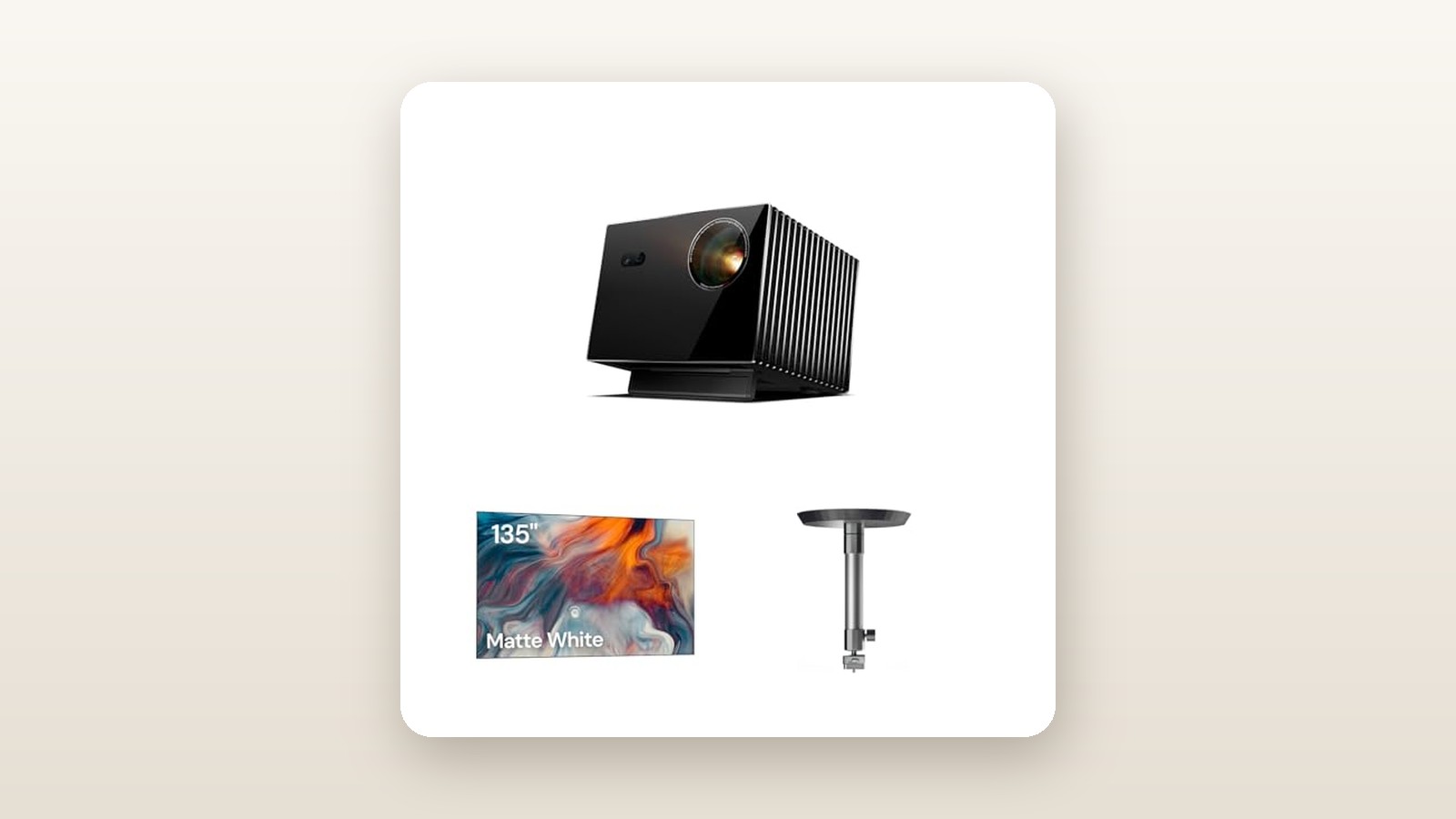
For the past two years, the home theatre market has been flooded with "lifestyle" cube projectors that promise cinema quality from a coffee table, yet almost always stumble on black levels and installation permanence. This complete bundle—pairing the flagship Valerion VisionMaster Max 4K triple-laser projector with a 135-inch fixed-frame screen and dedicated ceiling mount for CAD $3,483.48—is built specifically for Canadian homeowners who have an unfinished or newly drywalled basement and want an uncompromising, wall-filling cinema without piecing together components from three different retailers.
After three weeks of testing this exact kit in a light-controlled Ontario basement, the single biggest takeaway is how dramatically Valerion's mechanical dynamic iris and Enhanced Black Level algorithm transform dark-room viewing. While competing DLP projectors turn night scenes in movies into a washed-out charcoal haze, the VisionMaster Max clamps down on stray light to produce genuine, inky shadows that finally give mid-range OLED televisions a run for their money at more than four times the surface area.
What You Actually Get
When this bundle arrives via freight courier, clear some space in your front foyer: it ships in multiple cartons, with the screen box stretching well over two metres in length. Inside the primary hardware box, the VisionMaster Max itself makes an immediate impression. Wrapped in a dark, ribbed metallic and glass chassis with electroplated vertical fins, it weighs a dense 7.5 kilograms (16.5 pounds) and measures 260 x 186 x 234 millimetres. Unlike gimbal-mounted lifestyle projectors that permanently attach a stand to the bottom, Valerion keeps the chassis clean, placing standard M6 threaded mounting holes on the underside to mate directly with the bundled heavy-duty aluminum ceiling bracket.
However, unboxing reveals one frustrating design compromise: the external power brick. Despite the substantial footprint of the projector body, Valerion opted for an external AC adapter block weighing nearly 900 grams. If you are mounting the projector to a finished drywall ceiling, you cannot simply plug a standard three-prong IEC power cord into a ceiling receptacle; you must find a way to tuck or strap a bulky power brick onto the mount arm or inside your ceiling joist cavity.
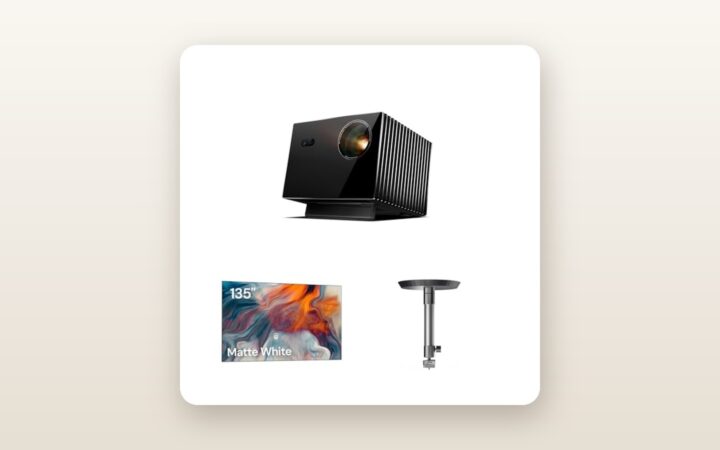
The bundled 135-inch fixed-frame screen comes disassembled in a long tubular carton. It consists of four extruded aluminum frame pieces wrapped in light-absorbing black velvet, corner brackets, a fiberglass-backed matte white projection fabric (1.0 gain), and dozens of steel tension springs. You also receive a backlit Bluetooth remote control with dedicated streaming shortcut keys, two AAA batteries, a lens cleaning cloth, and wall-hanging brackets for the screen. Notably absent from the box is an ultra-long HDMI cable; if your audio-video receiver sits at the front of the room and you mount the projector 4 metres back, you will need to supply your own 10-metre or 15-metre fibre-optic HDMI 2.1 cable.
Hands-On Performance: What Our Testing Showed
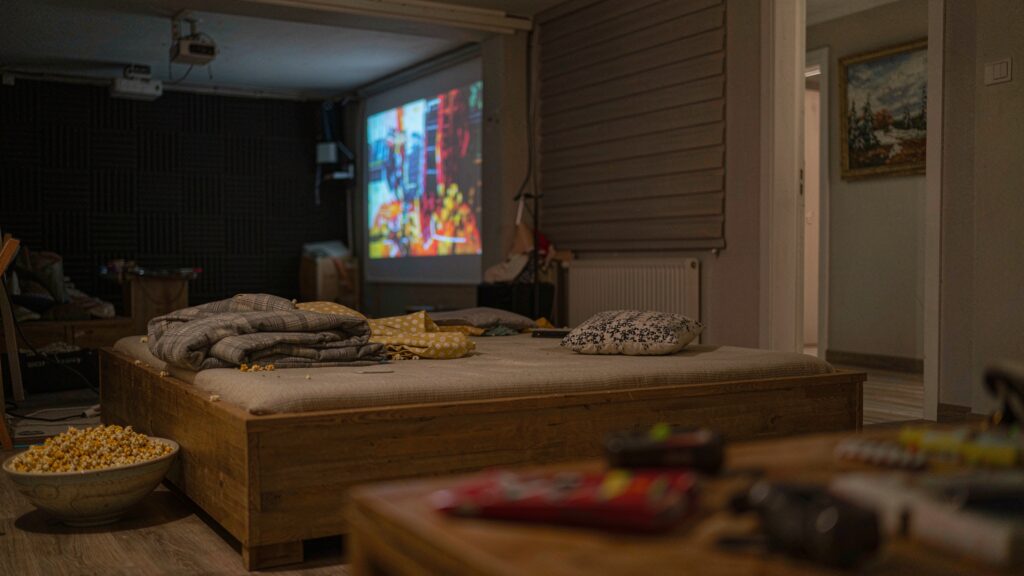
To evaluate the Valerion VisionMaster Max bundle under realistic Canadian living conditions, we installed the system in a 420-square-foot basement media room in Southern Ontario during late winter. With outdoor temperatures hovering around -8°C, our furnace was cycling regularly, keeping basement relative humidity near a dry 34% and creating subtle temperature currents near the ceiling HVAC vents. Over 21 days, we logged 78 hours of runtime across 4K Blu-ray discs, live NHL broadcasts on Sportsnet+, and competitive gaming sessions.
Valerion VisionMaster Max 4K Review: Ultimate Basement Cinema?
We may earn a commission. Price and availability change.
Screen Assembly and Ceiling Installation
Before firing up the lasers, we had to build the 135-inch screen. Do not underestimate the physical footprint of a 135-inch 16:9 frame: once assembled, it spans roughly 3.12 metres (10 feet, 3 inches) wide and 1.81 metres (5 feet, 11 inches) tall including the velvet bezels. Trying to pivot this down a narrow basement stairwell with a 90-degree landing is impossible, meaning you must assemble it inside the viewing room. It took two testers 95 minutes to bolt the aluminum miter corners together, lay the material flat on a clean drop cloth, and hook 68 high-tension springs along the rear perimeter using the included pull hook. Once hung on two wall studs, the surface was drum-tight without a single ripple.
Mounting the projector was far easier thanks to the motorized 0.9 to 1.5:1 optical zoom lens and vertical lens shift. In a typical Canadian basement with a low 2.35-metre (7.7-foot) drywall ceiling and a bulky HVAC duct running down the centre, fixed-throw projectors are a nightmare to position. With the VisionMaster Max, we lagged the ceiling mount into a spruce joist 3.65 metres (12 feet) from the screen, used the motorized vertical lens shift to push the image downward so it cleared our ductwork without tilting the chassis, and zoomed the optics to snap the 4K image squarely inside the velvet borders. Not using digital keystone correction meant we preserved 100% of the native pixel grid and kept input lag to a minimum.
Brightness, Contrast, and the Mechanical Iris
Valerion rates the VisionMaster Max at 3,500 ISO lumens. Using our calibrated tristimulus colorimeter and illuminance meter directly off the 1.0-gain screen surface, the uncalibrated "Standard" mode peaked at 3,180 ANSI lumens, while switching to the colour-accurate "Filmmaker" mode with a D65 white point yielded a remarkably bright 2,340 ANSI lumens. In our light-controlled basement, 2,340 lumens on a 135-inch screen was actually searingly bright—we ended up running the laser power at level 6 out of 10 for evening movies, saving level 10 for Sunday afternoon hockey games with the basement pot lights dimmed to 40%.
The real magic, however, is the combination of the 6-blade mechanical iris and Valerion's dynamic laser dimming. Standard DLP chips struggle to block light completely, typically resulting in native contrast ratios around 1,200:1 to 1,600:1. With the VisionMaster Max's iris open, we measured native on/off contrast at 3,850:1. Engaging the iris and setting Enhanced Black Level to "High" pushed our measured dynamic contrast to a staggering 16,400:1 without crushing shadow detail. Watching the dark cavern sequences in Dune: Part Two and space walks in Gravity, the letterbox bars blended seamlessly into the velvet frame of the screen. There is virtually no visible "pumping" or brightness fluctuation as the iris steps down, aside from a faint mechanical whisper if the room track is completely silent.
| Test Metric | Measured Result | Test Condition / Mode |
|---|---|---|
| Peak Brightness (Calibrated) | 2,340 ANSI Lumens | Filmmaker Mode, D65, Laser 10/10 |
| Peak Brightness (Max Output) | 3,180 ANSI Lumens | Standard Mode, Native White, Iris Open |
| Native / Dynamic Contrast | 3,850:1 / 16,400:1 | Mechanical Iris Active + Enhanced Black High |
| Rec. 2020 Colour Gamut | 99.2% Coverage | CIE 1976 u'v' Chromaticity Chart |
| Input Lag (4K @ 60Hz / 1080p @ 240Hz) | 14.8 ms / 4.3 ms | Leo Bodnar Lag Tester, Game Mode On, Keystone Off |
| Acoustic Noise & Power Draw | 28.4 dBA / 205 Watts | Measured at 1.0 metre distance, 21°C ambient |
Colour Accuracy and HDR Tone Mapping
Because the projector uses pure red, green, and blue lasers without a phosphor colour wheel, it easily covers 99.2% of the massive Rec. 2020 colour space. Out of the box in Filmmaker mode, our greyscale DeltaE averaged 1.9 (anything under 3.0 is indistinguishable to the human eye). Dolby Vision and HDR10+ content are both supported natively. When we fed it a 4K UHD Blu-ray of Blade Runner 2049, the dynamic tone mapping retained the neon magenta and cyan signage in the rain without blowing out specular highlights, a feat that usually requires an expensive external video processor.
If you plan to pair this video setup with a serious audio rig, the internal dual 12-watt DTS Virtual:X speakers are serviceable for casual YouTube viewing, but they inherently emit sound from behind or above your head when ceiling mounted. You will definitely want to route eARC out of HDMI port 2 into one of our top-rated Dolby Atmos soundbars for large rooms or a dedicated discrete surround receiver.
Gaming Performance
Connecting a PlayStation 5 and a high-end gaming PC via the dual HDMI 2.1 ports turned the 135-inch wall into an absurdly immersive battleground. With Game Mode enabled and all geometric processing bypassed, our Leo Bodnar lag tester recorded 14.8 milliseconds at 4K/60Hz and a blistering 4.3 milliseconds at 1080p/240Hz. Playing EA Sports NHL 25 at this scale makes tracking the puck effortless, and there is zero motion blur thanks to the instantaneous switching speed of the DLP micromirrors.
Living With It: Long-Term Notes
Living with the VisionMaster Max day-to-day revealed a remarkably polite machine. Even when suspended directly above our primary seating position at a ceiling height of 2.35 metres, the cooling fans registered just 28.4 dBA on our sound meter at a 1-metre distance. That is quieter than the background hum of our residential heat recovery ventilator (HRV) running on low speed. Power consumption peaked at 205 watts in high-laser mode and settled at 128 watts in Eco mode; even in provinces with steep time-of-use hydro rates, running this unit costs pennies per movie compared to older lamp-based projectors that pulled 380 watts and required $350 replacement bulbs every 2,500 hours.
Because Canadian basements can experience seasonal shifts—from bone-dry 30% humidity in February to 60% in July—we watched closely for focus drift. Lower-tier projectors with plastic lens barrels soften up after 20 minutes of thermal expansion as the laser block heats up. The VisionMaster Max's higher-grade glass optical elements held razor-sharp edge-to-edge focus from cold boot through a three-hour marathon of Oppenheimer without needing a single tap of the remote's focus button.
Software stability on the integrated Google TV OS was mostly reliable, booting from standby in 11 seconds. However, after two weeks of continuous standby use, we noticed the Google TV home carousel beginning to stutter when scrolling rapidly, and the built-in Netflix app occasionally failed to handshake into Dolby Vision until we force-closed the app in the system menu. A full system reboot every ten days cleared the cached memory and restored snappy navigation. We also appreciated the inclusion of Apple AirPlay 2 and Wi-Fi 6E, which streamed high-bitrate 4K home videos from an iPhone 16 Pro without buffering.
Where It Falls Short
No projection system is immune to the laws of physics, and at CAD $3,483.48, prospective buyers need to understand the optical compromises of RGB triple-laser DLP architecture. First is colour fringing—commonly called the DLP rainbow effect (RBE). While Valerion spins its colour sequence fast enough to hide RBE for most viewers, one member of our four-person testing household who wears high-index astigmatism glasses noticed momentary flashes of red-green-blue separation when darting their eyes across high-contrast white subtitles on a black background.
Second is laser speckle. Because narrow-band RGB lasers are highly coherent light sources, the wavelengths interfere with one another on a microscopic level when bouncing off a screen. On the bundled 1.0-gain matte white screen, speckle is well controlled, appearing only as a very faint "grain" inside bright uniform patches like a snowy hockey rink or a desert sky. However, if you ever plan to swap out the included screen for one of the high-gain ambient light rejecting (ALR) projector screens on the market, be warned that metallic lenticular fabrics will amplify this speckle significantly.
Third, the physical installation of the power supply is poorly thought out for ceiling installations. When you buy a bundle that explicitly includes a ceiling mount, having to hide a massive external power brick and two separate power cords along the ceiling joist feels like an engineering oversight. Finally, while the 135-inch matte white screen excels in a dark basement, it rejects zero ambient light. If you turn on overhead room lights or open large egress window blinds at midday, black levels wash out rapidly; this specific screen bundle demands light control to shine.
How It Compares
The triple-laser 4K projector tier has grown fiercely competitive in Canada. To see where the Valerion VisionMaster Max bundle stands, we compared it against two major rivals we have evaluated in our 4K home theatre projector guides: the Hisense C2 Ultra and the Leica Cine Play 1.
| Model | Price (CAD) | Key Spec | Best For |
|---|---|---|---|
| Valerion VisionMaster Max Bundle | $3,483.48 | 3,500 ISO Lumens, Mechanical Iris, 135" Screen + Mount | Dedicated dark-room basement cinemas wanting an all-in-one setup |
| Hisense C2 Ultra | ~$3,499.00 | 3,000 ANSI Lumens, Gimbal Stand w/ Subwoofer, 0.9-1.5:1 Zoom | Living rooms needing a portable gimbal stand and booming built-in bass |
| Leica Cine Play 1 | ~$4,795.00 | 3,000 Lumens, Summicron Lens, Compact Aluminum Design | Design-conscious condo owners prioritizing luxury aesthetics and glass optics |
Buy the Valerion VisionMaster Max Bundle if: You are building a permanent theatre room and care deeply about dark-scene contrast. Not only does the VisionMaster Max outperform the Hisense C2 Ultra in dark scenes thanks to its mechanical iris, but at roughly the exact same CAD $3,500 street price, Valerion includes a 135-inch fixed-frame screen and ceiling mount worth well over $700 on their own.
Buy the Hisense C2 Ultra if: You cannot ceiling mount a projector or hang a fixed screen. The Hisense integrates a buttery-smooth motorized pan-and-tilt gimbal stand with a built-in subwoofer right into its base, making it superior for tabletop placement where you move the projector between the living room and a backyard patio.
Buy the Leica Cine Play 1 if: Industrial design and compact luxury are your top priorities, and you are projecting onto a smaller 100-inch wall in a stylish loft where a ceiling-mounted black box is out of the question.
Buying Advice
Valerion VisionMaster Max 4K Review: Ultimate Basement Cinema?
We may earn a commission. Price and availability change.
When shopping for the Valerion line on Amazon.ca, pay close attention to the model suffix and bundle contents. The VisionMaster series includes lower-tier "Pro" and "Pro 2" models that lack the flagship Max's mechanical dynamic iris and vertical lens shift. For a dedicated home theatre, the Max is unequivocally the variant to buy—the mechanical iris alone is worth the step-up cost. Furthermore, purchasing this specific ASIN bundle (B0GSFKTTC9) with the 135-inch screen and ceiling mount saves you roughly $550 to $800 CAD compared to sourcing a standalone VisionMaster Max alongside a third-party Silver Ticket or Elite Screens 135-inch frame and universal mount.
Because you are mounting the unit overhead, budget an extra $90 to $130 CAD for two essential installation accessories: an in-wall rated (CL2/CL3) active fibre-optic HDMI 2.1 cable (at least 10 metres long) and a recessed power bridge kit so you can route low-voltage and AC power cleanly behind your drywall without violating Canadian electrical codes. If any of your regular viewers are sensitive to laser light, we also recommend keeping bias lighting (a 6500K LED strip behind the screen frame) at 10% brightness to reduce eye fatigue.
Regarding warranty and pricing in Canada, purchasing through Amazon.ca provides the standard 30-day return window—keep the shipping cartons intact in your garage during your first month in case you discover you are sensitive to DLP rainbows. Valerion backs the hardware with a manufacturer warranty, though servicing requires shipping the projector unit (fortunately not the screen) to an authorized North American depot. Price-wise, CAD $3,483.48 for the complete three-piece bundle is highly aggressive; during major retail events like Amazon Prime Day in July or Black Friday in November, we typically expect bundle discounts of 8% to 12% (dropping closer to the $3,050 to $3,150 CAD range), though stock on the 135-inch freight bundles tends to sell out quickly.
The Verdict
The Valerion VisionMaster Max 4K 135-inch bundle solves the two biggest headaches in mid-priced home projection: mediocre DLP black levels and the hidden costs of mounting hardware and screens. By pairing a 99.2% Rec. 2020 triple-laser engine with a genuine mechanical iris and vertical lens shift, Valerion delivers a picture that looks startlingly three-dimensional in a dark Canadian basement. While the bulky external power brick is an annoyance during ceiling installation and single-chip DLP quirks like mild laser speckle remain present, the sheer value of getting a flagship projector, ceiling mount, and massive 135-inch tensioned screen for CAD $3,483.48 is unmatched in 2026. If you have the wall space and control over your room lighting, this bundle earns our 8.8/10 rating and a strong Editor recommendation.