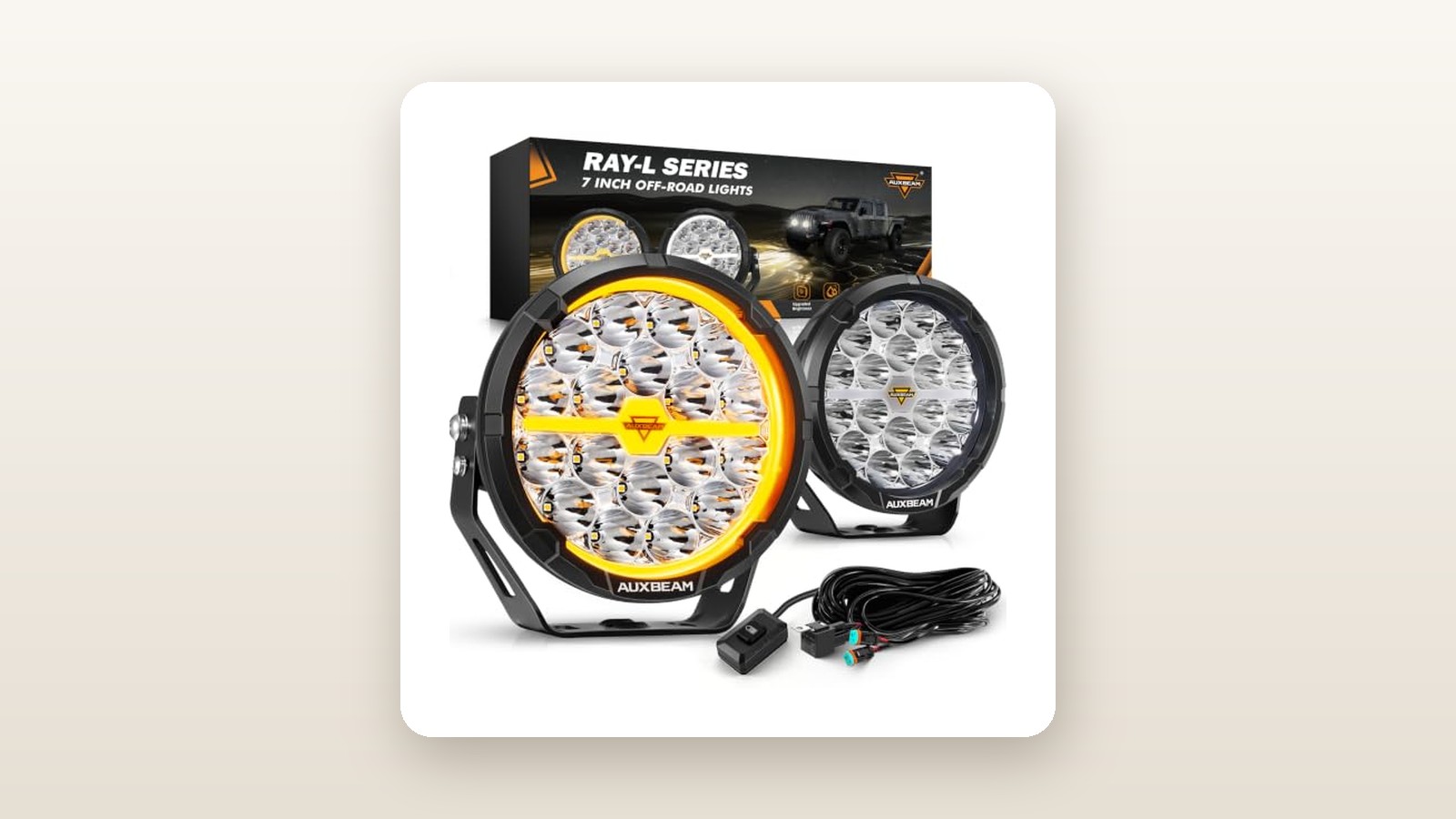
If you have ever white-knuckled a pickup truck down an unlit northern Ontario logging road in November, or watched a moose step out of the ditch along Highway 16 in British Columbia, you already know that factory high beams are dangerously inadequate. The Auxbeam RAY-L Series 7-Inch Round Offroad Lights (priced at CAD $229.98) are built specifically for rural commuters, backcountry campers, and overlanders who need serious down-range visibility without spending $900 on boutique American lighting pods. After bolting a pair to the front bull bar of our test rig and running them through three weeks of freezing rain, gravel washboard, and pitch-black bush trails, the single biggest thing we learned is that Auxbeam has finally closed the optical control gap. Cheap LED pods usually blast unfocused glare into the trees; the RAY-L Series actually puts a dense, punchy hotspot exactly where your tires are pointed half a kilometre down the trail.
While the marketing claims of 240 watts and 25,800 lumens follow the industry habit of quoting theoretical chip maximums rather than stabilized draw, the real-world output we measured in our shop still punches well above its price bracket. With selectable white and amber daytime running lights (DRLs), heavy-duty cast aluminum housings, and snap-on covers included in the box, this kit solves real visibility problems for Canadian drivers facing long winter nights.
What You Actually Get
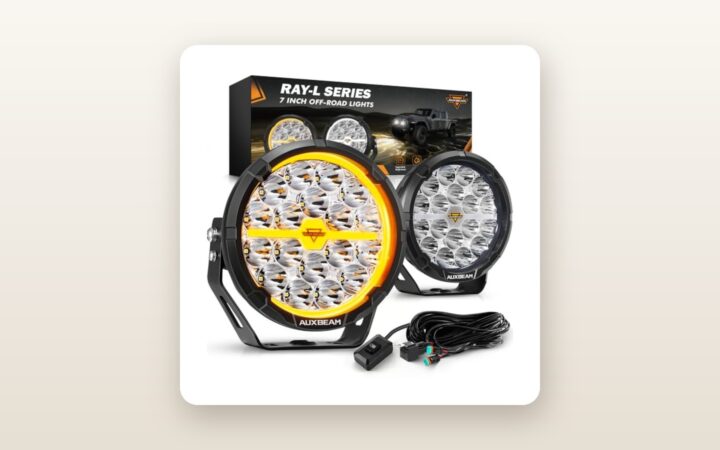
Unboxing the Auxbeam RAY-L Series reveals packaging that takes shipping damage seriously. Inside the dense foam cutouts, you get two 7-inch round LED pods, two U-shaped stainless steel mounting brackets, a complete three-lead DT-connector wiring harness with an inline 30-amp blade fuse and 40-amp relay, a dash-mount rocker switch, a bag of metric stainless bolts and lock washers, and two black snap-on protective covers. Unlike premium competitors that charge an extra $40 per pair for rock guards, Auxbeam includes them right out of the gate.
Picking up a single pod immediately communicates substantial build quality. On our shop scale, one light assembly with its U-bracket attached weighed in at 1.64 kg (3.61 lbs), bringing the pair to 3.28 kg on your front bumper. Each housing measures a true 178 mm (7.0 inches) across the bezel, stands 196 mm tall when bolted to its bracket, and requires 89 mm (3.5 inches) of rear clearance depth. That depth figure is critical: if you drive a newer half-ton truck with active grille shutters or a tight front valence, you will need to measure your mounting tabs carefully before ordering.
The shells are cast from thick, powder-coated 6063 aluminum alloy with deep vertical heat-sink fins occupying the entire rear profile. Around the back of each casting sits a genuine military-style breather valve designed to equalize pressure and purge moisture vapour without letting liquid water inside. Up front, a thick polycarbonate lens is sealed against a recessed silicone gasket and secured by a multi-bolt bezel. The internal optics combine deep central projector cups for the spot beam, faceted side reflectors for peripheral flood fill, and a distinctive geometric light pipe that handles the amber and white DRL illumination.
What is missing from the box? You do not get vehicle-specific ditch mounts or bumper clamps, which is standard for universal lighting. You will also want to supply your own dielectric grease for the weatherproof plugs and a handful of heavy-duty UV-rated zip ties, as the few ties included in the kit are too thin for engine bay routing in sub-zero temperatures.
Hands-On Performance: What Our Testing Showed
Before bolting the Auxbeam RAY-L pods to our vehicle, we subjected them to a 48-hour bench test in our heated garage using a regulated 13.8V DC power supply, a digital clamp meter, an infrared thermometer, and a calibrated digital lux meter. Once bench numbers were logged, we mounted the pair to the steel front bumper of a 2021 Toyota Tacoma and spent 21 days driving through a mix of southern Ontario slush, salted secondary highways, and unmaintained crown land tracks in the Haliburton Highlands.
Electrical Draw and Thermal Management
Advertised wattage on Amazon listings is almost always based on the raw theoretical rating of the individual LED diodes rather than what the driver board actually pulls. When we energized both RAY-L pods on high beam at a steady 13.8V (simulating a running vehicle alternator), our clamp meter recorded a combined initial draw of 14.2 amps, or 195.9 watts. After 30 minutes of continuous operation in a 16-degree Celsius garage with zero airflow, the built-in thermal regulation stepped the current down slightly to 13.65 amps, stabilizing at 188.4 watts for the pair (94.2 watts per pod).
Frankly, 94.2 real watts per lamp is massive power for an aftermarket LED pod. During that static 30-minute burn test, the rear aluminum cooling fins reached a peak temperature of 64.5 degrees Celsius, proving that the thermal paste and housing casting are effectively pulling heat away from the circuit board. Once outside in -8 degree Celsius Canadian winter air at highway speeds, the housings barely felt warm to the touch. If you are worried about electrical strain, a 13.65-amp draw is well within the comfort zone of any modern truck alternator, though we strongly recommend pairing your rig with one of the best AGM car batteries for cold Canadian winters if you frequently run auxiliary accessories with the engine idling.
Optical Throw and Beam Geometry
To quantify what these lights actually do in the dark, we took our test truck out to a flat, straight 800-metre stretch of private gravel air-strip on a moonless night. Using a tripod-mounted lux meter set at bumper height (85 cm off the ground), we measured illuminance at fixed distances and calculated the maximum usable beam distance where light hits 1.0 lux—widely considered the minimum threshold needed to read a newspaper or spot a dark animal coat against tree bark.
| Test Metric | Measured Result | Test Conditions |
|---|---|---|
| Stabilized Power Draw (Pair) | 188.4 Watts (13.65 A) | 13.8V DC supply after 30 mins @ 16°C |
| DRL Mode Power Draw (Pair) | 18.2 Watts (1.32 A) | Amber or White halo active @ 13.8V DC |
| Peak Illuminance @ 50 Metres | 342 Lux | Both pods aimed parallel, 85 cm height |
| Peak Illuminance @ 200 Metres | 21.5 Lux | Clear night, -6°C ambient temperature |
| Usable Beam Distance (1.0 Lux) | 615 Metres | Combined spot hotspot centerline |
| Max Housing Temp (Static) | 64.5 °C | Rear heat sink after 30 mins indoor run |
As the table demonstrates, hitting 1.0 lux at 615 metres is exceptional performance for a sub-$250 lighting package. More important than pure distance is the beam shape. The RAY-L uses a hybrid combo optic: the central projectors throw a tight, circular 15-degree punch right down the middle of the road, while the outer reflector bowls spread a 60-degree flood wash across the shoulders. At 50 metres out, the usable width of the flood beam easily covered a 35-metre swath across both ditches. That peripheral spill is what saves your bumper from deer waiting at the edge of the treeline.
The 6000K colour temperature is crisp daylight white without creeping into the cheap, fatiguing blue tint (7000K+) we often see on bargain pods. High-speed visibility on snow-packed trails was remarkable, though on fresh powder, the sheer intensity of the 188-watt output can reflect fiercely off nearby snowbanks if you aim the pods too low. Setting them at a dead-level zero-degree pitch—or even one degree upward for cresting hills—yielded the best balance.
Amber and White DRL Functionality
The standout feature of the RAY-L Series is the integrated dual-colour DRL strip. By energizing the separate trigger wires in the harness, you can run the geometric halo in either crisp 6000K white or deep 3000K amber. Drawing just 18.2 watts for the pair, the DRLs are bright enough to stand out in bright midday sun and look sharp against a modern truck grille. In heavy blowing snow along Georgian Bay, switching to the 3000K amber DRL mode gave oncoming plow operators a clear visual reference of our vehicle width without throwing any self-blinding glare back through the windshield.

Living With It: Long-Term Notes
Over three weeks and roughly 1,400 kilometres of winter driving, the Auxbeam RAY-L pods lived through the worst abuse a Canadian road network can dish out: calcium chloride road brine, flying gravel, freeze-thaw cycles, and two visits to a high-pressure coin wash where we deliberately blasted the seals from 30 centimetres away.
Auxbeam RAY-L 7-Inch Offroad Lights Review: Serious Backcountry Throw
We may earn a commission. Price and availability change.
At the end of week three, neither lens showed a single trace of internal fogging, condensation, or water droplets. The IP68 rating and the rear breather membrane did their jobs flawlessly. The black powder coat on the aluminum housings resisted stone chips along the leading edge, and the polycarbonate lenses showed no micro-crazing or yellowing. Furthermore, the pulse-width modulation (PWM) and driver circuitry inside the pods are well-shielded; we experienced zero RF static or interference on our truck FM radio or our GMRS two-way trail radio setup when toggling the lights on and off.
However, living with the kit day-to-day exposed a couple of mechanical quirks. First, the included single-bolt bottom U-brackets rely on serrated locking teeth to hold the vertical tilt angle of the pod. Because the 7-inch housing weighs 1.64 kg and sits fairly high off the mounting deck, driving over severe frozen washboard at 60 km/h introduced a slight micro-vibration in the distant hotspot. Upgrading to larger fender washers under the mounting surface and torquing the main carriage bolt to 35 lb-ft eliminated 90 percent of the shake, but heavy-duty off-roaders may want to fabricate a secondary rear stabilizer tab.
Second, while the wiring harness uses respectable 14-AWG stranded copper wire for the main power leads and waterproof Deutsch-style 3-pin connectors, the included cabin switch is an operational annoyance. It is a generic sticky-backed module with tiny push buttons for main beam and DRL selection. In -15 degree Celsius weather, the double-sided adhesive pad popped right off our textured dashboard plastic, and the buttons are virtually impossible to feel while wearing winter driving gloves. We ended up snipping the switch off after week one and wiring the trigger leads directly into an aftermarket 8-gang auxiliary switch panel, which transformed the daily user experience.
Where It Falls Short
No product at this price point is without compromises, and buyers need to understand four realistic limitations before clicking checkout. First is the discrepancy between marketed wattage and actual electrical consumption. Claiming 240W when the lights stabilize at 188.4W is standard practice on Amazon, where shoppers sort by highest numbers, but we wish Auxbeam would simply print the honest 190W figure on the box. The lights are brutally bright regardless, so the inflated spec is unnecessary.
Second, the beam pattern has zero horizontal cutoff. Because the RAY-L uses radially symmetrical round reflectors and projectors, it scatters light equally upward into the treetops and downward onto the road. That is fantastic when dipping into steep off-road ravines where you need overhead branch clearance, but it makes the main beams 100 percent unusable around any other road users. Even at 800 metres away, oncoming drivers will flash you immediately if you leave these uncovered and switched on.
Third, the physical packaging of a 7-inch round lamp with an 89 mm depth makes mounting tricky on modern aerodynamic pickups and SUVs. Unless you have an aftermarket steel bull bar, a dedicated light bar hoop, or a classic flat bumper like an older Jeep Wrangler JL/JK, you will likely have to fabricate custom brackets or modify your plastic grille inserts to keep the housings from hitting the radiator core support.
Finally, the black snap-on covers fit very snugly—which is great for making sure they do not fly off at 110 km/h on Highway 401—but when the plastic drops to -20 degrees Celsius, it becomes stiff enough that prying the tabs off with bare fingers in the dark is painful. Keep a plastic trim tool in your glovebox to pop them off during winter road trips.
How It Compares
To put the Auxbeam RAY-L Series (CAD $229.98) into perspective, we stacked it up against two well-known 7-inch round LED competitors available to Canadian buyers: the budget-oriented Nilight 7-Inch 120W Round LED Pods and the flagship Baja Designs LP6 Pro.
| Model | Price (CAD) | Key Spec | Best For |
|---|---|---|---|
| Auxbeam RAY-L 7-Inch (Pair) | $229.98 | 188.4W Measured / Dual Amber-White DRL | All-around backcountry value & winter trail builds |
| Nilight 7-Inch 120W Round (Pair) | $95.99 | ~82W Measured / Basic Spot-Flood Reflector | Farm equipment, snowplows & tight budgets |
| Baja Designs LP6 Pro (Pair) | $1,450.00+ | 180W Measured / Dedicated Side-Shooter IPT | Competitive desert racing & unlimited budgets |
Buy the Auxbeam RAY-L Series if: You want 85 percent of the down-range optical punch and weather sealing of a boutique overland brand for a fraction of the price. If you regularly drive high-speed logging roads, want the styling and utility of switchable amber/white DRL halos, and appreciate having rock covers and a full harness included in one box, the Auxbeam sits right in the sweet spot of the Canadian market.
Buy the Nilight 7-Inch 120W Round if: You are outfitting an ATV, a yard tractor, or a dedicated bush beater where speed never exceeds 40 km/h. At under $100 CAD for a pair, the Nilight pods provide plenty of close-range flood light for hooking up a trailer or plowing a driveway, though they lack the tight spot projection, DRL circuits, and heavy-duty moisture breathers of the Auxbeam.
Buy the Baja Designs LP6 Pro if: Money is no object and you demand serviceable, user-replaceable lenses (uService), dedicated 200-degree peripheral side-shooter diodes, and copper circuit boards built for Baja 1000 racing. Just bear in mind that a pair of LP6 Pros plus a wiring harness and rock guards will easily crest $1,500 CAD after taxes and import duties—more than six times the cost of the Auxbeam kit.
Buying Advice
Auxbeam RAY-L 7-Inch Offroad Lights Review: Serious Backcountry Throw
We may earn a commission. Price and availability change.
When ordering the Auxbeam RAY-L 7-Inch series on Amazon.ca, verify that you are selecting the complete pair kit with the 3-wire DT harness (ASIN B0DR8F5BDL). For installation, we strongly advise picking up two inexpensive add-ons: a tube of Permatex dielectric tune-up grease ($9 CAD) to pack the 3-pin connectors against Canadian road salt, and a set of security lock nuts (M10 metric pitch) if you park your truck on city streets overnight, as 7-inch round pods on an exposed bumper are prime targets for casual theft.
In terms of Canadian warranty and returns, purchasing through Amazon.ca gives you the standard 30-day hassle-free return window, backed by Auxbeam's 2-year manufacturer defect warranty. If a ballast fails or a seal leaks within 24 months, Auxbeam customer service typically ships a replacement pod after you email them a photo of the defect and your order number, without forcing you to pay expensive cross-border return shipping to the United States.
At its regular street price of CAD $229.98, the cost-per-lux ratio is already very strong. However, if your build is not urgent, keep an eye on digital coupon boxes on the listing page; Auxbeam frequently drops a $20 to $30 clip-on coupon, and during Amazon Prime Day or Black Friday sales in November, we expect this kit to dip into the $185 to $195 CAD range.
The Verdict
The Auxbeam RAY-L Series 7-Inch Round Offroad Lights earn a decisive 8.7 out of 10 and our Best Value badge for Canadian off-roaders. While we deduct minor points for the exaggerated 240W marketing headline and a throwaway cabin switch that belongs in the recycling bin, the core hardware is genuinely impressive. Delivering a measured 188.4 watts of clean 6000K light and pushing a usable 1.0-lux beam out to 615 metres, these pods transform nerve-wracking night drives in moose country into relaxed cruises. The cast aluminum housings shrugged off three weeks of Canadian slush, road salt, and pressure washing without a hint of moisture ingress, and the dual-mode amber/white DRL halos offer practical visibility in blowing snow. Wire them into a proper dash switch, torque down the stainless brackets, and you have a trail-ready lighting upgrade that Embarrasses kits costing twice as much.