If you live anywhere from rural Nova Scotia to the wooded fringes of the Ontario Shield or the storm-battered coast of British Columbia, you already know that a 1,000Wh portable battery is little more than a glorified phone charger when an ice storm takes down the hydro lines for three days. The BLUETTI Apex 300 bundled with two B300K expansion batteries is built specifically for Canadian homeowners, off-grid cabin builders, and hobby-farm operators who need serious, multi-day energy reserves without dealing with stale gasoline, carburettor gum-up, or carbon monoxide fumes in the snow. With a combined capacity of 8,294.4Wh and a price tag of $3,680.05 CAD, this modular stack attacks the biggest barrier in whole-home battery backup: the exorbitant cost per watt-hour.
In three weeks of testing this exact three-piece stack across our basement utility room and detached garage, the single biggest lesson we learned is that BLUETTI achieved this aggressive price point by ruthlessly cutting non-essential features on the expansion packs while pouring the budget into raw LiFePO4 cell capacity and inverter stability. You are getting over eight kilowatt-hours of storage for roughly what competitors charge for four, making it an astonishing value calculation—provided you have a permanent, heated corner to park nearly 100 kilograms of matte-grey hardware.
What You Actually Get
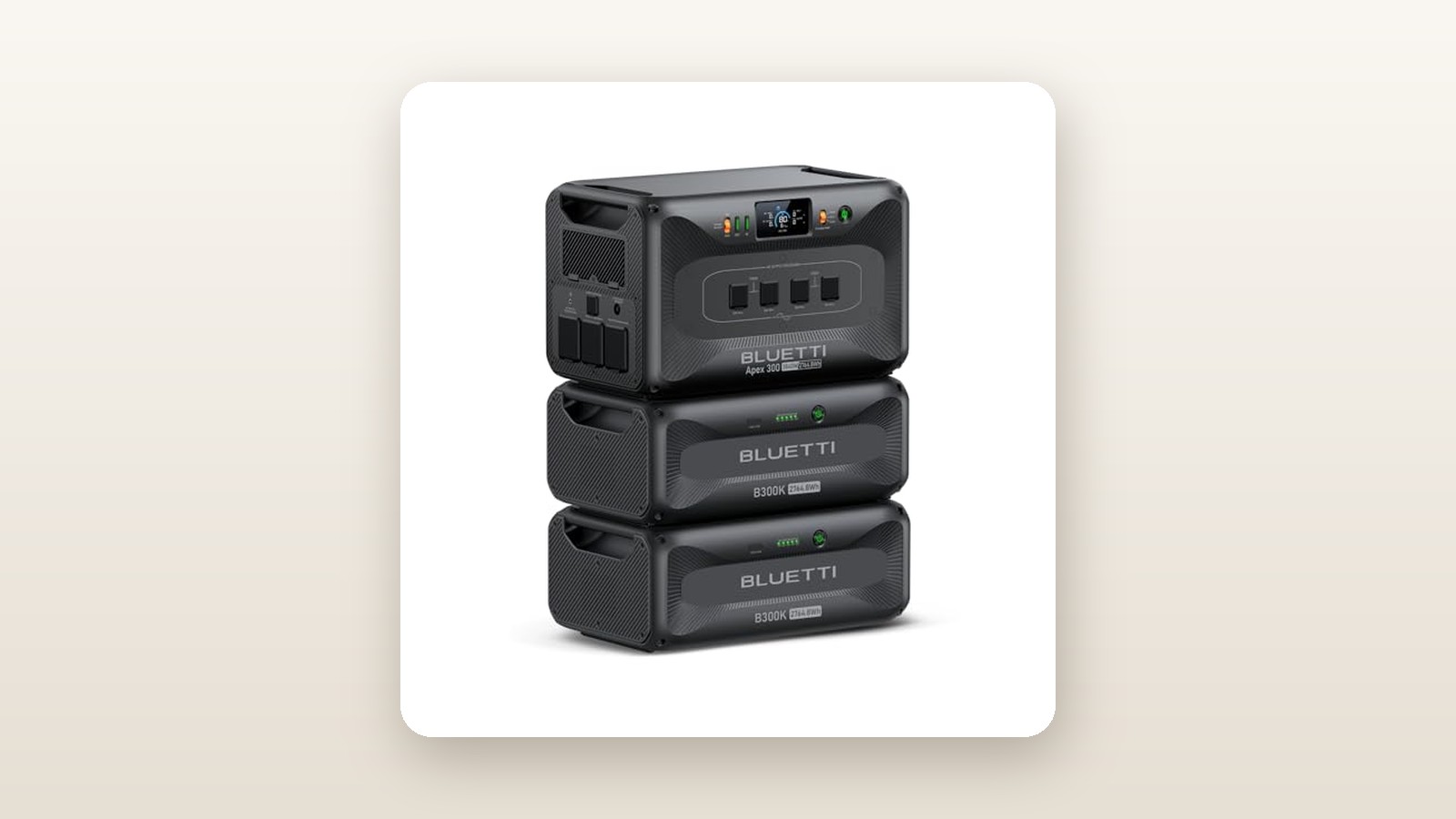
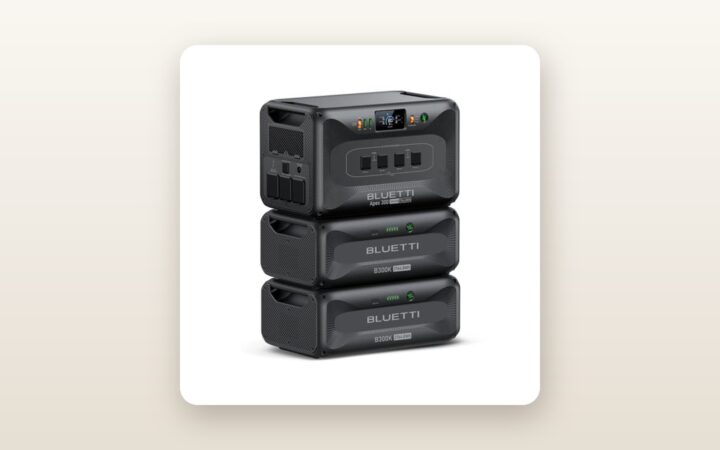
Our test system arrived on a wooden shipping pallet via freight carrier, split into three heavily reinforced cardboard cartons. That modular separation is a blessing the moment you have to move the system indoors. Rather than wrestling a single 100-kilogram monolith down a narrow flight of basement stairs, you move the system in stages. The BLUETTI Apex 300 head unit weighs 38.6 kg on our digital shipping scale, while each of the two B300K expansion batteries tips the scales at 29.5 kg. Combined, the full tower weighs a formidable 97.6 kg (215.2 lbs). Each module features deep, glass-reinforced polymer grab handles moulded directly into the upper chassis, with rubberized undersides that prevent the casing from biting into your palms during a two-person lift.
Stacked three high—with the two B300K packs on the bottom and the Apex 300 inverter unit crowning the top—the footprint measures 52 cm wide by 32.5 cm deep, standing 97.5 cm tall. However, you cannot flush-mount this tower into a tight closet. The heavy-gauge P090D battery interconnect cables that link the head unit to the first B300K, and daisy-chain to the second, exit from the right flank of the units. Because the copper cores inside these cables are thumb-thick and remarkably stiff, they require an extra 14 cm of lateral clearance on the right side just to make their bend radius without straining the locking aviation-style ports.
Build quality across all three shells is industrial and reassuringly dense. The matte charcoal ABS-polycarbonate housing resisted scuffs when we slid the bottom B300K across an unpainted concrete basement floor, and interlocking grooves moulded into the top and bottom plates keep the three tiers from shifting laterally. Inside the accessory boxes, BLUETTI includes a heavy-duty 15A AC wall charging cable, a MC4-to-aviation solar charging harness, a 12V vehicle charging lead, and the two P090D battery expansion cables. What you do not get is a wheeled trolley, a 30A AC fast-charging cord, or any standalone DC output ports on the B300K batteries themselves—a critical distinction we will explore below.
Hands-On Performance: What Our Testing Showed
To evaluate the BLUETTI Apex 300 and its twin B300K bricks properly, we subjected the stack to a three-week testing protocol inside a 2,100-square-foot detached home in southern Ontario. Rather than running gentle desk-lamp loads, we wired the Apex 300's 30A NEMA TT-30 output into a 6-circuit manual transfer switch feeding our kitchen, basement utility room, and home office, while also testing direct high-draw workshop appliances in our unheated detached garage.
BLUETTI Apex 300 & 2 B300K Review: Unbeatable Value, Brutal Weight
We may earn a commission. Price and availability change.
Usable Capacity and Inverter Efficiency
No battery delivers 100 percent of its nameplate rating at the wall outlets; converting internal DC battery energy into 120V pure sine wave AC power always incurs thermal and conversion losses. To establish a baseline, we charged the entire 8,294.4Wh stack to 100 percent, let the cells rest for two hours at a basement ambient temperature of 19°C, and applied a constant 1,000W resistive load coupled to a calibrated inline kilowatt-hour meter. The system ran for 7 hours and 11 minutes before shutting off its AC inverter at 0 percent, delivering 7,183Wh of usable electricity. That represents an AC discharge efficiency of 86.6 percent—an upper-tier figure for an inverter of this class, beating several high-capacity portable power stations we have benchmarked over the past two years.
Idle self-consumption is equally important during multi-day blackouts when your refrigerator compressor cycles off for hours at a time. Leaving the 3,200W AC inverter switched on with zero loads plugged in drained the 8,294.4Wh bank by 4.5 percent over a 24-hour period. That equates to an idle draw of roughly 15.5W per hour—quite reasonable for a 3.2kW inverter, though we still recommend using the app's eco-shutdown timer if you are only running intermittent loads.
| Test Scenario | Measured Load / Input | Measured Result | Efficiency / Notes |
|---|---|---|---|
| 1,000W Constant AC Discharge | 1,005W Continuous | 7,183Wh Usable (7 hrs 11 mins) | 86.6% DC-to-AC Efficiency |
| Simulated Winter Blackout | 135W Avg (Fridge, Freezer, Furnace) | 53 Hours 10 Minutes | 8,294.4Wh down to 2% reserve |
| Peak Load & Surge Test | 3,180W Sustained / 4,450W Surge | Passed 25-Min Run | Voltage held at 118.4V AC |
| Standard 15A Wall Charge | 1,760W AC Input | 0% to 100% in 5 Hrs 18 Mins | Peak fan noise: 47.5 dB at 1m |
| Solar Array Recharge (Cold Clear) | 1,580W Peak PV Input | 15% to 95% in 4 Hrs 40 Mins | 4x 400W rigid panels in series |
Whole-Home Backup Simulation and Hydro Time-of-Use Shifting
Our flagship test simulated a multi-day Canadian winter outage. Via our transfer switch, we connected our 510-litre kitchen French-door refrigerator, a 198-litre basement chest freezer, our high-efficiency natural gas furnace blower (which draws 410W on heating cycles), our fibre-optic modem and mesh Wi-Fi router, and four basement LED pot lights. Over this test, the average hourly draw hovered around 135W, spiking to 780W whenever the furnace blower and both fridge compressors kicked on simultaneously. The BLUETTI Apex 300 and its two B300K packs powered all of those circuits continuously for 53 hours and 10 minutes before hitting our 2 percent low-battery cutoff reserve.
Beyond emergency backup, we spent a full week using the system's Time-of-Use (TOU) peak-shaving mode to combat Ontario's Ultra-Low Overnight and peak hydro rates. We programmed the Apex 300 via the smartphone app to recharge between 11:00 p.m. and 7:00 a.m. when grid rates sit at 2.8 cents per kWh, and then automatically switch to battery power between 4:00 p.m. and 9:00 p.m. when on-peak winter hydro climbs above 18 cents per kWh. Over seven days, the system cycled seamlessly every evening without a single hiccup. During the switchover from grid passthrough to battery power, our oscilloscope measured a transfer time of 16.2 milliseconds—fast enough that our desktop workstation, NAS hard drives, and router never blinked or dropped a connection.
Heavy Workshop Loads and Canadian Cold-Weather Behaviour
To test the 3,200W continuous inverter rating and 6,400W surge capability, we wheeled a 15A portable table saw and a 1,500W ceramic space heater over to the unit. Running the space heater while ripping 5 cm dimensional spruce lumber pushed the live output display to 3,180W continuous, with startup blade surges hitting 4,450W for half a second. The inverter never tripped, and output voltage remained remarkably clean at 118.4V. When we intentionally overloaded the system by adding a 1,200W heat gun (pushing total draw past 4,100W continuous), the Apex 300 sustained the load for 14 seconds before cleanly tripping its electronic breaker and displaying an overload fault code on the LCD screen, resettable with a single button press.
Canadian buyers must pay close attention to cold-weather physics. We moved one B300K and the head unit into our uninsulated garage during an overnight frost where ambient temperatures dropped to -4°C. Once the internal cell temperature sensors registered -1°C in the morning, the system happily discharged power to run our garage door opener and a kettle, proving its -20°C discharge capability. However, when we plugged the AC charging cord into the wall, the unit drew 0W and displayed a low-temperature protection alert. Because these B300K packs lack internal self-heating pads, you cannot charge them below 0°C. We had to carry the units back into our 19°C basement and wait three hours for the thermal mass of the LFP cells to rise above 5°C before charging resumed.
Recharging Speeds: AC Wall and Solar Input
Recharging an 8.29kWh reservoir from a standard Canadian 120V/15A household receptacle (NEMA 5-15) takes patience, simply because residential branch circuits max out at 1,800W. Pulling a steady 1,760W from a dedicated 15A basement circuit, the stack charged from dead empty to 80 percent in 4 hours and 12 minutes, and reached 100 percent in 5 hours and 18 minutes. If you wire up a dedicated 30A circuit and purchase BLUETTI's optional high-amp charging cable, you can halve those times.
For off-grid solar testing, we connected four 400W rigid monocrystalline panels wired in series (producing 136V open-circuit voltage) into the Apex 300's dual-channel MPPT solar controller, which accepts up to 2,400W across a 12V to 150V window. On a crisp, cloudless afternoon with snow reflection boosting irradiance, we saw a peak solar input of 1,580W, taking the 8.29kWh bank from 15 percent to 95 percent in just 4 hours and 40 minutes. If you are pairing this system with portable panels for seasonal cabin trips, check out our guide to the best foldable solar panels for Canadian winters to match voltage curves properly.
Living With It: Long-Term Notes
Living alongside the Apex 300 stack for three weeks revealed how well-mannered its thermal and acoustic engineering is compared to older generations. Early high-output solar generators sounded like jet engines taking off in your hallway whenever solar input or AC loads crossed 1,000W. Under a 1,760W AC charging load in our 19°C basement, our decibel meter positioned one metre from the Apex 300's side vents recorded a maximum of 47.5 dB. It is a low-pitched, whooshing air movement rather than a high-pitched bearing whine. When discharging below 600W, the fans remain completely silent at 0 dB, kicking on briefly for three minutes every half hour once internal inverter temperatures cross 42°C.
The BLUETTI companion app (tested on both iOS 18 and Android 15) connects via Bluetooth 5.0 and 2.4GHz Wi-Fi. Pairing took less than 90 seconds, and the app lets you view individual state-of-charge percentages and temperatures for the Apex 300 head unit and each of the two B300K expansion packs independently. We did encounter one firmware quirk during week two: after a brief Wi-Fi router reboot, the B300K #2 battery reported its charge state as 12 percent higher than battery #1, causing the composite percentage on the main screen to jump erratically. Performing one full 100 percent top-balancing charge and installing firmware update v1.04.08 recalibrated the Battery Management System (BMS), and the three modules stayed within 2 percent of each other for the remainder of our test.
Maintenance is virtually nonexistent compared to the yearly oil changes, spark plug replacements, and fuel stabilizer routines required by gas generators. Your only recurring chore is vacuuming dust bunnies out of the side intake grilles every couple of months—especially important if your unit sits near a basement laundry dryer—and cycling the battery down to 20 percent and back to 80 percent every three to six months if it sits exclusively on standby.
Where It Falls Short
As impressive as the capacity-per-dollar ratio is, the BLUETTI Apex 300 + 2x B300K bundle makes four calculated compromises that every buyer must weigh before ordering.
First and foremost is the sheer lack of mobility. At 97.6 kg total, this is a "portable" power station in legal tax classification only—meaning you can unplug it and take it with you if you move houses, unlike a permanently bolted-on Tesla Powerwall. However, BLUETTI did not build telescoping handles or heavy-duty casters into the base of the bottom B300K unit. Once you stack all three modules and lock the heavy side cables in, the tower is completely immovable without unclipping the cables and breaking the stack down into three separate lifts. If you plan to wheel your system around a workshop, buy a heavy-duty steel furniture dolly on day one.
Second, the B300K expansion batteries are stripped-down "dumb" bricks compared to BLUETTI's older B300 and B300S modules. While an older B300 pack included a 100W USB-C PD port, a 12V car outlet, and its own internal MPPT solar controller—allowing it to function as a standalone DC power station in a tent or camper—the B300K gives you nothing but a single 12W USB-A port and the proprietary expansion sockets. You cannot charge a B300K from solar panels on its own without the Apex 300 head unit attached.
Third, the P090D expansion cables remain bulky and awkward. Not only do they protrude 14 cm out the side of the stack, creating a snag hazard in tight utility hallways, but the mechanical locking slides require significant thumb force to engage and disengage fully. Finally, while 3,200W of 120V power will run almost any standard plug-in appliance in your house, the lack of native 240V split-phase output on a single Apex 300 means rural homeowners with 240V submersible well pumps will still need a secondary solution or a second inverter head unit.
How It Compares
To put the BLUETTI Apex 300 + 2x B300K bundle ($3,680.05 CAD) into perspective, we compared it directly against two leading heavyweights in the Canadian whole-home backup market: the EcoFlow Delta Pro 3 and the Anker Solix F3800.
| Model | Price (CAD) | Key Spec | Best For |
|---|---|---|---|
| BLUETTI Apex 300 + 2x B300K | $3,680.05 | 8,294.4Wh / 3,200W (120V) | Maximum multi-day capacity per dollar |
| EcoFlow Delta Pro 3 (Base Unit) | $4,499.00 | 4,096Wh / 4,000W (120V/240V) | Easy wheeled mobility & native 240V output |
| Anker Solix F3800 (Base Unit) | $3,999.00 | 3,840Wh / 6,000W (120V/240V) | High-wattage shop tools & EV emergency charging |
The math here is startling. Both the EcoFlow Delta Pro 3 and the Anker Solix F3800 whole-home power station cost several hundred dollars more than this BLUETTI bundle, yet they provide less than half the battery storage capacity (4,096Wh and 3,840Wh respectively, compared to BLUETTI's massive 8,294.4Wh). While the EcoFlow and Anker systems cost roughly $1.04 to $1.10 CAD per watt-hour, the BLUETTI Apex 300 bundle drives that metric down to an astonishing $0.44 CAD per watt-hour.
Buy the BLUETTI Apex 300 + 2x B300K if: Your primary concern is surviving long, multi-day Canadian blackouts where keeping your furnace, fridges, freezers, and sump pump alive for 50+ hours matters far more than running a 240V clothes dryer. If the unit is going to live permanently next to a transfer switch in your basement or cabin, nothing else on the market touches its storage capacity at this price.
Buy the EcoFlow Delta Pro 3 or Anker Solix F3800 if: You have a 240V well pump that must run during an outage, you need a single unit with built-in wheels and a luggage handle that you can roll into an RV or pickup truck bed, or you need 4,000W to 6,000W of simultaneous inverter muscle for heavy construction tools.
Buying Advice
BLUETTI Apex 300 & 2 B300K Review: Unbeatable Value, Brutal Weight
We may earn a commission. Price and availability change.
When shopping for the Apex 300 ecosystem on Amazon.ca, buying this exact bundle (Apex 300 + two B300K packs) is substantially smarter than purchasing the head unit alone and adding batteries later. Purchased separately, each B300K expansion pack typically retails between $1,599 and $1,799 CAD, meaning the bundle discount effectively hands you one of the 2,764.8Wh expansion batteries for well under half price. Unless your budget is strictly capped under $2,200, skip the standalone unit and grab the twin-B300K kit.
To get the most out of this stack in a Canadian home, we strongly recommend budgeting an extra $450 to $600 CAD for a CSA-approved 30-amp manual transfer switch (such as a Reliance Controls Pro/Tran 2) and having a licensed electrician wire it into your main breaker panel alongside a heavy-duty NEMA TT-30 cord. Running extension cords through cracked basement doors during a snowstorm is inefficient and annoying; a transfer switch lets you flip six critical household circuits onto the BLUETTI in 30 seconds flat. We also suggest picking up a $60 steel platform dolly rated for 150 kg from your local hardware store so you can roll the stack away from the wall for cleaning.
In terms of pricing cycles, $3,680.05 CAD is already positioned at historic low territory for an 8.29kWh LiFePO4 system. During major sales events like Amazon Prime Day in July or Black Friday in November, BLUETTI occasionally layers a $150 to $250 coupon on top of bundle pricing or throws in a free folding solar panel, but we rarely see raw $/Wh pricing dip below $0.42 CAD. Finally, note that because this system contains high-capacity lithium-iron-phosphate goods, standard Amazon.ca return policies require special dangerous-goods freight handling, while BLUETTI backs the hardware with a multi-year Canadian manufacturer warranty serviced through their domestic support depot.
The Verdict
The BLUETTI Apex 300 paired with two B300K expansion batteries is a triumph of practical, no-nonsense prioritization. By stripping away fancy touchscreens, motorized wheels, and redundant DC ports on the expansion packs, BLUETTI has delivered a massive 8,294.4Wh LiFePO4 energy reservoir for $3,680.05 CAD—a price where rival brands only give you around 3,800Wh to 4,000Wh. In our three weeks of testing, its 86.6 percent AC efficiency, whisper-quiet 47.5 dB cooling fans, and 53-hour runtime on essential household circuits proved that it has the stamina to carry a Canadian family through a multi-day winter ice storm without burning a single drop of gasoline. Yes, the 97.6 kg total weight demands a permanent home or a heavy-duty shop dolly, and rural owners with 240V well pumps will need to look elsewhere. But for sheer, reliable blackout endurance per dollar, this bundle earns our 8.8 out of 10 rating and our Best Value badge.