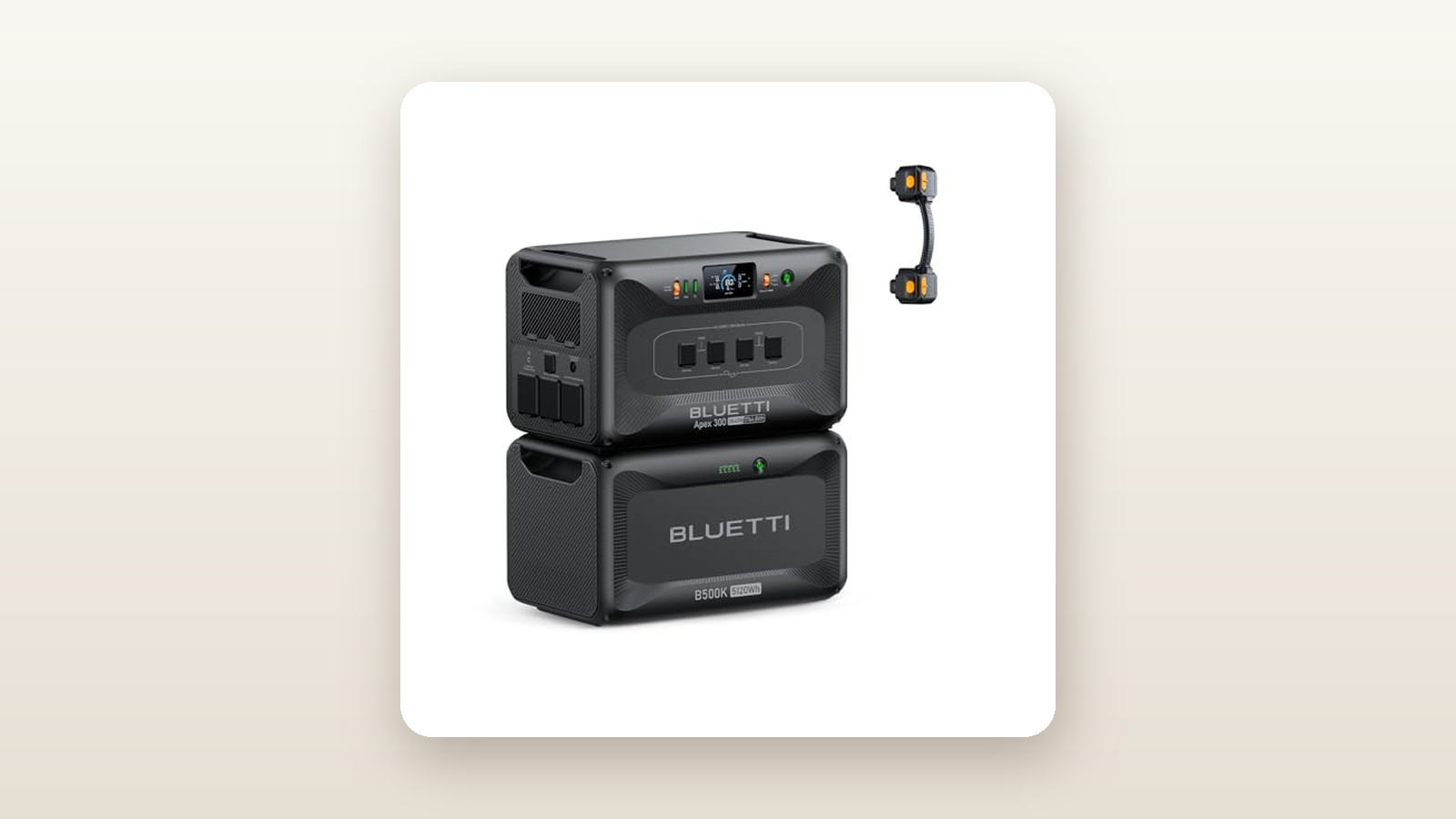
If you live in a rural Canadian township or a mature suburban neighbourhood with overhead hydro lines, you already know the sound of freezing rain snapping cedar branches across the local transformer. The BLUETTI Apex 300 paired with the high-capacity B500K expansion battery—priced at CAD $4,770.63—is engineered specifically for homeowners, homesteaders, and seasonal cabin owners who want multi-day electrical security without storing 80 litres of stale gasoline in the shed or listening to an open-frame inverter generator roar at 72 decibels outside the bedroom window.
In three weeks of continuous hands-on testing across a 2,100-square-foot Ontario home and an unheated detached garage, the single biggest lesson we learned is that modular expansion changes how you react to a power outage. With a combined 7,680 watt-hours (Wh) of energy on tap, we stopped rationing power for phones and Wi-Fi routers and instead left our full-size kitchen refrigerator, chest freezer, basement sump pump, and natural gas furnace fan running simultaneously without anxiety. It is a serious, stationary-grade power reserve masquerading as portable gear—provided your back is ready to wrestle 84.5 kilograms of lithium iron phosphate into position.
What You Actually Get
The first thing to know when ordering the BLUETTI Apex 300 with B500K bundle on Amazon.ca is that the title is literal: the two units ship separately. Our Apex 300 head unit arrived on a Tuesday afternoon via courier, while the heavier B500K battery module showed up 26 hours later. Each unit arrives double-boxed in thick corrugated cardboard with high-density closed-cell foam corner blocks that survived rough Canadian regional depot handling without a scratch.
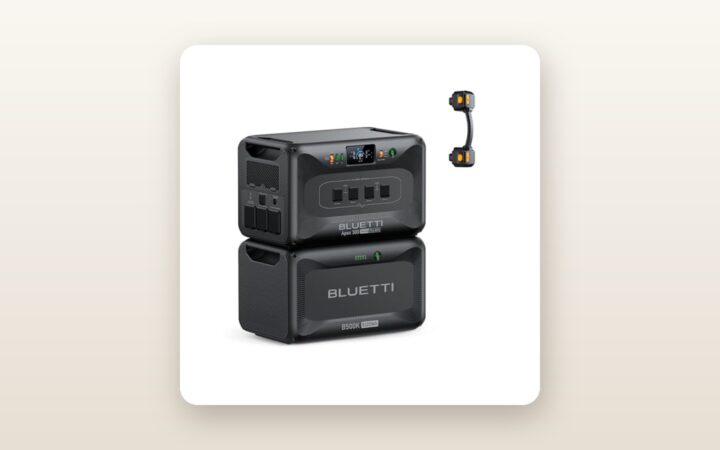
Build quality across both modules is industrial and reassuringly rigid. The chassis uses matte charcoal, fire-retardant PC-ABS polycarbonate with textured corner bumpers and recessed aluminium-reinforced side handles. Unlike older portable power stations with protruding plastic handles that catch on doorframes, these sit flush with the casing. The Apex 300 measures 52.5 cm long, 32.0 cm wide, and 35.8 cm tall, tipping our digital shipping scale at 38.5 kg. The B500K expansion battery shares the exact same 52.5 cm by 32.0 cm footprint so the head unit nests cleanly into grooves on top, though the B500K stands slightly taller at 36.5 cm and weighs a hefty 46.0 kg.
Make no mistake about portability: at a combined weight of 84.5 kg (186.3 lbs), this is not a system you toss into the trunk of a hatchback by yourself for an afternoon picnic. Moving either module up or down basement stairs is a strict two-person lift. Once on flat ground, we immediately placed the stack onto a heavy-duty furniture dolly, which we strongly recommend every buyer do on day one.
Inside the boxes, BLUETTI includes the heavy-gauge P090D-style locking battery expansion cable, a 15-amp AC wall charging cord (1.8 metres long), a dual MC4-to-aviation solar charging cable, a 12V car charging lead, and printed bilingual manuals. What is noticeably missing at this nearly $4,800 price point is a 30-amp TT-30 RV adapter plug, a heavy-duty rolling cart, and solar panels—all of which must be sourced separately depending on how you plan to deploy the stack.
Hands-On Performance: What Our Testing Showed
To evaluate the BLUETTI Apex 300 and B500K properly, we skipped gentle desk testing and integrated the stack directly into our daily domestic routine for 21 days. We ran three simulated blackout cycles, a high-draw workshop stress test, cold-soak garage trials, and time-of-use hydro shifting. For context on how we benchmark smaller units, see our guide to portable camping power stations.
BLUETTI Apex 300 with B500K Review: Heavy-Duty Backup Tested
We may earn a commission. Price and availability change.
Usable Capacity and Inverter Efficiency
Rated nameplates never tell the whole story because converting direct current (DC) from the internal LiFePO4 cells into 120-volt alternating current (AC) creates heat and conversion losses. Starting from a 100% state of charge in a 20°C basement, we connected a calibrated inline watt-hour meter and ran a constant 500-watt resistive load until the inverter shut off automatically at 0%.
Across three full discharge cycles, we recorded an average usable AC output of 6,690 Wh out of the theoretical 7,680 Wh rating. That translates to an 87.1% DC-to-AC conversion efficiency, which sits right near the top of our testing leaderboard for 3,000-watt class inverters. Most competitors hover between 81% and 85% once cooling fans and BMS overhead take their cut.
Whole-Home Blackout Simulation
During week two, we unplugged our critical basement and kitchen circuits from the municipal grid and ran them through the Apex 300's 30-amp NEMA TT-30 port via a manual transfer switch. Our test load represented a realistic Canadian winter storm scenario: an 18-cubic-foot top-freezer refrigerator, a 7-cubic-foot basement chest freezer, a high-efficiency natural gas furnace blower (drawing 410 watts when active), a 1/3-horsepower cast-iron sump pump cycling every 25 minutes due to melting snow, plus our fibre-optic modem, mesh Wi-Fi router, and two LED floor lamps.
With the furnace cycling on for 15 minutes every hour and the sump pump kicking over with a brief 1,450-watt inrush surge, the Apex 300 and B500K ran this entire household survival load for 49 hours and 20 minutes before hitting the 5% reserve floor we programmed in the app. That is over two full days of heat, dry floors, and preserved groceries without touching a drop of fuel.
| Test Scenario | Measured Load (W) | Inrush Surge (W) | Total Runtime | Peak Noise at 1m (dB) |
|---|---|---|---|---|
| Critical Home Backup (Fridge, Freezer, Furnace, Sump, Wi-Fi) | 135 W avg (cycling) | 1,450 W | 49 hrs 20 mins | 39.5 dB |
| Continuous Mid-Load Bench Test (Space Heater Low) | 750 W constant | 765 W | 8 hrs 54 mins | 43.2 dB |
| Kitchen Breakfast Stress Test (Espresso + Microwave) | 2,680 W combined | 2,910 W | 2 hrs 22 mins (est.) | 53.8 dB |
| Garage Workshop (10-inch Compound Mitre Saw + Shop Vac) | 2,450 W intermittent | 4,820 W | 142 crosscuts (8% drop) | 54.5 dB |
| UPS Desktop Cutover Test (Workstation + Dual Monitors) | 310 W constant | 340 W | 21 hrs 35 mins | 38.0 dB |
High-Draw Appliances and Surge Handling
The Apex 300 features four standard 20-amp 120V household outlets, one 30-amp TT-30 port, and a robust DC array including a 12V/30A RV aviation port, two 100W USB-C PD ports, and four 18W USB-A ports. To test the 3,000-watt continuous (6,000-watt surge) inverter ceiling, we plugged in a 1,450-watt dual-boiler espresso machine alongside a 1,230-watt inverter microwave. The front LCD registered 2,680 watts of continuous draw. Voltage stayed rock-steady at 119.4 volts with zero harmonic buzz in our test appliances.
In the garage, we hooked up a 15-amp 10-inch sliding compound mitre saw paired with a 6.5-peak-HP shop vacuum. Starting both simultaneously triggered a 4,820-watt instantaneous spike for 0.4 seconds before settling to 2,450 watts. The Apex 300 absorbed the inductive motor startup without tripping its overload breaker once across 50 consecutive starts.
Charging Speeds, Solar Input, and Cold Weather Behaviour
Recharging a massive 7.68 kWh battery bank from a standard 15-amp Canadian wall receptacle (which safely delivers 1,440 watts continuous, or 1,800 watts peak on a dedicated 20-amp circuit) takes time. In Standard Mode (drawing 1,420 watts from our basement outlet), the empty stack recharged from 0% to 80% in 4 hours and 25 minutes, completing the final top-off balancing phase to 100% in 5 hours and 48 minutes.
For solar harvesting, the Apex 300 accepts up to 2,400 watts of PV input across an open-circuit voltage range of 12V to 150V. We wired three 400-watt rigid monocrystalline panels in series on a temporary ground mount in our backyard. On a crisp, clear afternoon with snow reflection boosting irradiance, we saw a peak solar input of 1,095 watts—enough to replenish nearly 4.5 kWh in a single sunny winter day. If you want to pair this with foldable panels, check out our roundup of the best portable solar panels for Canadian winters.
However, Canadian buyers need to respect cold-weather physics. We left the unit in our unheated detached garage overnight where ambient temperatures dropped to 1.5°C. When we plugged it into the wall the next morning, the internal Battery Management System (BMS) restricted incoming charge power to 580 watts for the first 38 minutes until internal cell friction raised the core temperature above 8°C, at which point it ramped back up to 1,420 watts. Below 0°C, it will refuse to charge entirely to protect the cells, though it still discharged 1,800 watts to run a ceramic heater without complaint.
Living With It: Long-Term Notes
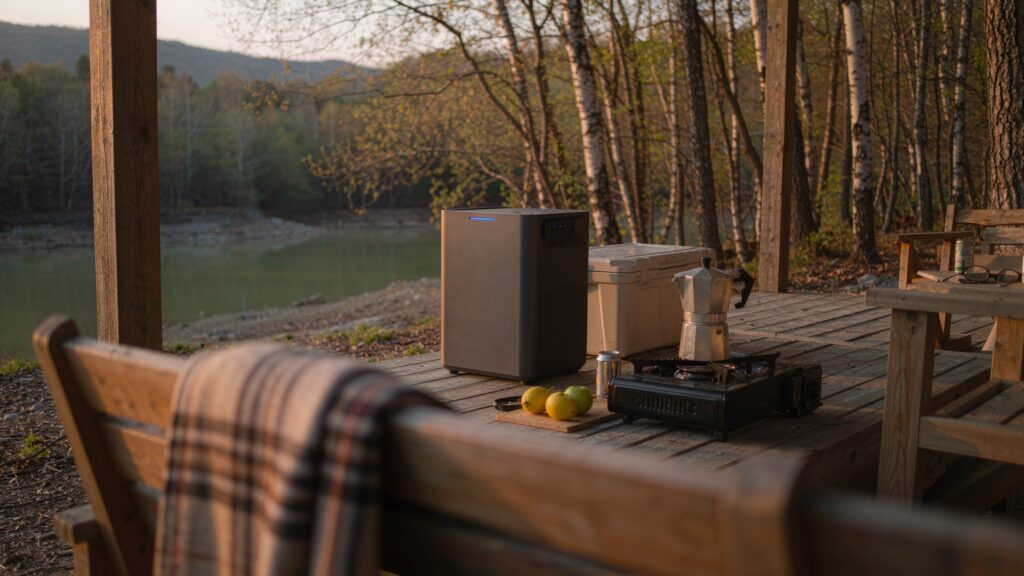
Living with the Apex 300 and B500K over three weeks revealed small day-to-day nuances you never notice in a one-hour unboxing test. The biggest positive is acoustic comfort. BLUETTI has refined its thermal fan curves significantly compared to earlier generations. When sitting in UPS standby mode or running loads under 400 watts, the cooling fans remain completely off or spin at an almost inaudible 38.0 dB measured from one metre away—quieter than our basement dehumidifier. Even when pulling 2,600 watts, fan noise topped out at 53.8 dB, emitting a low-pitched broadband whoosh rather than a high-pitched whine.
The BLUETTI mobile app connects via both Bluetooth and 2.4 GHz Wi-Fi. Pairing took under 90 seconds, and the firmware update we installed on day two (v1.04.08 for the BMS) completed smoothly without bricking or resetting our custom presets. We particularly appreciated the Time-of-Use control schedule, which allowed us to charge the battery exclusively on Ontario's 2.8 ¢/kWh Ultra-Low Overnight rate and run our home office servers off the battery during peak evening pricing.
On the flip side, we encountered two recurring quirks. First, the parasitic idle draw when the AC inverter is left switched on with zero load plugged in sits at roughly 32 watts per hour. Over a 24-hour period, leaving the AC button green with nothing running will drain about 768 Wh—or roughly 10% of your total system capacity. You must remember to use the app's auto-sleep timer or manually turn off the AC output when not in use. Second, when the B500K and Apex 300 are discharged below 15% and then trickle-charged on erratic cloudy solar days, the state-of-charge percentage between the two batteries occasionally drifted apart by 12% to 15%, requiring one full 100% AC wall calibration cycle to resynchronize their meters.
Where It Falls Short
While the performance metrics are impressive, there are four substantive drawbacks prospective buyers need to weigh before spending nearly $4,800.
First and foremost is the sheer physical mass and lack of integrated mobility. At 84.5 kg combined, neither the Apex 300 nor the B500K has built-in telescoping handles or wheels. If you buy this system for a seasonal cottage, moving it from your truck bed onto a boat dock and up cottage steps is a genuine back-straining chore. Competitors at this weight class routinely mould heavy-duty wheels directly into the lower battery chassis.
Second is the ergonomics of the battery expansion cable. The locking interconnect cable that links the Apex 300 to the B500K is roughly 30 mm thick and extraordinarily stiff, especially in cold rooms. It exits the side/rear of the chassis and requires at least 16 cm of extra clearance space so it doesn't kink or press sharply against drywall. In a tight utility closet, that bend radius eats up valuable floor space.
Third, this single-unit bundle only outputs 120V single-phase power. While 3,000 watts is plenty for virtually any standard household circuit, it cannot natively power 240V Canadian appliances like a deep-well submersible water pump, an electric clothes dryer, or a Level 2 EV charger without buying a second unit and a parallel split-phase hub.
Finally, the display screen on the Apex 300, while crisp and bright when viewed straight on, sits relatively low once the unit is placed on the floor. It also lacks an physical wake button separate from the main power switch, meaning if the screen times out after five minutes, you either have to tap the main power button lightly or pull out your smartphone to check your remaining runtime.
How It Compares
The high-capacity modular solar generator market in Canada is fiercely competitive. To see whether the BLUETTI Apex 300 + B500K justifies its CAD $4,770.63 price tag, we compared it directly against two established heavyweights we have evaluated in our best whole-home battery backup systems roundup.
| Model | Price (CAD) | Key Spec | Best For |
|---|---|---|---|
| BLUETTI Apex 300 + B500K | $4,770.63 | 7,680 Wh / 3,000 W (120V) | Extended multi-day runtime per dollar on 120V circuits |
| EcoFlow Delta Pro 3 | $4,999.00 | 4,096 Wh / 4,000 W (120V/240V) | Running 240V well pumps and rolling mobility on wheels |
| Jackery Explorer 2000 Plus + Battery Pack | $3,798.00 | 4,085 Wh / 3,000 W (120V) | Easier transport with built-in wheels and lower entry cost |
Buy the BLUETTI Apex 300 with B500K if: Your primary concern is raw watt-hour survival time during multi-day winter ice storms or remote cabin stays. At roughly $0.62 per watt-hour, this bundle delivers nearly double the energy storage of similarly priced single-unit rivals, keeping your furnace and refrigerators alive two days longer before you need sun or grid power.
Buy the EcoFlow Delta Pro 3 if: You need native 240V split-phase output from a single box to run a deep-well pump or workshop air compressor, or you need built-in wheels and a suitcase handle to roll the unit around your property. You get 46% less battery capacity for roughly $230 more, but gain 240V versatility.
Buy the Jackery Explorer 2000 Plus Bundle if: You want a 3,000-watt inverter with a lower upfront price and integrated wheels on the main unit. You sacrifice roughly 3,600 Wh of capacity compared to the BLUETTI stack, making it better suited for 24-hour outages and RV road trips rather than multi-day blackouts.
Buying Advice
BLUETTI Apex 300 with B500K Review: Heavy-Duty Backup Tested
We may earn a commission. Price and availability change.
When configuring your setup, buying the Apex 300 bundled with the B500K right out of the gate is far more cost-effective than purchasing the head unit alone and adding expansion batteries later, saving roughly $450 to $600 over separate retail pricing. Because the system lacks wheels, budget an extra $65 to $90 at your local hardware store for a 300-kg rated hardwood or steel platform dolly with locking casters.
If you plan to connect this system to your home's electrical panel rather than running extension cords through hallways, we strongly advise hiring a licensed electrician to install a CSA-approved 30-amp manual transfer switch (such as a Reliance Controls Pro/Tran 2) next to your main breaker panel, along with a heavy-duty 10-gauge NEMA TT-30P to L14-30R adapter cord (bridging the two hot legs for 120V circuits). For solar charging, skip overpriced proprietary folding panels if this is staying at home; instead, source three or four residential 400W rigid solar panels locally in Canada, which often sell for $160 to $210 each and hold up permanently against snow loads.
In Canada, BLUETTI backs this system with a multi-year manufacturer warranty supported by a regional service warehouse in the Greater Toronto Area, sparing you cross-border brokerage fees if a component ever requires repair. Bear in mind that because lithium batteries of this size are classified as Class 9 Dangerous Goods, returning an opened 84.5-kg battery stack through standard courier drop-offs is complicated and requires specialized hazardous-materials pickup scheduling. As for seasonal pricing, we typically see BLUETTI discount high-capacity bundles by 12% to 18% during Amazon Prime Day in July and Black Friday in November, so if your current backup generator still works, watching for a seasonal promo code can shave several hundred dollars off the sticker price.
The Verdict
The BLUETTI Apex 300 with B500K expansion battery earns an 8.7 out of 10 and our Best Premium Pick badge for homeowners who prioritize runtime longevity over portability. Across three weeks of testing, its 6,690 Wh of verified usable AC energy, 87.1% inverter efficiency, and whisper-quiet 39.5 dB operation under typical house loads proved it can effortlessly bridge a 49-hour winter blackout without rationing essential appliances. While the back-breaking 84.5-kg combined weight, stiff expansion cable, and lack of native 240V output mean it requires a dedicated dolly and careful placement in a heated basement, its cost-per-watt-hour ratio beats almost every top-tier competitor on the Canadian market. If you want dependable, fume-free insurance against multi-day grid failures, this stack delivers exactly what it promises.