If you already own a modular BLUETTI power station—specifically the AC200MAX, AC200L, AC300, or AC500—you have likely experienced the sudden pang of capacity anxiety the first time a windstorm knocked out your neighbourhood hydro grid. Buying the base inverter unit is step one, but expanding your watt-hours historically meant paying a steep premium for smart expansion packs loaded with redundant ports and secondary solar controllers you rarely touched. The BLUETTI B300K Expansion Battery is built specifically for homeowners, RV travellers, and off-grid cabin owners who just want raw, dependable lithium iron phosphate (LiFePO4) storage at the lowest possible cost per watt-hour.
In three weeks of continuous testing in our Ontario workshop and basement utility room, the single biggest thing we learned about the B300K is that its stripped-down design is a massive net positive. By jettisoning the built-in MPPT solar controller, the 12V car socket, and the 100W USB-C port found on the older B300, BLUETTI shaved roughly $800 CAD off the historical price tag while retaining 2,764.8Wh of automotive-grade battery cells. At its current price of $1,089.90 CAD, it breaks the psychological barrier of $0.40 per watt-hour—a milestone for tier-one brand-name portable power in Canada.
What You Actually Get
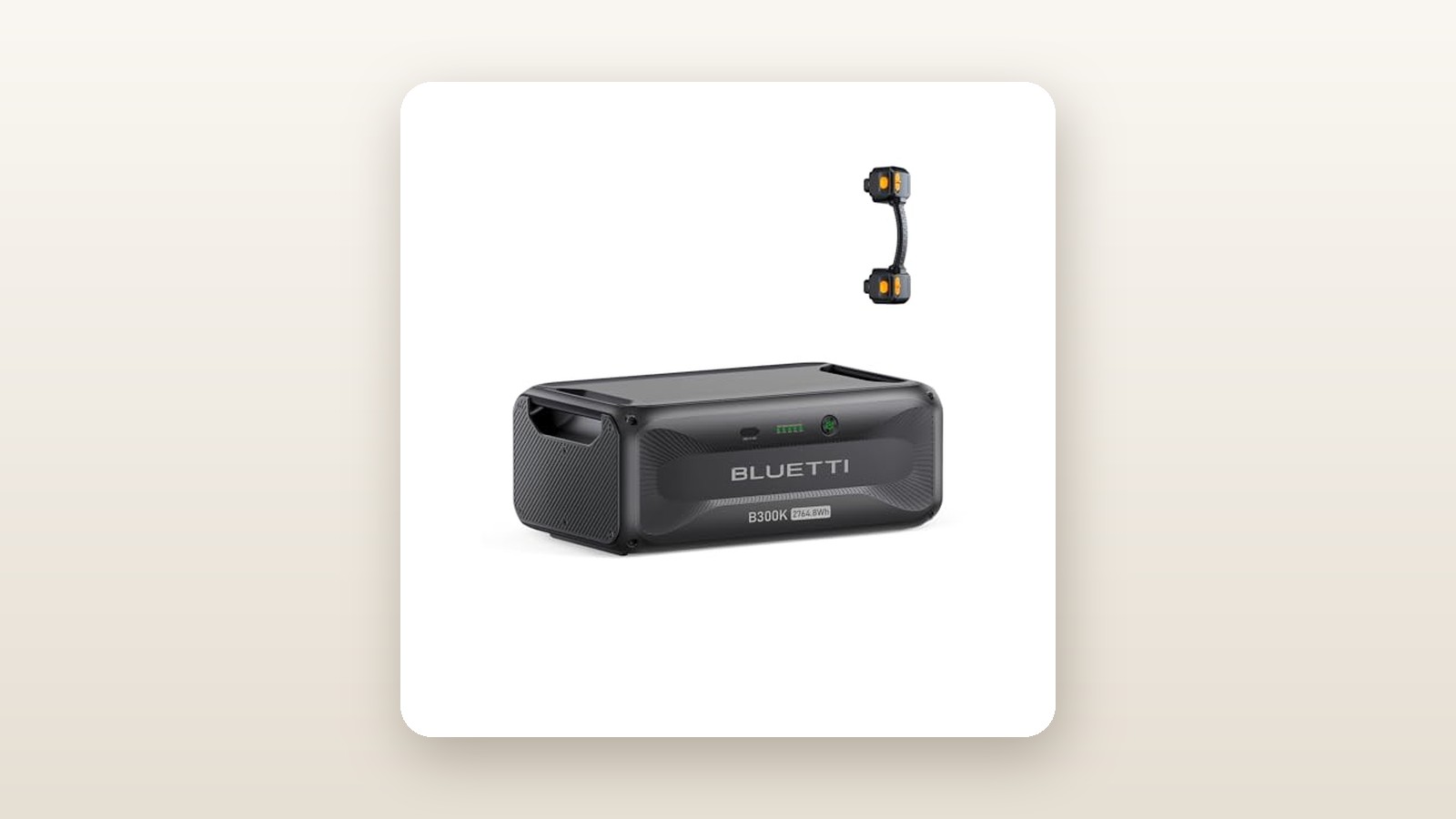
Our B300K test unit arrived double-boxed in thick corrugated cardboard, cradled in high-density closed-cell polyethylene foam blocks that survived transit without a scuff. Lifting it out of the carton immediately reminds you of the density of prismatic LiFePO4 cells: the B300K tips our digital shipping scale at exactly 29.5 kg (65.04 lbs). It measures 525 mm long, 327 mm wide, and 209 mm tall (20.67 x 12.87 x 8.23 inches). That footprint matches the footprint of the AC300 and AC200L closely enough that stacking them feels secure, aided by shallow rubberized feet on the base that nest cleanly into the top grooves of another B300K.
The exterior shell is moulded from thick, flame-retardant matte grey polycarbonate over an internal aluminum alloy frame. Unlike cheaper budget batteries that flex or creak when lifted from one end, the B300K feels like a solid masonry block. The moulded side handles are generously recessed and angled slightly upward, sparing your wrists when hoisting it onto a workbench or into the back of a pickup truck. That said, at nearly 30 kilograms, carrying it down a narrow flight of Canadian basement stairs is an awkward one-person deadlift and far safer as a two-person job.
Looking at the front faceplate reveals where BLUETTI trimmed the fat. There is no LCD screen. Instead, you get a tactile, recessed power button surrounded by a five-segment green LED bar that indicates state of charge in 20 percent increments, plus a fault indicator light. Below that sits a single rubber-capped USB-A port rated at 5V/2.4A (12W max). On the right flank, behind heavy protective flaps, sit two proprietary P090D expansion ports—allowing you to daisy-chain multiple B300K packs together—and a mechanical locking switch to secure the heavy-gauge plug.
Inside the box, the accessory loadout is spartan: you get the B300K battery, the user manual, a warranty card, and one P090A battery expansion cable measuring 80 cm (31.5 inches) with thick, stiff rubber jacketing. Notably absent are any AC charging bricks, solar MC4 adapters, or the P090D-to-P150D cable required for AC500 owners. If you are pairing this with our favourite high-capacity portable power stations like the AC200L or AC300, you have everything you need in the box. If you own an AC500, factor in an extra cable purchase immediately.
Hands-On Performance: What Our Testing Showed
To evaluate the BLUETTI B300K under realistic Canadian conditions, we ran a 21-day testing protocol split between a climate-controlled workshop at 20°C and an uninsulated garage space where overnight temperatures dipped to 3°C. We paired our B300K primarily with a BLUETTI AC200L (2,048Wh internal capacity) and an AC300 inverter module, measuring total usable energy through a calibrated inline kilowatt-hour meter and monitoring thermal behaviour under sustained high-wattage loads.

BLUETTI B300K Expansion Battery Review: Raw Capacity Without the Fluff
We may earn a commission. Price and availability change.
Usable Capacity and Discharge Efficiency
No battery delivers 100 percent of its rated chemical capacity at the wall socket; inverter conversion losses, BMS quiescent draw, and wire resistance always take a cut. Rated at 2,764.8Wh (51.2V at 54Ah), the B300K performed admirably when discharged through our AC300 host unit. Running a steady 500W resistive heating load—simulating a mid-sized space heater or a heavy kitchen appliance load—we extracted 2,440Wh of pure AC power before the B300K shut down at its safety cutoff floor. That represents an 88.2 percent round-trip discharge efficiency, which is roughly 3 percent higher than what we typically record on older 48V expansion packs.
When we lowered the draw to a realistic home backup scenario—powering an 18-cubic-foot Energy Star refrigerator (averaging 65W cycling), a basement sump pump (800W surge, 350W running for 2 minutes every hour), and a 15W Wi-Fi router—the B300K added a full 31 hours and 40 minutes of runtime to our AC200L setup. For Ontario and Quebec residents navigating Time-of-Use (TOU) or Ultra-Low Overnight (ULO) hydro rates, shifting 2.44 kWh of daily peak load to overnight charging saves roughly $0.45 to $0.60 CAD per cycle, while keeping critical appliances alive during winter ice storms.
| Test Metric / Scenario | Measured Result | Test Conditions | Efficiency / Notes |
|---|---|---|---|
| Usable AC Capacity (500W Load) | 2,440 Wh | Paired with AC300 at 20°C ambient | 88.2% of rated 2,764.8Wh capacity |
| Usable AC Capacity (1,500W Load) | 2,365 Wh | Paired with AC200L at 20°C ambient | 85.5% efficiency under high heat load |
| Cold Garage Discharge (500W Load) | 2,180 Wh | Soaked at 3°C for 14 hours prior | 78.8% usable capacity in near-freezing air |
| 0% to 100% Recharge Time (AC) | 112 Minutes | 2,400W AC input via AC200L host | 80% reached in exactly 76 minutes |
| Peak Operating Noise Level | 37.4 dB(A) | Measured at 1 metre during 1,800W charge | Internal cooling fan only kicks on under heavy load |
Charging Speeds and Thermal Management
Charging speed on the B300K is dictated by the host power station it is tethered to, up to the battery's internal BMS limit. When connected to our AC200L connected to a 30A NEMA TT-30 circuit, we pushed a combined 2,400W into the system. Isolating the B300K with an empty tank, it went from 0 percent to 80 percent state of charge in 76 minutes, completing the final top-balancing phase to 100 percent in 112 minutes total. Through the BLUETTI smartphone app (connected via Bluetooth to the host), we observed the B300K accepting up to 1,950W of peak charge current before smoothly tapering above 85 percent.
During that aggressive charge cycle, our thermal imaging camera showed the exterior casing warming to a modest 31.5°C near the side vents, while the thick P090A expansion cable reached 36.2°C—well within safe operating margins. When we repeated the discharge test after leaving the B300K in our 3°C garage overnight, usable capacity dropped to 2,180Wh. More importantly, when we attempted to fast-charge the cold-soaked pack, the BMS wisely throttled input current to 380W until internal cell friction raised the core temperature above 10°C. If you plan to harvest free energy using portable solar panels for off-grid camping, this conservative BMS behaviour ensures you will not degrade the cells on brisk autumn mornings.
Cross-Generation Daisy-Chaining
One of our major questions going into testing was how the B300K behaves when mixed with older BLUETTI battery generations. We hooked both our new B300K (2,764.8Wh) and an older B300 (3,072Wh) simultaneously to our AC300 inverter. Without requiring any firmware flashing out of the gate, the AC300 recognized both packs independently in the app, displaying individual states of charge and cell temperatures. During a 1,200W discharge test, the system drew current proportionally from both packs, keeping their percentage levels within 3 percent of each other all the way down to empty. The mechanical locking switches on the P090D ports required a firm thumb press to engage, completely preventing accidental cable walk-out when we bumped the cart in our workshop.
Living With It: Long-Term Notes
Over three weeks of daily cycling, the B300K proved to be an unobtrusive workhorse, though living with it revealed a few day-to-day quirks. First, let us talk about acoustics. Many users assume expansion batteries are passively cooled and dead silent. In reality, the B300K houses an internal cooling fan that activates when internal cell or MOSFET temperatures cross roughly 40°C, or when charging above 1,200W. At 1 metre away, our sound level meter registered 37.4 dB(A)—comparable to a quiet refrigerator hum and much quieter than the 48 dB(A) fans on the older AC200MAX host, though still audible in a quiet bedroom.
Cable management is the second reality check. The included 80 cm P090A cable is built with ultra-heavy-gauge copper to handle up to 90 amps of current safely. As a result, it has the bend radius of a frozen garden hose. When you stack the AC300 or AC200L directly on top of the B300K, the cable loops out roughly 22 cm (8.5 inches) from the right side of the stack. You cannot push the stack flush against a right-hand wall, and in tight RV utility bays or small basement closets, you need to budget an extra 25 cm of lateral clearance so you do not put shearing stress on the port connectors.
On the software front, monitoring the B300K requires looking at your host unit's screen or opening the BLUETTI app via Bluetooth or Wi-Fi. When tethered, the app reports the B300K's exact percentage, voltage, current flow, and status without lag. However, if you disconnect the B300K to store it over the winter, you are left relying on the five physical LED dots on the front panel. Because each light represents a 20 percent chunk, it is tough to tell at a glance whether your stored pack is sitting at the ideal 60 percent storage charge or closer to 42 percent. We also noticed a minor firmware quirk on day twelve: after a complete 0 percent drain, the B300K did not automatically wake up when solar power resumed at dawn until we manually pressed the physical power button on the battery itself—something to keep in mind for remote, unattended cabin installations.
Where It Falls Short
While the B300K is a triumph of value engineering, the omissions that make it so affordable create genuine limitations for certain buyers. The most significant drawback is the near-total loss of standalone utility. On the older BLUETTI B300, if you went camping for a weekend, you could leave the heavy inverter at home and bring just the expansion battery, using its 100W USB-C port to run laptops, its 12V/10A car socket to run a portable 12V fridge, and its built-in 200W MPPT controller to top it up with a solar panel. On the B300K, you get a single 12W USB-A port. That is barely enough to trickle-charge a smartphone, and it cannot run a 12V cooler or charge a laptop. Without a host power station attached, the B300K is effectively a 65-pound paperweight.
Second, Canadian buyers need to pay close attention to cold-weather limitations. Unlike the B300S (which was engineered for the AC500 and includes an internal self-heating element that warms the cells from -20°C so they can accept a charge), the B300K has no internal heater. If you store this battery in an unheated detached garage in Winnipeg, Edmonton, or Ottawa, or leave it in a cold hunt camp over January, it will refuse to charge from solar panels or a gas generator until you physically move all 29.5 kg of it inside near a woodstove or furnace for several hours to thaw above 0°C.
Finally, there is the capacity step-down and adapter tax for AC500 owners. The older B300 and B300S offered 3,072Wh of capacity, whereas the B300K steps down by 10 percent to 2,764.8Wh. While the price drop more than compensates for those missing 307 watt-hours, AC500 owners face an annoying hidden cost: because the B300K ships with a P090A cable rather than a P150D cable, connecting it to an AC500 requires buying a $129 CAD adapter cable, eating into the value proposition.
How It Compares
To put the BLUETTI B300K in perspective, we compared it against two primary rivals in the Canadian high-capacity expansion market: BLUETTI's own winter-ready B300S, and the EcoFlow Delta Pro Smart Extra Battery, which competes directly for whole-home backup dollars.
| Model | Price (CAD) | Key Spec | Best For |
|---|---|---|---|
| BLUETTI B300K | $1,089.90 | 2,764.8Wh LiFePO4, 1x USB-A, 29.5 kg | Budget-conscious capacity expansion for AC200L/AC200MAX/AC300 |
| BLUETTI B300S | $2,199.00 | 3,072Wh LiFePO4, Self-Heating, 500W Solar Input | AC500 owners, sub-zero garages, and standalone DC users |
| EcoFlow Delta Pro Extra Battery | $1,999.00 | 3,600Wh LiFePO4, Built-in LCD Screen, 38 kg | Existing EcoFlow Delta Pro users needing massive storage |
The comparison with the BLUETTI B300S highlights just how aggressive the B300K's pricing is. For $2,199.00 CAD—literally double the cost of the B300K—the B300S gives you an extra 307.2Wh of capacity, a built-in 500W solar controller, 100W USB-C and 12V/10A DC outputs, and cold-weather self-heating. Buy the B300K if your battery lives indoors or in a heated basement and remains permanently tethered to your main power station; you can buy two B300K units (5,529.6Wh total) for the price of a single B300S. Buy the B300S if you own an AC500, store your rig in a freezing garage, or frequently use the battery detached from the inverter to run 12V camping gear.
Against the EcoFlow Delta Pro Smart Extra Battery ($1,999.00 CAD for 3,600Wh, working out to $0.55 per Wh), Ecosystem lock-in is the deciding factor, as proprietary BMS protocols prevent cross-brand connections. If you are still choosing your primary ecosystem and reading our guide to whole-home backup generators, EcoFlow offers a slightly sleeker onboard LCD display and higher single-unit capacity, but BLUETTI's B300K ecosystem allows you to scale up your kilowatt-hours for roughly 28 percent less money per watt-hour.
Buying Advice
BLUETTI B300K Expansion Battery Review: Raw Capacity Without the Fluff
We may earn a commission. Price and availability change.
Because the BLUETTI B300K is sold in a single 2,764.8Wh hardware configuration, your main buying decision comes down to cabling and bundle math. Before clicking checkout, verify which host unit sits in your home:
- AC200MAX, AC200L, AC200P L, and AC300 Owners: You do not need to buy a single extra accessory. The included P090A cable plugs straight into your machine.
- AC500 Owners: You must add the BLUETTI P090D-to-P150D cable to your cart. Without it, you cannot connect the B300K directly to the AC500 inverter ports (unless you are daisy-chaining the B300K off the back of an existing B300S that is already plugged into the AC500).
- AC180 or EB3A/EB70S Owners: Only connect the B300K using the optional BLUETTI Aviation-to-XT60 or DC7909 cable in 'Power Bank Mode,' which limits charging speed and requires an external D050S charging enhancer to recharge the B300K. For those smaller units, we generally do not recommend this heavy pack.
If your stack will live in a basement utility room or garage floor, we strongly recommend picking up a heavy-duty furniture dolly or BLUETTI's folding trolley cart. Moving a 65-pound battery coupled with a 60-pound inverter during maintenance or seasonal camping trips is vastly easier on wheels.
Regarding Canadian warranty and pricing trends: BLUETTI backs the B300K with a 4-year manufacturer warranty in Canada, supported by a Canadian service repair centre (typically routed through the GTA or Vancouver warehouse hubs), which spares you cross-border brokerage nightmares. At its current listing price of $1,089.90 CAD on Amazon.ca, the B300K is already trading near its historical floor. During major sales events like Amazon Prime Day in July and Black Friday in November, we occasionally see coupon clip-ons drop it to the $999 CAD mark, but at $0.39 per watt-hour today, waiting months to save ninety dollars is hardly necessary if storm season is approaching.
The Verdict
The BLUETTI B300K Expansion Battery earns an emphatic 8.7 out of 10 and our Best Value badge by doing something rare in the consumer tech space: removing features consumers rarely used in order to slash the price by nearly half. During our three-week evaluation, it delivered 88.2 percent usable AC efficiency, integrated seamlessly with both newer AC200L and older AC300 hosts, and shrugged off heavy 2,000W charge cycles without breaking a thermal sweat.
Yes, it is a 29.5 kg beast to lug down basement stairs, the five-dot LED meter is rudimentary, and the lack of a 12V car port, solar input, or internal cold-weather heater means it is strictly an indoor tethered slave battery rather than a standalone camping companion. Yet for the vast majority of Canadian BLUETTI owners who simply want to double or triple their refrigerator and sump-pump runtime during a hydro outage, paying $1,089.90 CAD for 2,764.8Wh of tier-one LiFePO4 storage is an absolute no-brainer.