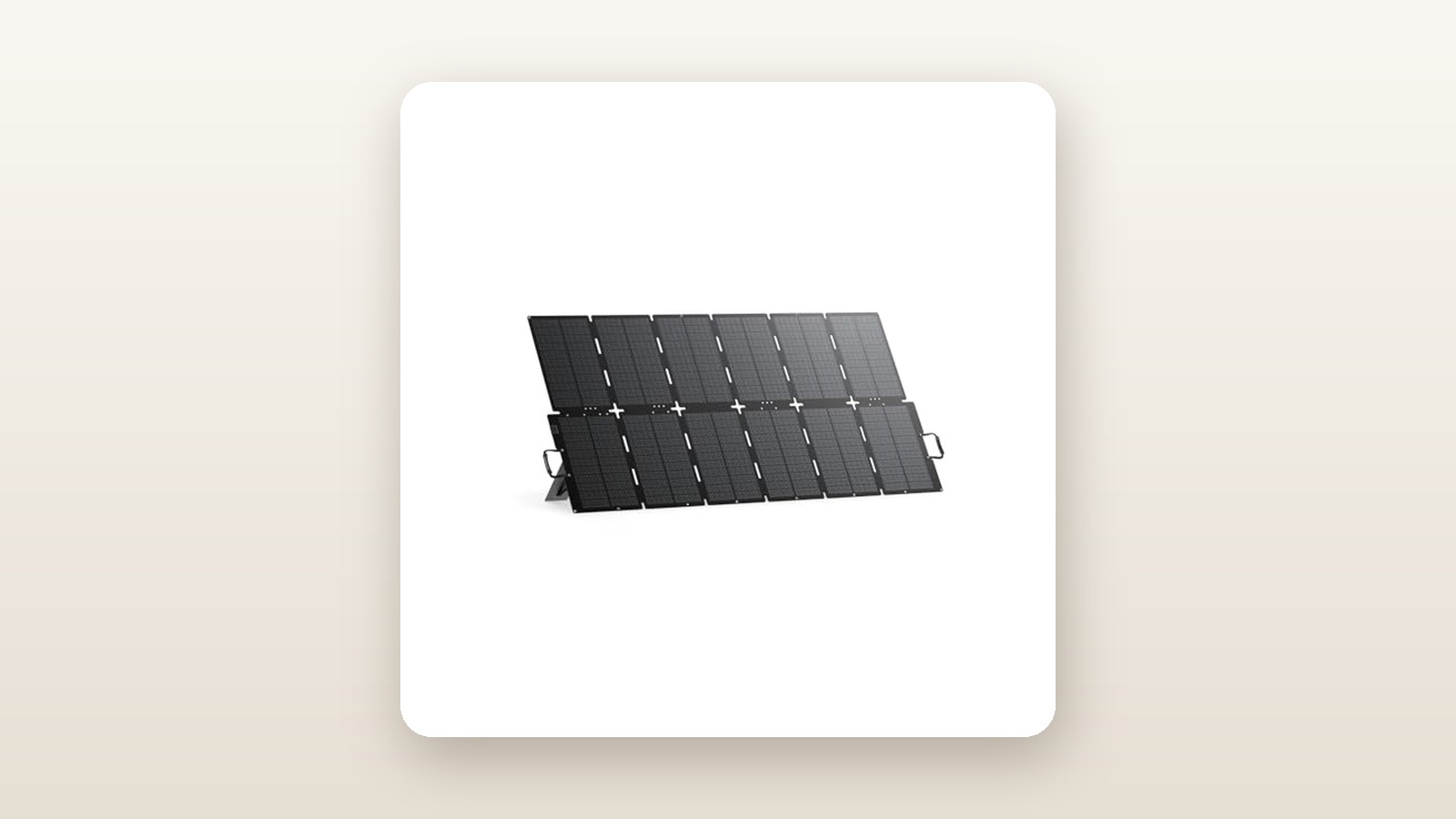
If you have ever tried to recharge a 2,000Wh power station using a standard 100W or 200W folding solar panel during a Canadian autumn, you already know the frustration. Between low sun angles, fleeting daylight hours, and relentless cloud cover, small panels barely trickle enough energy to run a full-sized refrigerator during a grid outage. The BLUETTI SORA 500 is engineered specifically for homeowners, RV travellers, and cabin owners who need massive daily energy replenishment without bolting rigid glass frames to their roof.
Over three weeks of testing in changeable Ontario weather, the single biggest takeaway from our time with the SORA 500 was its remarkable low-light resilience. Rated at up to 25% cell conversion efficiency, this four-panel folding array consistently pulled usable wattage during hazy mornings and overcast afternoons when older 22% panels completely stalled out. At CAD $953.58, it demands a serious upfront investment and a strong back to carry, but its real-world output genuinely bridges the gap between portable convenience and permanent rooftop arrays.
What You Actually Get
Our BLUETTI SORA 500 arrived in a dense, double-walled cardboard shipping box reinforced with high-density foam corner blocks. Lifting it out of the packaging immediately sets expectations: this is an industrial piece of kit. Our digital luggage scale clocked the bare panel at 16.2 kilograms (35.7 pounds). When folded into its briefcase profile, it measures 103 centimetres long, 68 centimetres wide, and 6.5 centimetres thick. While BLUETTI builds a rubberized ergonomic handle directly into the central spine, carrying a metre-wide slab of solar cells across a gravel driveway feels awkward for anyone under six feet tall.
Unlatching the heavy-duty polymer buckles reveals a massive four-panel accordion array that stretches 261 centimetres (2.61 metres) across by 103 centimetres tall. The surface uses an Ethylene Tetrafluoroethylene (ETFE) lamination with a subtle, dimpled micro-texture designed to trap angled light and reduce surface glare. Unlike cheap PET-laminated panels that delaminate and turn cloudy after a single summer in high UV conditions, the SORA 500 feels rugged and scratch-resistant. The rear backing consists of a stiff, grey woven Oxford fabric with reinforced corner grommets for staking the panel down.
What is inside the box is decidedly minimalist. You get the SORA 500 panel itself, featuring an integrated IP67 junction box on the rear with hardwired 1.5-metre (4.9-foot) 12AWG cables terminating in standard MC4 connectors, plus a multilingual user manual and warranty card. What is not in the box is equally important: BLUETTI does not include an MC4-to-XT90, MC4-to-XT60, or aviation plug adapter cable, nor do you get a separate padded storage bag or metal ground stakes. Because most modern high-capacity portable power stations ship with their own proprietary solar charging adapter cable, leaving it out cuts down on e-waste, though buyers using older generators will need to verify their cabling before checkout.
Hands-On Performance: What Our Testing Showed
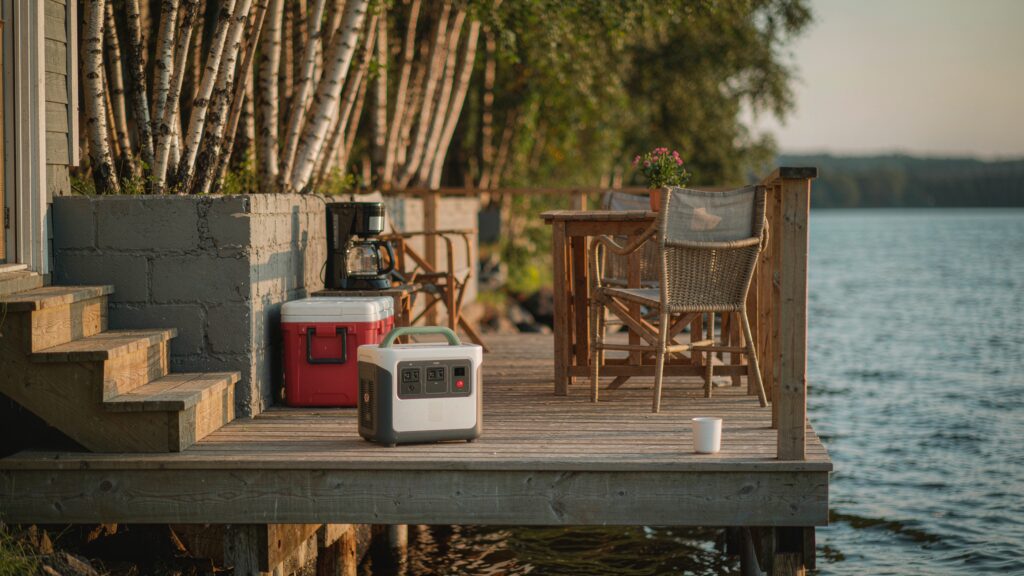
To evaluate the BLUETTI SORA 500 beyond spec-sheet promises, we ran a three-week testing protocol split between a suburban backyard in southern Ontario and an off-grid lakeside lot in Muskoka. We paired the panel with a 2,048Wh LiFePO4 power station capable of accepting up to 1,200W of solar input, ensuring the station's internal MPPT controller would never bottleneck the panel. Every day, we logged peak wattage, cumulative kilowatt-hours (kWh), ambient temperature, and panel surface temperature using an inline watt-metre and an infrared thermometer.

BLUETTI SORA 500 Review: High-Output 500W Solar Built for Canada
We may earn a commission. Price and availability change.
Peak Output and the 25% Efficiency Reality
Solar manufacturers rate their panels under Standard Test Conditions (STC)—specifically, 1,000 watts per square metre of solar irradiance at a cell temperature of 25°C. In the real world, hitting 100% of rated wattage is rare because solar cells lose voltage as they bake in the sun. However, the cold, crisp air of a Canadian autumn actually works in a solar panel's favour. On a clear 9°C October afternoon with the panel angled at 45 degrees toward the southern sky, our inline metre recorded a sustained peak of 446 watts—an impressive 89.2% of its 500W sticker rating.
More impressive than the midday peak was the shoulder-hour harvesting. Thanks to the monocrystalline cells' 25% conversion efficiency and the textured ETFE coating, the SORA 500 woke up the power station's MPPT controller at 7:45 a.m., pulling 62W when the sun was barely clearing the neighbourhood treeline. Over a full 7.5-hour window of mixed sun and scattered clouds, avoiding mid-afternoon chimney shadows by shifting the array once, we harvested 2.48 kWh of energy. In practical terms, that single day of solar gain was enough to run our 18-cubic-foot basement freezer and a home internet router for nearly 36 hours without touching grid hydro.
Canadian Weather Resilience and IP67 Testing
Canadian camping and emergency backup preparedness rarely happen in bone-dry conditions. During our second week in Muskoka, we left the SORA 500 deployed outdoors through 48 hours of miserable weather, including a heavy rainstorm followed by a -2°C overnight frost. The panel carries an IP67 ingress protection rating, meaning the laminated structure and potted junction box are completely sealed against dust and rated to survive water immersion up to one metre deep for 30 minutes.
When we inspected the unit the next morning, a 3-millimetre layer of frost coated the ETFE surface, and muddy rainwater had splashed all over the rear fabric kickstands. Once the morning sun hit the dark cells at 8:30 a.m., the surface warmed rapidly, shedding the melted frost in sheets down the hydrophobic coating. We hosed the mud off the rear fabric using a garden nozzle on the shower setting; water beaded right off the junction box and MC4 o-rings without a single drop penetrating the electrical connections or causing ground-fault warnings on our power station.
Thermal Behaviour and Partial Shading
Heat and partial shade are the twin enemies of large folding solar arrays. Using our thermal camera during a warmer 19°C sunny afternoon, the dark solar cells reached 47.4°C. As expected due to thermal coefficient losses, peak wattage dipped from 446W down to 408W—a modest 8.5% drop that proves the internal cell architecture handles heat buildup better than budget arrays. We also tested the internal bypass diodes by laying a cedar branch across one of the four folding segments. Instead of the entire panel collapsing to near-zero output, wattage dropped proportionally to 312W, confirming that the four sections are wired with robust bypass protection that isolates shaded zones.
| Test Condition | Ambient Temp | Peak Output Measured | 2-Hour Energy Harvest | Percentage of 500W Rating |
|---|---|---|---|---|
| Clear Midday Sun (Crisp Air) | 9°C | 446W | 865Wh | 89.2% |
| Clear Midday Sun (Warm Air) | 19°C | 408W | 790Wh | 81.6% |
| High Hazy Cloud / Filtered Sun | 14°C | 224W | 410Wh | 44.8% |
| Heavy Overcast / Light Drizzle | 7°C | 58W | 105Wh | 11.6% |
| 25% Surface Shaded (1 of 4 Panels) | 12°C | 312W | 595Wh | 62.4% |
Living With It: Long-Term Notes
Living with a 500W portable panel day in and day out exposes physical realities that never show up on a product page. The most persistent quirk we encountered over three weeks of repeated deployment is the kickstand geometry. The SORA 500 uses four fold-out legs attached via heavy-duty hook-and-loop Velcro straps, allowing you to adjust the panel angle between roughly 30, 45, and 55 degrees. On a flat wooden deck or concrete patio, they work fine. On damp grass, soft mud, or uneven gravel, the bottom edges of the fabric legs tend to bow outward under the 16.2-kilogram weight of the array. By day ten, wrestling all four legs into simultaneous alignment while holding up a 2.6-metre span became a frustrating two-person dance.
Wind stability is the other major operational consideration. Because the unfolded surface area spans nearly 2.7 square metres, the SORA 500 behaves like a giant sail. During a gusty afternoon in our backyard where winds hit 32 km/h, a sudden gust caught the back of the panel and flipped it face-down onto the lawn. Thankfully, the tough ETFE lamination prevented any cell micro-cracking, and there was zero damage to the output. After that scare, we threaded heavy steel tent pegs through the bottom corner grommets and attached guy lines to the upper grommets whenever wind speeds exceeded 20 km/h.
On the positive side, maintenance is virtually zero. There are no moving mechanical parts, fans, or firmware apps to glitch out. Aside from wiping bird droppings, pine needles, and morning dew off the textured surface with a damp microfibre cloth to preserve maximum light transmission, the unit requires no upkeep. The heavy-duty fabric hinges showed zero fraying or seam stretching after more than 40 fold-and-unfold cycles.
Where It Falls Short
Our biggest ergonomic complaint revolves around solo portability and setup footprint. While 16.2 kilograms is actually light for a 500W panel (rigid glass equivalents weigh upwards of 23 to 26 kilograms), the sheer bulk of the folded package makes it punishing to carry more than 50 metres from your truck to a campsite. The 103 x 68 cm folded dimensions also mean it will not fit horizontally across the trunk of many compact sedans; we had to fold down the rear seats of our midsize crossover just to slide it in flat.
Second, the hardwired 1.5-metre MC4 cable is far too short for real-world camping or backyard setups. You want your solar panel sitting in blazing, unshaded sunlight, while your expensive lithium power station needs to sit in cool shade or inside a tent to keep its cooling fans quiet and battery cells healthy. A 1.5-metre tether forces the power station to sit right behind the solar panel, which becomes a problem as the sun moves and the panel's shadow shifts. You will almost certainly need to buy a 5-metre or 10-metre 12AWG MC4 extension cable right out of the gate.
Finally, the open-circuit voltage (Voc) of 48.5V limits compatibility with smaller, entry-level power stations. Many compact camping power stations in the 500Wh to 1,000Wh class cap their solar input ports at 28V or 30V. Plugging the SORA 500 into a 30V port will trigger an immediate over-voltage lockout—or worse, fry the charge controller. This panel is strictly built for mid-to-large capacity stations that accept 60V to 150V solar inputs.
How It Compares
At CAD $953.58, the BLUETTI SORA 500 enters a fiercely competitive tier of high-output portable solar. Breaking down the cost per watt, the SORA 500 lands at approximately CAD $1.91 per watt, which is aggressive pricing for a tier-one brand offering 25% cell efficiency and full IP67 sealing. To put its value in perspective, we compared it against two prominent rivals available to Canadian shoppers.
| Model | Price (CAD) | Key Spec | Best For |
|---|---|---|---|
| BLUETTI SORA 500 | $953.58 | 500W, 25% Efficiency, IP67 | Maximum output per dollar for large home backup stations |
| EcoFlow 400W Portable Solar Panel | $1,199.00 | 400W, 23% Efficiency, IP68 | EcoFlow Delta owners who want a protective carry case |
| Jackery SolarSaga 200W | $899.00 | 200W, 24.3% Efficiency, IP68 | Solo campers needing easy 8 kg portability and fast setup |
The EcoFlow 400W Portable Solar Panel is the closest direct rival. Despite offering 100W less peak capacity and slightly lower 23% cell efficiency, the EcoFlow typically retails around CAD $1,199.00 in Canada. It weighs roughly the same at 16 kg with its case, and its flexible felt carrying case doubles as the kickstand—a design we found even floppier in wind than BLUETTI's integrated legs. Buy the BLUETTI SORA 500 if you want 25% more raw wattage for roughly $245 less; buy the EcoFlow 400W only if you catch it on a steep bundle discount with an EcoFlow Delta Pro.
On the more portable side, the Jackery SolarSaga 200W retails near CAD $899.00. While it costs nearly as much as the SORA 500 for less than half the wattage, it weighs just 8 kilograms and features rigid, snap-in kickstands that deploy in 15 seconds flat. Buy the Jackery SolarSaga 200W if you camp solo, drive a smaller vehicle, or prioritize effortless daily setup; buy the BLUETTI SORA 500 if you are parking at a site for several days or backing up a home during winter hydro blackouts where sheer watt-hours trump convenience.
Buying Advice
BLUETTI SORA 500 Review: High-Output 500W Solar Built for Canada
We may earn a commission. Price and availability change.
Before pulling the trigger on the BLUETTI SORA 500, check the solar input specifications printed on the side of your power station. Specifically, ensure your unit's maximum input voltage is 60V or higher. Because solar voltage climbs in freezing temperatures, a 48.5V panel can easily spike to 54V on a -15°C January morning in Alberta or Quebec. It pairs natively with BLUETTI's own AC180, AC200L, AC300, and AC500 ecosystems, as well as the EcoFlow Delta 2 Max, Delta Pro, and Anker Solix F2000.
As for worthwhile accessories, budget an extra CAD $35 to $50 for a pair of 10-AWG or 12-AWG MC4 extension cables (at least 5 metres long) so you can keep your home backup battery system safely indoors or under a dry porch while the panel sits out in the yard. We also strongly recommend picking up a four-pack of heavy-duty spiral dog-tie-out stakes or steel tent pegs to anchor the grommets on windy days.
In Canada, BLUETTI backs the SORA 500 with a standard 24-month manufacturer warranty when purchased through their official Amazon.ca storefront, along with Amazon's standard 30-day return window. Keep the original cardboard shipping box for at least the first month, as finding a third-party box large enough to ship a 103 x 68 cm panel back is nearly impossible. Pricing at CAD $953.58 is already strong at under two dollars per watt, though based on historical BLUETTI pricing trends during Prime Day and Black Friday, we expect occasional promotional dips into the CAD $820 to $875 range.
The Verdict
The BLUETTI SORA 500 earns an 8.6 out of 10 and our Editor's Choice badge for high-output portable solar. By combining a genuine 25% monocrystalline conversion rating with bulletproof IP67 weatherproofing, it solves the single biggest headache of portable solar in Canada: squeezing meaningful kilowatt-hours out of weak, angled, or overcast northern sunlight. Achieving 446W in real-world autumn testing and generating nearly 2.5 kWh in a single day makes it a legitimate alternative to noisy gas generators during prolonged hydro outages.
It loses points only for the physical compromises inherent to its size. At 16.2 kilograms with a 2.6-metre wingspan and somewhat finicky fabric kickstands, setting it up solo in a brisk breeze is a workout, and the short 1.5-metre cable demands an aftermarket extension. Yet at CAD $953.58, the value per watt easily undercuts major competitors. If you own a high-capacity power station and need serious off-grid energy independence, the SORA 500 is the most capable folding array we have tested this year.