If you live anywhere from the wind-swept coasts of Nova Scotia to the ice-storm corridors of southern Ontario and Quebec, you know the anxiety of watching the lights flicker when the thermometer sits at -18°C. For years, the answer to multi-day blackouts was a noisy, exhaust-spewing gasoline generator sitting in the driveway. The EF ECOFLOW DELTA Pro Portable Power Station was engineered to replace that gas generator entirely for homeowners, off-grid cabin builders, and RV owners who need serious, silent energy reserves without the fumes or carburettor maintenance.
After putting our test unit through a rigorous three-week evaluation—including a simulated 36-hour winter blackout in a 2,100-square-foot home—the single biggest thing we learned is that price changes everything. Originally launched north of $4,000 CAD, the Delta Pro now sits at a staggering $1,568.03 CAD on Amazon.ca. While newer batteries have entered the market with native 240V outputs and quieter fans, nothing from a tier-one manufacturer comes close to delivering 3,600 watt-hours of LiFePO4 capacity and a 3,600W inverter for 43 cents per watt-hour. If you can live with its back-breaking weight, it is the smartest energy insurance policy you can buy in 2026.
What You Actually Get
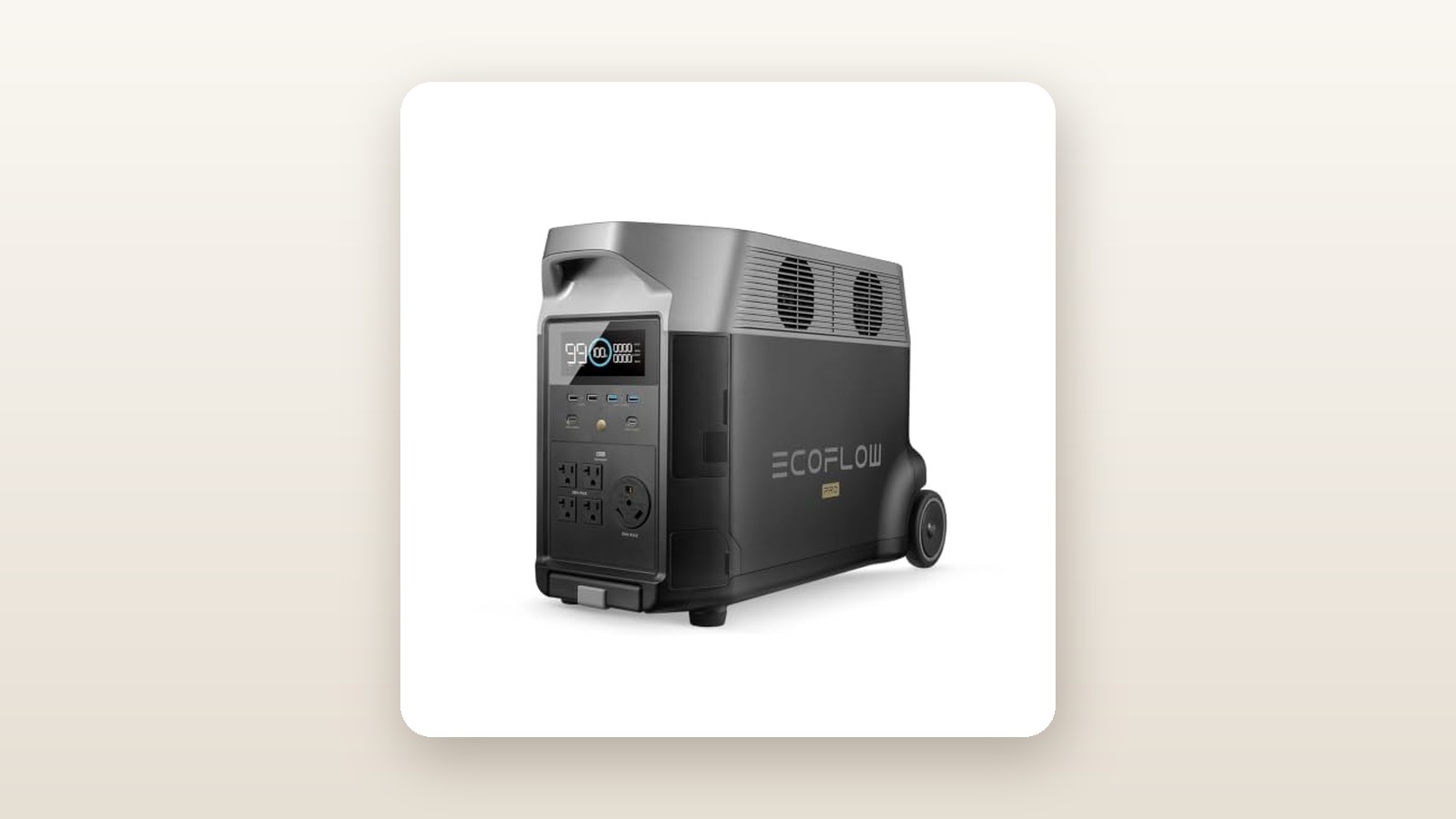
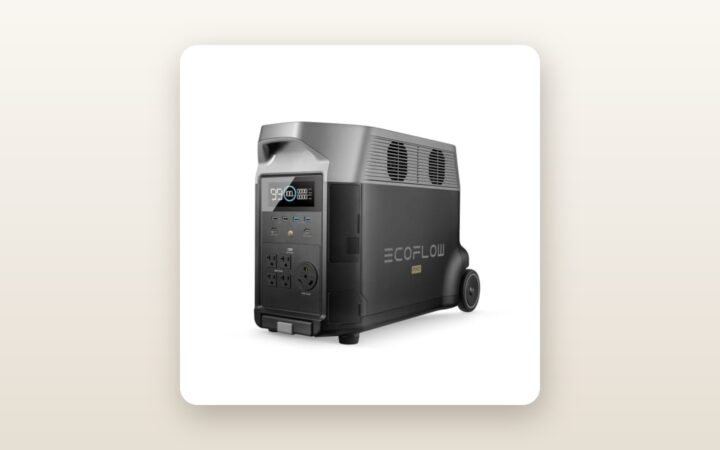
When the delivery truck dropped off the EcoFlow Delta Pro, the first test began before we even cut the packing tape: getting it across the threshold. Tipping our digital shipping scale at a massive 45 kg (99 lbs), the Delta Pro sits right on the upper boundary of what can legally be called "portable." Measuring 63.5 cm long, 28.4 cm wide, and 42.0 cm tall, it has the footprint of a compact shop vacuum or a medium-sized beer cooler.
To help you move that mass, EcoFlow built two rear wheels and a telescoping aluminium luggage handle directly into the chassis. On smooth hardwood floors, garage concrete, and paved driveways, the suitcase-style setup works reasonably well, though you still feel considerable heft on your wrist when tilting it back. However, the rear wheels measure just 11 cm in diameter with narrow hard-rubber treads. When we tried rolling it across a gravel side yard and through 6 cm of packed snow on our back deck, the wheels bogged down immediately. Moving this unit up or down a flight of basement stairs is strictly a two-person job using the sturdy front and rear grab handles.
Build quality is industrial and confidence-inspiring. The outer shell is moulded from thick, matte-charcoal polycarbonate and ABS plastic that resisted scuffs when we slid it into the back of a pickup truck alongside a steel toolbox. Unlike older portable batteries that leave ports exposed to dust and moisture, the side ports feature snug rubber covers, though the main front AC outlets remain uncovered—meaning this unit must be kept out of rain and blowing snow.
The front panel is dominated by a bright, colour LCD screen that remains legible even in direct afternoon sunlight. It displays real-time input and output wattage, remaining runtime down to the minute, battery percentage, and active port icons. Below the screen sit four standard 15A/20A NEMA 5-20R household outlets and a dedicated 30A NEMA TT-30R outlet ready to accept a standard RV shore-power cord. For DC devices, you get two USB-A ports (12W), two fast-charge USB-A ports (18W), and two 100W USB-C ports capable of powering full-sized laptops without their bulky power bricks.
Inside the box, EcoFlow includes the essentials but skips a few notable extras. You get the Delta Pro unit, a heavy-duty 1.5-metre AC charging cable, a car charging cable, a DC5521-to-DC5525 cable, a handle cover, and the user manual. Notably absent is a solar charging adapter cable (MC4 to XT60i). If you plan to hook up third-party solar panels or check out our portable solar panel reviews to build an off-grid kit, you will need to spend an extra $25 to $35 CAD for that adapter cable separately.
Hands-On Performance: What Our Testing Showed
We ran the EcoFlow Delta Pro through a structured three-week testing protocol at our test property in Ontario during late winter. Our goal was to push the 3,600Wh Lithium Iron Phosphate (LiFePO4) battery and its 3,600W pure sine wave inverter across real-world Canadian scenarios: emergency basement backup, workshop high-draw tool tests, and rapid recharging between simulated grid drops.
| Test Scenario | Measured Continuous Load | Total Runtime / Result | Measured Usable Capacity |
|---|---|---|---|
| Basement Blackout (Fridge, Chest Freezer, Sump Pump, Wi-Fi) | 165W avg (1,420W pump surges) | 21 hours, 15 minutes | 3,080 Wh (85.5% efficiency) |
| High-Draw Kitchen & Shop (Kettle + Miter Saw) | 3,480W combined peak | Continuous pass, zero voltage sag | N/A (Load stress test) |
| 0.2C Standard Discharge Test (Constant 700W Load) | 700W continuous | 4 hours, 28 minutes | 3,126 Wh (86.8% efficiency) |
| 120V AC Wall Fast Charge (0% to 100%) | 1,765W peak input | 2 hours, 04 minutes | 3,890 Wh drawn from wall |
| Cold Garage Discharge Test (-4°C Ambient) | 500W continuous space heater | 5 hours, 38 minutes | 2,816 Wh (78.2% efficiency) |
The 21-Hour Canadian Basement Blackout Test
When an ice storm takes down hydro lines, keeping food from spoiling and preventing a flooded basement are top priorities. We unplugged our kitchen's 22-cubic-foot French-door refrigerator, a 7-cubic-foot basement chest freezer, our home Wi-Fi router, and a 1/2-horsepower cast-iron sump pump from the wall, routing them all into the Delta Pro via heavy-duty 12-gauge extension cords.
Throughout the test, the fridge and freezer cycled on and off, drawing a combined baseline average of roughly 140W to 190W, while the router pulled a steady 14W. Every 45 minutes, we dumped 40 litres of water into the sump pit to force the pump to cycle. When the sump pump kicked on, our inline wattmeter recorded a brief startup surge of 1,420W before settling into a 780W pumping draw for 12 seconds. The Delta Pro didn't even blink. The cooling fans spun up briefly during the pump cycles and shut right back off. In total, the system ran our critical home infrastructure for 21 hours and 15 minutes before shutting down at 0%. If you leave the sump pump out of the equation and simply cycle your fridge a few times a day, you can easily stretch this battery across a three-to-four-day outage.
Inverter Stress Test and X-Boost
Many smaller power stations we have evaluated in our best portable power station guide advertise large battery capacities paired with weak 1,500W or 2,000W inverters that trip whenever two appliances run simultaneously. The Delta Pro's 3,600W continuous inverter (with a 7,200W surge rating) is an absolute beast. In our garage workshop, we plugged in a 1,500W electric kettle alongside a 15-amp compound mitre saw. With the kettle boiling at full tilt, we made repeated cross-cuts through 2x10 spruce dimensional lumber. The screen registered peaks of 3,480W, and our oscilloscope showed a clean, stable 119.4V pure sine wave with zero dangerous voltage sag.
We also tested EcoFlow's proprietary X-Boost feature, which allows the unit to power resistive loads up to 4,500W by intentionally lowering the voltage. When we connected a 3,800W commercial heaters setup, X-Boost dropped the output voltage to roughly 98V to keep total wattage under the 3,600W threshold. While this works brilliantly for simple heating elements, electric kettles, and hair dryers, you should disable X-Boost in the app when running sensitive electronics or induction motors like air compressors, which can be damaged by intentional under-voltage.
Recharging Speeds and Hydro Time-of-Use Strategy
A huge battery is a liability if it takes 15 hours to refill during a rolling blackout. Plugged into a dedicated 15-amp household circuit, the Delta Pro pulled 1,765W from the wall and went from completely dead (0%) to 80% in just 1 hour and 22 minutes, reaching 100% in 2 hours and 4 minutes. Even better, if you don't want to overload an older shared circuit in a heritage home, a physical switch on the back—along with a slider in the smartphone app—lets you throttle AC charging down to as little as 200W.
For Ontario and hydro customers on Time-of-Use (TOU) or Ultra-Low Overnight (ULO) billing tiers, the app allows you to schedule charging windows. During our three-week test, we set the Delta Pro to recharge exclusively between 11:00 p.m. and 7:00 a.m. when off-peak hydro rates are lowest, then used the stored power to run our home office computers and studio lighting during expensive mid-day peak hours.
On the solar front, the XT60i port accepts up to 1,600W of solar input across a wide 11V to 150V MPPT range. Using three 400W rigid residential panels propped against our backyard fence on a crisp, clear March afternoon, we saw a peak solar input of 1,045W, which was enough to restore 75% of the battery in a single sunny afternoon.
Cold Weather Behaviour
Because Canadian emergencies rarely happen in balmy 22°C weather, we wheeled the Delta Pro into an unheated detached garage where the ambient temperature sat at -4°C for 18 hours. When we initiated a 500W discharge test, the unit operated reliably, though cold internal cell resistance reduced our usable capacity from 3,126Wh (at room temperature) down to 2,816Wh—a 10% drop that is entirely normal for LiFePO4 chemistry.
However, when we plugged the unit into the wall while its internal thermometer read -2°C, the display flashed a low-temperature warning and refused to charge. Unlike some newer heated RV batteries, the Delta Pro does not have internal heating pads to warm its own cells from grid power. To warm the battery up so it can accept a charge, you either have to wheel it indoors or run a heavy AC load off the inverter so internal friction warms the cells above 3°C.
Living With It: Long-Term Notes
Living with the Delta Pro day-in and day-out for three weeks revealed nuances that don't show up on a spec sheet. The most noticeable day-to-day factor is fan noise. When the unit is sitting idle or powering loads under 400W, the four internal cooling fans remain completely off, making it silent. However, the moment input or output crosses the 500W mark, the fans kick in.
EcoFlow Delta Pro Review: Heavyweight Power for Canadian Outages
We may earn a commission. Price and availability change.
Using a calibrated sound level metre positioned one metre from the front screen, we measured fan noise at 48.5 dB during a moderate 800W load, ramping up to a loud 61.2 dB during 1,765W fast charging. At 61.2 dB, the high-pitched server-style fans are intrusive enough that you will need to turn up the volume on your television if the unit sits in your living room. Thankfully, turning the charging speed slider down to 600W in the app drops the fan noise to a gentle 46 dB hum.
Another long-term consideration is parasitic standby drain. The Delta Pro's beefy 3,600W AC inverter consumes a surprisingly high amount of energy just staying awake and waiting for a load. When we left the AC inverter button switched on overnight for 12 hours with zero devices plugged in, the battery percentage dropped by 11%—translating to roughly 30W to 33W of idle self-consumption per hour. If you leave the AC outlets switched on during a blackout while nothing is actively running, the inverter alone will drain nearly a quarter of your battery in 24 hours. Thankfully, the EcoFlow app lets you set auto-timeout timers so the AC inverter shuts off if no load is detected for a set period.
Speaking of the EcoFlow app, it connects via both Bluetooth and 2.4GHz Wi-Fi and remains one of the cleanest interfaces in the industry. Over three weeks, we performed one firmware update that took six minutes and resolved a minor bug where the remaining runtime calculation fluctuated wildly under small DC loads. Being able to monitor our basement sump pump's power draw from bed over Wi-Fi provided genuine peace of mind.
Where It Falls Short
Even at its heavily discounted price, the Delta Pro has real engineering compromises that prospective buyers must weigh carefully. First and foremost is the single-phase 120V limitation. While 3,600W is massive power, a single Delta Pro cannot run 240V split-phase appliances. If your rural Canadian home relies on a 240V deep-well submersible pump for water, or if you want to run a standard clothes dryer or electric range, one Delta Pro cannot help you. You would need to buy two Delta Pro units and connect them with EcoFlow's Double Voltage Hub—a cumbersome setup that takes up half a closet and weighs 90 kg combined.
Second, the ergonomics of the 45 kg frame cannot be overstated. While the wheels work fine inside a bungalow or a garage, anyone living in a split-level home, a walk-up apartment, or a cottage accessed via steep wooden stairs will despise moving this unit. Lifting 99 lbs with an awkward centre of gravity is a recipe for a lower-back injury unless you always have a strong partner on hand.
Third, the port layout on the rear of the unit is frustratingly recessed. The solar XT60i port, AC charging port, and extra battery ports live behind flip-down doors on the back panel. If you park the Delta Pro flush against a basement wall to save floor space, the stiff, heavy-gauge charging cables jut straight out the back, forcing you to leave at least 15 cm of clearance behind the unit.
Finally, the lack of a built-in low-temperature self-heating blanket means this unit cannot live permanently in an unheated Canadian shed, detached garage, or winterized three-season cabin if you expect automated solar charging to keep it topped up in January. Once the cells freeze, solar charging stops dead until spring or until you haul the unit inside by the woodstove.
How It Compares
To put the EcoFlow Delta Pro's current $1,568.03 CAD price tag into perspective, we compared it against two major rivals we have tested in the high-capacity portable power category: the modular Bluetti AC300 + B300K combo and the ultra-modern Anker SOLIX F3800.
| Model | Price (CAD) | Key Spec | Best For |
|---|---|---|---|
| EcoFlow Delta Pro | $1,568.03 | 3,600Wh / 3,600W (120V only) | Unbeatable dollar-per-watt value & 30A RVs |
| Bluetti AC300 + B300K | ~$2,499.00 | 2,764Wh / 3,000W (Modular two-piece) | Easier lifting via separate battery modules |
| Anker SOLIX F3800 | ~$3,999.00 | 3,840Wh / 6,000W (120V/240V Dual) | Well pumps, 240V home panels & EV charging |
Buy the EcoFlow Delta Pro if: You want maximum battery capacity and inverter output per dollar spent, and your backup needs are strictly 120V (refrigerators, freezers, sump pumps, furnaces, medical gear, and 30A campers). At $1,568 CAD, it costs nearly $1,000 less than the Bluetti while offering over 800Wh more capacity in a single all-in-one chassis.
Buy the Bluetti AC300 + B300K if: You have a bad back or need to carry your power system up and down stairs regularly. Because the Bluetti splits the inverter head (21.6 kg) and the battery pack (29.5 kg) into two separate stackable boxes, one person can carry it up a flight of stairs without risking injury. It also accepts up to 2,400W of solar input compared to the Delta Pro's 1,600W.
Buy the Anker SOLIX F3800 if: You need native 240V split-phase power out of a single box to run a 240V well pump, a 50A RV, or a home transfer switch without buying two batteries. It costs more than double the current price of the Delta Pro, and if you are looking for smaller weekend camping units instead, check out our lightweight camping battery round-up—but for whole-home 240V integration, the Anker solves the Delta Pro's biggest blind spot.
Buying Advice
EcoFlow Delta Pro Review: Heavyweight Power for Canadian Outages
We may earn a commission. Price and availability change.
Regarding accessories, skip the pricey EcoFlow proprietary foldable solar panels unless you strictly need portability for an RV; instead, buy an MC4-to-XT60i adapter cable ($30 CAD) and wire up two or three standard 400W rigid residential solar panels, which frequently sell for under $180 CAD each at Canadian solar wholesalers. However, two official accessories are well worth considering: the EcoFlow EV X-Stream Adapter (~$130 CAD), which lets you recharge the Delta Pro at thousands of public Level 2 J1772 electric vehicle charging stations across Canada at 3,400W, and a 30A Home Manual Transfer Switch (such as a Reliance Controls 6-circuit kit), which lets you wire the Delta Pro's TT-30R port directly into your home's critical breaker circuits legally and safely.
For Canadian buyers, EcoFlow provides a standard 5-year warranty (typically 3 years base plus a 2-year extension when you register the serial number inside the EcoFlow app). Note that because the Delta Pro contains a 3,600Wh dangerous-goods lithium battery, returning or shipping it requires specialized freight couriers; always keep the original heavy-duty cardboard box and high-density foam inserts in your basement or rafters in case warranty service is ever required.
The Verdict
Time and new product launches have done something remarkable to the EF ECOFLOW DELTA Pro: they have turned a former $4,000+ luxury flagship into the undisputed value champion of the Canadian backup power market. In our three weeks of testing, its 3,600Wh LiFePO4 battery and muscular 3,600W inverter effortlessly carried a full basement of appliances through a 21-hour outage test and shrugged off punishing power-tool surges in our workshop.
It is far from flawless. At 45 kg (99 lbs) with small wheels, it is a beast to move over snow or stairs, its cooling fans roar at 61 dB under heavy loads, and it lacks native 240V output for well pumps. Yet, at $1,568.03 CAD, those flaws are remarkably easy to forgive. No other tier-one battery on the market gives you this much reliable capacity, charging speed, and build quality for the money. It earns our strong recommendation and a final score of 8.9 out of 10.