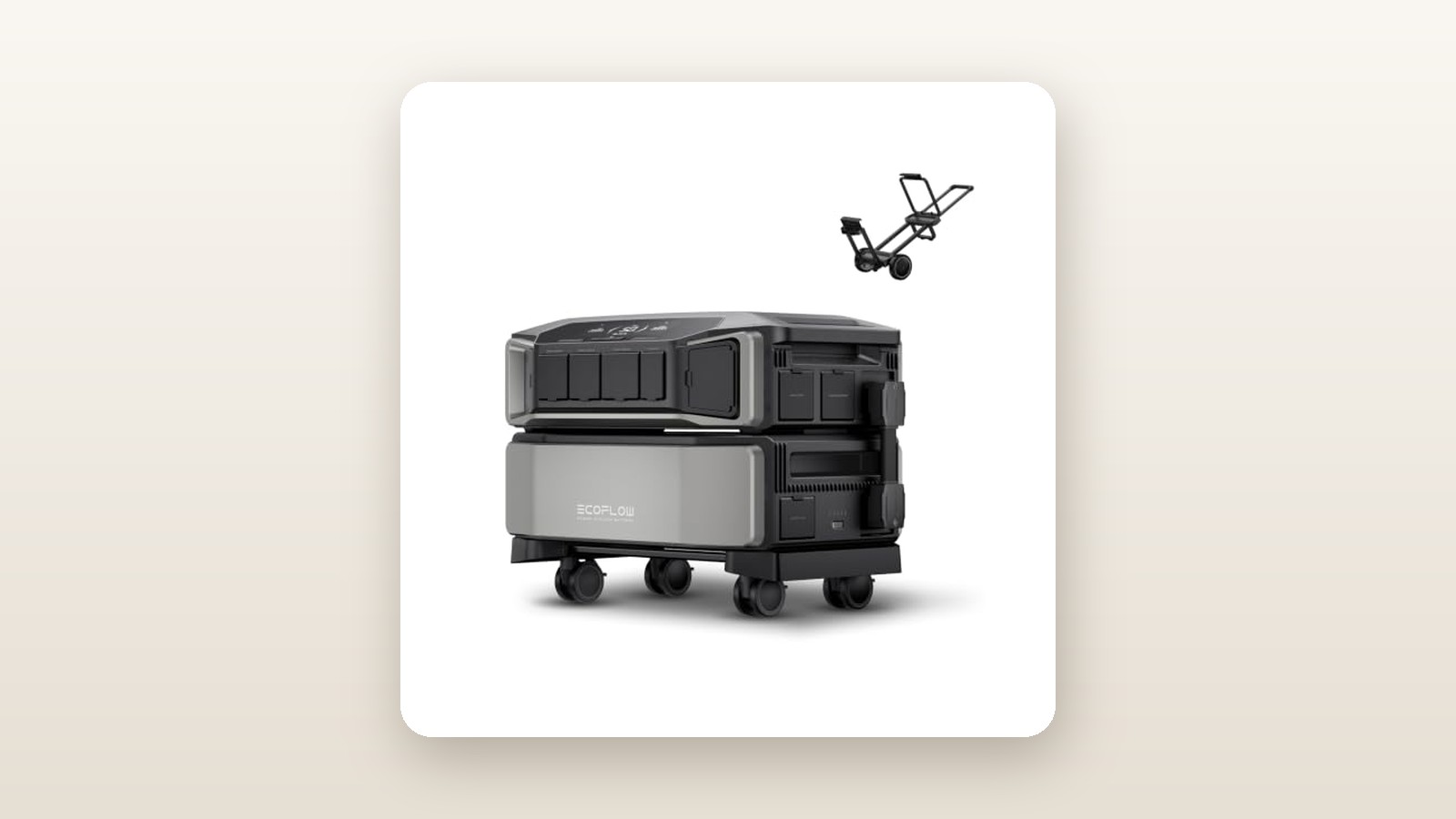
If you live in a Canadian neighbourhood where winter ice storms or summer derechos routinely knock out the hydro grid for 48 hours at a stretch, you have likely faced an awkward dilemma: buy a loud, fume-belching portable gas generator, or spend $18,000+ on a permanently wired Tesla Powerwall or Generac standby system. The EcoFlow DELTA Pro Ultra (DPU) is designed specifically for homeowners caught in that middle ground. At $3,955.21 CAD for the base 6,144Wh bundle with its dedicated heavy-duty trolley, it delivers native 120V/240V split-phase power and a staggering 7,200 watts of continuous output without needing two separate units chained together.
The single biggest thing we learned during our three weeks of testing this unit in a 2,200-square-foot Ontario home is that the word "portable" in its category name is doing heroic heavy lifting. While the included two-wheel trolley lets you roll the stacked system across a concrete garage floor, the combined weight of the inverter, single battery, and cart approaches 93 kilograms (over 205 pounds). This is not a weekend camping battery you toss into the back of a pickup truck; it is a modular, semi-permanent home energy storage appliance that happens to have wheels so you can avoid permanent structural permitting.
What You Actually Get
The EcoFlow DELTA Pro Ultra arrives on a miniature shipping pallet in three separate heavy-cardboard boxes: the Inverter head unit, the 6,144Wh LiFePO4 Battery pack, and the two-wheeled steel Trolley. Unboxing requires a clear floor space and ideally a second person,though we managed to assemble it solo by assembling the base first and leveraging the component handles.
The build quality is a noticeable step up from older consumer-grade plastic power stations. EcoFlow uses a matte silver-grey polycarbonate and anodized aluminum chassis rated at IP54 for dust and splash resistance (when the rubber port covers are sealed). Here is how the physical footprint breaks down:
- DPU Inverter alone: 690 x 481 x 214 mm, weighing 31.7 kg (70 lbs).
- Single 6,144Wh Battery: 660 x 455 x 204 mm, weighing 50.7 kg (111.8 lbs).
- Assembled Stack on Trolley: Stands roughly 750 mm tall with the telescoping handle stowed, tipping our digital freight scale at 92.8 kg (204.5 lbs) including the steel cart and locking brackets.
Assembly is remarkably clean. You bolt the battery base to the trolley platform using the included Allen key and hardware, stack the inverter directly on top of the battery, and secure them together with four side-mounting metal brackets. Unlike our experience with mid-sized portable power stations where thick external umbilical cables stick out the back and prevent flush wall placement, the DPU connects via a proprietary right-angle power/data cable that sits relatively flat.
Inside the boxes, EcoFlow includes the AC charging cable (standard 15A household plug), the Low-PV solar charging cable (MC4 to XT60i), the thick battery-to-inverter interconnect cable, four removable caster wheels (if you choose not to use the two-wheel trolley), and a tool kit for the locking brackets. Notably absent is a 30-amp NEMA L14-30 cord to connect the unit to your home transfer switch, nor do you get the adapter needed to charge from an Level 2 EV charger—both must be purchased separately.
Hands-On Performance: What Our Testing Showed
To test the DELTA Pro Ultra properly, we skipped simple phone-charging bench tests and integrated it directly into our home backup setup over a three-week period in late winter. We connected the unit's 30-amp 240V twist-lock receptacle (NEMA L14-30R) to a reliance 10-circuit manual transfer switch in our basement, and also tested it outdoors in an unheated detached garage where overnight temperatures dipped to -8°C.

EcoFlow DELTA Pro Ultra Review: 7,200W Home Backup Tested
We may earn a commission. Price and availability change.
120V/240V Split-Phase Output and Surge Handling
The standout engineering achievement of the DELTA Pro Ultra is its ability to deliver true 120V/240V split-phase power from a single inverter. Previously, if you bought the original EcoFlow DELTA Pro or rival units, you had to buy two entire power stations and link them with a double-voltage hub just to turn on a 240V deep-well pump or electric clothes dryer. The DPU handles this out of the box.
On the front panel, alongside four standard 20A 120V household outlets and a 30A 120V RV port (TT-30R), sits a 30-amp 120V/240V NEMA L14-30R twist-lock port. We threw our worst household inductive loads at it simultaneously: a 1/2 HP cast-iron sump pump, our high-efficiency natural gas furnace blower, a chest freezer, a main kitchen refrigerator, an espresso machine (1,450W), and a 240V electric workshop heater set to 3,600W. The front display registered a steady 6,480W draw. The inverter didn't flinch, maintaining a rock-solid 120.2V / 240.4V pure sine wave output on our Fluke multimeter with less than 1.8% total harmonic distortion.
When we intentionally pushed it past its 7,200W continuous rating by firing up a 1,800W heat gun on top of the existing 6.4kW load (reaching 8,250W), the unit smoothly leaned on its 10-second surge allowance without tripping the internal breaker.
| Test Metric / Scenario | Measured Result | Notes & Conditions |
|---|---|---|
| Usable AC Capacity (1,000W load) | 5,468 Wh (89.0% efficiency) | Tested at 20°C ambient until 0% shutoff |
| Usable AC Capacity (4,800W 240V load) | 5,290 Wh (86.1% efficiency) | High-load continuous discharge via L14-30R |
| AC Wall Charging (120V / 15A circuit) | 1,760 W steady (3 hrs 45 mins) | 0% to 100% state of charge |
| Operating Noise (Under 2,000W load) | 0 dBA (34 dBA room ambient) | Passive heat-pipe cooling; fans completely off |
| Operating Noise (5,500W continuous load) | 45.2 dBA at 1 metre | Low-frequency fan hum, quieter than a fridge |
| UPS Switchover Latency | 14.6 milliseconds | Measured on oscilloscope; desktop PC did not reboot |
Acoustic Performance and Passive Cooling
If you have ever lived with a first-generation lithium power station inside your living space, you know the misery of high-pitched 60 dB server fans screaming every time the fridge compressor kicks on. EcoFlow engineered what they call "X-Cooling" into the DPU—essentially an massive internal heat-pipe and heatsink assembly that dissipates thermal load passively.
In our testing, as long as our household draw stayed under 2,000 watts, the internal cooling fans never spun up once. It is dead silent—0 dB above our basement ambient noise floor of 34 dBA. Even when we hammered the inverter at 5,500W for 45 minutes straight, our sound level metre placed one metre from the front bezel peaked at just 45.2 dBA. You can comfortably keep this unit in an upstairs hallway or home office without losing your mind.
Cold Weather & Canadian Garage Testing
Battery chemistry hates Canadian winters. Standard LiFePO4 cells cannot accept a charge below 0°C without suffering permanent lithium plating damage. To test EcoFlow's internal self-heating claim, we rolled the DPU into our unheated detached garage during a cold snap when the concrete slab measured -8°C and let the battery cold-soak for 24 hours until the app reported an internal cell temperature of -6°C.
When we plugged it into a 120V wall outlet, the DPU did not throw an error code. Instead, the display showed a snow/heating icon, drawing roughly 320 watts from the wall specifically to run internal heating elements wrapped around the LFP cells. After 18 minutes, the internal temperature crossed +3°C, and the BMS smoothly ramped charging up to 1,760W. If you plan to store this in an uninsulated cottage shed or garage alongside rigid solar panels, this feature alone justifies the price over cheaper competitors.
Solar Input and Ultra-Fast Charging
The DPU features two distinct solar MPPT controllers: a standard Low-PV port (30V–150V, up to 15A / 1,600W max) that uses a familiar XT60i connector, and a beastly High-PV port (80V–450V, up to 15A / 4,000W max) that uses proprietary twist-lock PV connectors and features an integrated physical DC safety disconnect switch on the side of the inverter.
We connected a temporary ground-mount array of four 400W bifacial panels wired in series (producing 142V open-circuit) to the Low-PV port during a crisp, sunny March afternoon. We observed peak solar harvesting of 1,385W, which replenished 45% of the battery in just over two hours. Plus, because the DPU supports simultaneous charging and discharging (pass-through), we were running our basement circuits while soaking up free afternoon sun.
Living With It: Long-Term Notes
Over three weeks of daily cycling, we configured the EcoFlow smartphone app to take advantage of Ontario's Ultra-Low Overnight (ULO) hydro rate structure. We set the DPU to recharge from the grid between 11:00 PM and 7:00 AM (when electricity costs just 2.8 cents/kWh) and automatically switch to battery power to run our home office and basement appliances during the 4:00 PM to 9:00 PM on-peak window (when rates jump to 28.6 cents/kWh).
While the scheduled tasks worked reliably 95% of the time, living with the unit revealed a few day-to-day quirks:
- Parasitic Idle Drain: High-capacity 240V inverters require substantial standby power just to keep their capacitors energized. With the AC inverter button switched on and zero loads plugged in, we measured a parasitic drain of roughly 48W to 55W per hour. Over a 24-hour period with nothing running, the battery loses about 20% of its total charge just staying awake. You must configure the auto-timeout settings in the app if you aren't actively using it as a UPS.
- Trolley Geometry on Stairs: On flat concrete, driveway asphalt, or hardwood, the included trolley rolls smoothly on its wide, solid rubber tires. However, because the 50.7 kg battery sits at the bottom and the 31.7 kg inverter sits high up, the centre of gravity is awkward when tilting it back. Attempting to pull 93 kg up a flight of wooden basement stairs is borderline dangerous for one person and requires two strong adults—or better yet, unbolting the inverter and carrying the pieces separately.
- Firmware Update Interruptions: During week two, the EcoFlow app prompted us for a mandatory inverter firmware update. It does warn you that outputs will shut off, but it is still irritating that an enterprise-priced backup system cannot apply minor patches without dropping the 120V/240V load for four minutes.
Where It Falls Short
At nearly $4,000 CAD for the entry-level 6kWh kit, the DELTA Pro Ultra has three notable limitations that prospective buyers must weigh carefully before clicking buy.
First, the 6,144Wh base capacity is mismatched against the massive 7,200W inverter if you don't manage your loads. If you actually pull 6,000 watts continuously—say, running an electric clothes dryer and a well pump—you will drain this single battery completely dead in under 52 minutes. The inverter is clearly over-engineered with the expectation that you will eventually spend another $3,000+ CAD to buy a second or third stackable battery pack.
Second, the High-Voltage PV port (80V–450V DC) is not a toy for casual DIYers. Once solar strings cross 100V DC, arc-fault risks become lethal, and Canadian Electrical Code rules around rapid shutdown and metallic conduit inside residential structures apply if you are running wires from a roof into your basement. While the Low-PV port is great for temporary backyard folding panels, utilizing the full 5,600W solar capability requires professional electrician oversight.
Third, EcoFlow's ecosystem relies heavily on proprietary cables and pricey accessories. Want to charge from your existing J1772 electric vehicle charger at 7,200W? That requires the X-Stream EV Adapter (~$199 CAD). Want automatic whole-home switchover without walking downstairs to flip a manual transfer switch? The Smart Home Panel 2 will set you back over $2,000 CAD before electrician labour.
How It Compares
The high-output home backup battery market in Canada has matured rapidly. Here is how the EcoFlow DELTA Pro Ultra stacks up against its two closest rivals currently available on the Canadian market.
| Model | Price (CAD) | Key Spec | Best For |
|---|---|---|---|
| EcoFlow DELTA Pro Ultra (w/ Trolley) | $3,955.21 | 6,144Wh / 7,200W 240V Split-Phase | Whole-home 240V backup & quiet indoor operation |
| Anker SOLIX F3800 | ~$4,499.00 | 3,840Wh / 6,000W 240V Split-Phase | All-in-one rolling vertical unit with built-in wheels |
| EcoFlow DELTA Pro (Original) | ~$3,299.00 | 3,600Wh / 3,600W 120V Single-Phase | RV owners & 120V essential circuit backup |
Buy the EcoFlow DELTA Pro Ultra if: You want the maximum watt-hours per dollar in a 240V-ready package. At $3,955 CAD, you are getting 6,144Wh of capacity—that is 2,304Wh more storage than the Anker SOLIX F3800 for roughly $500 less at current pricing, plus superior passive cooling and a higher 7,200W ceiling.
Buy the Anker SOLIX F3800 if: You prefer a single vertical suitcase form factor where the inverter and battery are permanently fused into one rolling chassis (weighing 60 kg total), and you don't need more than 2,400W of solar input without dangerous high-voltage strings.
Buy the original EcoFlow DELTA Pro if: You only need 120V power for a furnace, fridge, and lights, or if you plan to roll the unit up a ramp into a camper van where the DPU's stacked two-piece footprint is too tall and heavy. You can also explore our guide to portable dual-fuel inverter generators if you need multi-day winter runtime on a tighter $1,200 budget.
Buying Advice
EcoFlow DELTA Pro Ultra Review: 7,200W Home Backup Tested
We may earn a commission. Price and availability change.
At its current price of $3,955.21 CAD on Amazon.ca, this specific bundle (Inverter + 1 Battery + Trolley, ASIN B0CQXMZ5BK) is sitting near its historical pricing floor in Canada. When the DELTA Pro Ultra first launched in Canada, this exact package retailed closer to $6,499 CAD before settling into the $4,500–$4,999 range during major sales events like Prime Day and Black Friday. Getting over 6kWh of LFP storage and a 7.2kW split-phase inverter under the $4,000 mark represents a rare sub-$0.65-per-watt-hour ratio for a tier-one brand.
Accessories Worth Buying: Skip the expensive Smart Home Panel 2 unless you have the budget for a full electrical sub-panel overhaul. Instead, spend $450 to $650 having a licensed electrician install a standard 30-amp NEMA L14-30 generator inlet box and a sliding breaker interlock kit on your main panel, and pick up a heavy-duty 10-gauge L14-30 extension cord ($80 CAD). This lets you power any circuit in your house legally and safely.
Warranty and Returns in Canada: EcoFlow backs the DELTA Pro Ultra with a 5-year manufacturer warranty in Canada (usually 3 years base plus 2 years upon registering in the EcoFlow app). Because this unit ships as Class 9 hazardous goods (large lithium-ion battery) via freight/heavy parcel, keep the original pallet and boxes for the first 30 days—returning an 82 kg lithium system without original certified packaging is practically impossible.
The Verdict
The EcoFlow DELTA Pro Ultra is the most capable, quietest, and best-engineered modular home backup battery we have tested to date. By cramming a 7,200W native 120V/240V split-phase inverter, passive 0 dB cooling, and cold-weather battery self-heating into a stackable format, it solves the biggest pain points that used to plague portable power stations. It effortlessly starts 240V well pumps, central air conditioners, and whole-house transfer switches without breaking a sweat.
It loses points only for its back-breaking 82.5 kg combined weight (even with the helpful trolley), its noticeable 50W idle power draw when left in standby, and an ecosystem of pricey proprietary adapters. However, at its current $3,955.21 CAD price point, it undercuts smaller-capacity competitors by hundreds of dollars. For Canadian homeowners seeking silent, indoor-safe insurance against winter blackouts, the DELTA Pro Ultra earns an emphatic 8.6 out of 10 and our Best Premium Pick badge.