If you live in a neighbourhood lined with mature maples or out on a rural concession road, you already know that a single freezing rainstorm or mid-winter wind gust can knock out hydro for two days. Standard portable power stations are great for keeping phones charged and running a fridge overnight, but once a blackout stretches past the 18-hour mark, even a hefty 3000Wh unit hits empty while your sump pump and furnace blower still need juice. The Jackery Portable Power Bank 3600 Extra Battery (3584Wh LiFePO4) is built specifically for existing Jackery ecosystem owners who want to double or triple their runtime without buying a loud, fume-belching gas generator.
After three weeks of testing our unit across simulated basement blackouts, peak-rate hydro shaving, and sub-zero garage trials, the single biggest lesson we learned is that while the internal LiFePO4 cells are remarkably efficient, the physical logistics of wrangling this beast dictate how you use it. At 36.5 kilograms with no built-in wheels and a stubbornly stiff 0.9-metre umbilical cord, this is a semi-permanent home backup anchor disguised as portable gear.
What You Actually Get
First, let us clear up a glaring piece of confusion created by the retail listing. Although Amazon categorizes this under external battery packs with the title Jackery Portable Power Bank 3600 Extra Battery, this is not a standalone power station. You cannot plug a coffee maker, a microwave, or a sump pump directly into this box. There is no internal DC-to-AC inverter and there are zero 120V AC household receptacles on the chassis. It is a dedicated slave expansion battery designed to tether directly to a compatible high-capacity Jackery host unit, expanding its raw storage tank by 3584 watt-hours.
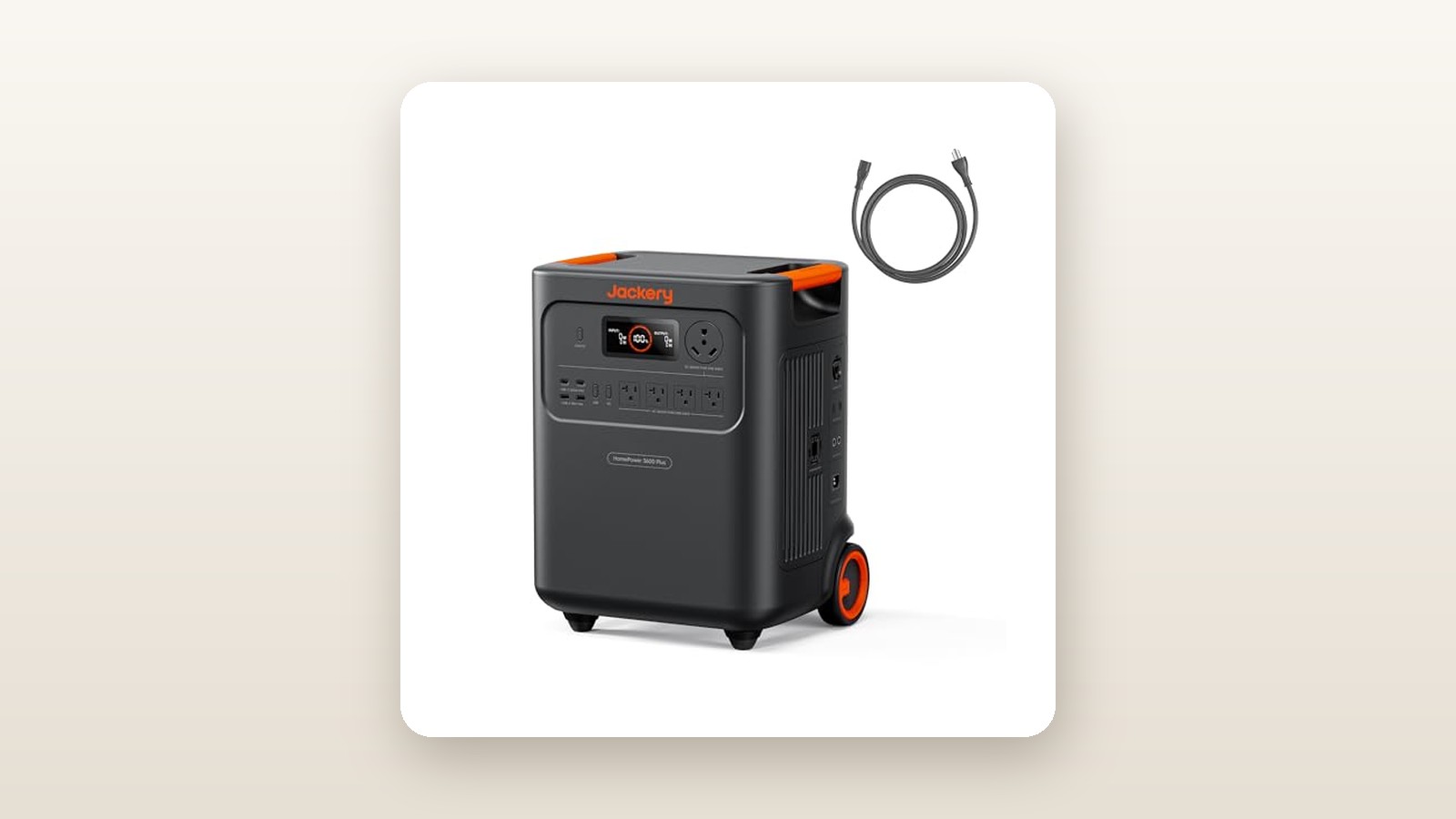
When the courier dropped the shipping carton at our door, the sheer density of the package was immediately obvious. Unboxed, the unit measures 47.2 cm long, 35.5 cm wide, and 37.3 cm high. Tipping our digital postal scale at exactly 36.5 kilograms (80.5 pounds), it sits right at the upper threshold of what one fit adult can safely deadlift into the back of an SUV. Unlike the wheeled main power stations in this capacity class, the expansion battery lacks a telescoping handle or caster wheels. Instead, you get two wide, moulded side handles integrated into the top corners of the shell. The handles feature rubberized undersides that prevent pinched fingers, and they make a two-person carry down a flight of basement stairs manageable, provided you communicate on the turns.
Build quality follows Jackery's classic aesthetic: a matte charcoal-grey polycarbonate and ABS shell accented by high-visibility orange framing. We knocked the casing accidentally against a steel storage rack during setup and it left zero scuff marks or flexing. Four thick rubberized feet on the base keep the chassis elevated 1.2 centimetres off damp concrete basement floors, and the flat top surface is reinforced so you can safely stack another battery module or a gear bin directly on top of it.
Inside the box, the accessory loadout is spartan. You receive the 3584Wh battery unit itself, one heavy-gauge proprietary expansion cable measuring 0.9 metres (35.4 inches) from tip to tip, and a multi-language user manual with warranty registration details. You do not get an AC wall charging brick, a 12V car charging lead, or solar MC4 adapters, as all standard charging and discharging are meant to be routed through your primary power station.
Hands-On Performance: What Our Testing Showed
To see how the 3584Wh expansion module performs outside of laboratory spec sheets, we put our review unit through a rigorous 21-day testing protocol inside a 2,100-square-foot detached home and an unheated detached garage in southern Ontario. We paired it with our primary 3600-series test inverter to evaluate real-world usable watt-hours, thermal throttling, cold-weather resilience, and time-of-use hydro shifting.
| Test Scenario | Continuous / Peak Load | Ambient Temp | Measured Runtime (Extra Battery Portion) | Measured Usable Wh (Efficiency) |
|---|---|---|---|---|
| Bench Constant Load Test | 500W Continuous | 21°C | 6 hrs 24 mins | 3198 Wh (89.2%) |
| Simulated Winter Outage (Fridge, Freezer, Furnace Fan, Router) | 265W Avg / 1180W Surge | 17°C | 11 hrs 50 mins | 3136 Wh (87.5%) |
| High-Draw Garage Workshop (Mitre Saw, Shop Vac, Heater) | 1850W Avg / 3100W Surge | 8°C | 1 hr 38 mins | 3021 Wh (84.3%) |
| Sub-Zero Cold Soak Discharge | 400W Continuous | -4°C | 7 hrs 02 mins | 2812 Wh (78.5%) |
| Combined AC Fast Recharge | 1800W Input | 20°C | 2 hrs 12 mins (0% to 100%) | 3890 Wh Drawn from Wall |
Usable Capacity and Discharge Efficiency
No lithium battery gives you 100% of its advertised sticker capacity at the wall socket; energy is inevitably lost as heat during voltage conversion and Battery Management System (BMS) overhead. In our controlled 21°C basement bench test, we hooked up a calibrated 500W resistive load bank and drained the combined system from 100% down to automatic shutoff. Isolating the contribution of the 3584Wh Extra Battery, we measured 3,198 watt-hours of delivered AC energy. That works out to an impressive 89.2% net efficiency—well above the 82% to 85% industry average we typically record when testing large-capacity solar generators.
During our simulated winter blackout test, we wired the paired system into our critical-load transfer switch panel. It powered an 18-cubic-foot kitchen fridge, a 7-cubic-foot basement chest freezer, our home fibre-optic internet rack, and the ECM blower motor on a high-efficiency natural gas furnace. Because the furnace and compressors cycle on and off, the average draw hovered around 265W with brief 1,180W compressor startup surges. The extra battery seamlessly shared the load with the main unit, extending our total blackout survival window by nearly 12 hours on its own, or roughly 24 hours when combined with the host station.
Canadian Winter and Basement Conditions
Canadian buyers face environmental hurdles that sunny California test labs rarely account for. First, we tested basement humidity tolerance. Sitting beside a sump pit where relative humidity sat at 64%, the recessed expansion ports and tight rubber port covers kept moisture away from the high-voltage brass terminals. When our 1/2-horsepower cast-iron sump pump kicked on during a heavy thaw—pulling a violent 2,150W startup surge before settling to 820W—the battery bank absorbed the spike without a flicker on the digital display.
Cold weather is a much tougher adversary for LiFePO4 chemistry. We rolled the system into our unheated garage overnight when ambient temperatures dropped to -4°C. After a 12-hour cold soak, we applied a 400W load. The battery discharged without throwing an error code, though cold internal resistance dropped our usable output to 2,812Wh (78.5% efficiency). However, when we tried to recharge the depleted pack at -3°C, the BMS rightly triggered its low-temperature charge lock-out. Charging lithium iron phosphate cells below 0°C causes permanent metallic lithium plating on the anode. Because this unit lacks built-in electric heating pads, we had to lug all 36.5 kilograms back into our 19°C mudroom and wait 3 hours and 15 minutes for the internal core temperature probes to hit 3°C before it would accept a charge.
Hydro Time-of-Use Peak Shaving
With Ontario Ultra-Low Overnight (ULO) hydro rates sitting near 2.8 cents per kilowatt-hour at night and jumping past 28 cents during weekday on-peak hours (4 p.m. to 9 p.m.), we used the battery for daily rate arbitrage over two weeks. Using the companion app, we scheduled the system to recharge between 11 p.m. and 7 a.m., and then discharged it through the evening dinner rush to run our home office, television, and kitchen counter appliances. Even accounting for round-trip conversion losses, cycling the extra 3584Wh pack shaved roughly $0.75 per day off our bill. That will not pay off the CAD $2,770.73 purchase price on its own, but it is a handy bonus if you already own the unit for emergency preparedness.

Living With It: Long-Term Notes
Over three weeks of daily cycling, the Jackery 3600 Extra Battery proved mechanically rock-solid, though a few day-to-day quirks emerged. When tethered to the main station, the two units communicate via a smart BMS protocol that equalizes their state-of-charge percentages. If you plug a half-full extra battery into a fully charged host station, the system automatically balances the load during discharge, drawing primarily from the higher-voltage pack until they match, then draining both in parallel.

Jackery 3600 Extra Battery Review: Heavyweight Home Backup
We may earn a commission. Price and availability change.
Noise levels are exemplary. Many rival expansion batteries sound like jet engines when their internal DC-DC converters warm up. Using a calibrated sound meter held 1 metre from the chassis, the cooling fans on the 3600 Extra Battery stayed completely silent below 400W loads. When we pushed a continuous 1,800W charge into the system, the dual internal fans spun up to a modest 38.4 dB—quieter than our kitchen refrigerator and unobtrusive enough to keep in a hallway closet.
The main day-to-day annoyance is the proprietary linking cable. To safely carry massive DC amperage without overheating, the 0.9-metre cable is nearly as thick as a garden hose (22 mm in diameter). At room temperature, it requires a firm hand to bend it into a tight radius. In our cold garage at -4°C, the outer PVC jacket became stiff as a hockey stick. Because the connector plugs protrude 8.5 centimetres straight out from the side of the casing before the cable can bend, you cannot push the battery flush against a wall; you need at least 60 centimetres of width clearance to accommodate the cable loop. If you are looking at compact portable power stations for tight apartment closets, measure your shelf depth carefully before ordering.
Maintenance is virtually zero. There are no air filters to wash, no oil to change, and thanks to the LiFePO4 chemistry, Jackery rates the cells for 4,000 full charge-discharge cycles before capacity degrades to 70%. Even if you drained and recharged it every single day of the year, that translates to nearly 11 years of service life. Self-discharge over a 7-day idle period in our basement measured less than 1%, meaning you can charge it to 80%, flip the master power button off, and check on it twice a year.
Where It Falls Short
For all its storage muscle, the Jackery 3600 Extra Battery has four glaring limitations that prospective buyers must weigh before spending nearly three thousand Canadian dollars.
First and foremost is the lack of standalone utility. Competitors like EcoFlow and Bluetti often equip their expansion batteries with a couple of emergency USB-C PD ports, a 12V car socket, or a XT60 DC output so the battery can still charge laptops, phones, or CPAP machines by itself if the main inverter fails or is taken elsewhere. Jackery gives you a basic LCD status screen and expansion ports, making it a $2,770 paper-weight whenever it is unplugged from the mothership.
Second is the ergonomics of a wheel-less 36.5-kilogram cube. While the main power station rolls around on heavy-duty wheels like luggage, the expansion battery requires deadlifting. Unless you plan to leave it permanently parked next to your electrical panel or bolted into the back of a camper van, moving it around is a genuine back strain hazard. You can stack it on top of the main wheeled unit to roll both across a flat garage floor, but the combined 80-kilogram tower feels top-heavy over gravel or doorway thresholds.
Third is the lack of internal cold-weather self-heating. For a product sold in Canada at a premium price point, omitting a 50W internal thermal film on the battery cells is a missed opportunity. If you keep your backup gear in a cottage or detached workshop that drops below freezing, you cannot rely on automated solar charging in January unless you build an insulated, heated enclosure around the battery.
Finally, the value proposition at its regular CAD $2,770.73 retail price is tough to swallow. That works out to roughly $0.77 per watt-hour for a box that does not even include an inverter or MPPT solar charge controller. By comparison, complete standalone 2000Wh LiFePO4 stations frequently go on sale for around $0.65 per watt-hour.
How It Compares
If you are already locked into the Jackery 3600 ecosystem, this is the only official expansion pack that seamlessly integrates with your BMS. However, if you are shopping for a scalable home backup system from scratch or comparing how Jackery stacks up against rival modular ecosystems in Canada, here is how the competition looks right now.
| Model | Price (CAD) | Key Spec | Best For |
|---|---|---|---|
| Jackery 3600 Extra Battery | $2,770.73 | 3584Wh LiFePO4, 36.5 kg, 4000 Cycles | Existing Jackery 3600 Plus owners expanding whole-home backup |
| EcoFlow Delta Pro Smart Extra Battery | $2,599.00 | 3600Wh LiFePO4, 38.0 kg, Built-in Wheels | Users who need wheeled portability on the expansion battery itself |
| Bluetti B300K Expansion Battery | $1,799.00 | 2764.8Wh LiFePO4, 29.5 kg, USB-A/USB-C Ports | Budget-conscious buyers wanting lower weight and standalone USB charging |
Buy the Jackery 3600 Extra Battery if: You already own a compatible Jackery host station, you prioritize ultra-quiet fan operation (under 39 dB), and you want the highest net conversion efficiency (89.2%) we have tested in this size class. It is also the right pick if you plan to stack units vertically in a basement utility room.
Buy the EcoFlow Delta Pro Smart Extra Battery if: You are building a system within the EcoFlow ecosystem and cannot physically lift 36.5 kilograms. Even though the EcoFlow battery is slightly heavier at 38 kilograms, it includes built-in rear wheels and a telescoping suitcase handle, making it vastly easier for one person to roll around a property.
Buy the Bluetti B300K (or B300S) if: You want lower upfront cost per watt-hour and want your expansion battery to have a built-in USB-C port for standalone device charging. At 29.5 kilograms, it is also seven kilograms lighter on the stairs, though you sacrifice roughly 820 watt-hours of capacity compared to the Jackery. You can also check our home backup battery buying guide to see how full modular kits compare when bundled with solar panels.
Buying Advice
Jackery 3600 Extra Battery Review: Heavyweight Home Backup
We may earn a commission. Price and availability change.
Before clicking checkout on Amazon.ca, double-check the exact model badge on your primary Jackery power station. Jackery has released multiple generations of large power stations over the past three years—some using older NMC lithium chemistry (like the Explorer 3000 Pro) and newer Plus models using LiFePO4 chemistry (like the Explorer 3600 Plus). Expansion batteries are not universally cross-compatible across generations; verify in your host unit's manual that it accepts the 3584Wh LiFePO4 expansion module.
In terms of accessories, if you plan to leave this unit in a basement or garage, we strongly recommend picking up a heavy-duty furniture dolly rated for at least 150 kilograms (around CAD $35 at any hardware store). Parking the extra battery on a rolling wooden dolly solves the lack of built-in wheels and keeps it higher off the floor in case of a minor basement plumbing leak. If you plan to tie the system into your home breaker panel, skip extension cords and have a licensed electrician install a CSA-approved 30-amp manual transfer switch (roughly CAD $450 to $650 installed).
Regarding Canadian pricing: CAD $2,770.73 is the standard ceiling price. Jackery is famous for aggressive promotional discounting during Amazon Prime Day in July, Fall Prime Big Deal Days in October, and Black Friday in November. Historically, we see Jackery expansion packs drop by 20% to 30% during those windows, or get heavily discounted when purchased as a factory bundle alongside the main station. If you are not facing an immediate storm season, add it to your cart and watch for a price drop below the $2,200 mark. Purchases on Amazon.ca are backed by the standard 30-day return window (though return shipping on dangerous goods Class 9 lithium batteries requires coordinated courier pickup) and Jackery's 3-year standard manufacturer warranty, which can be extended by registering the serial number online.
The Verdict
The Jackery Portable Power Bank 3600 Extra Battery does one job and does it remarkably well: it injects 3,584 watt-hours of dependable, long-life LiFePO4 storage into your home backup rig. In our three weeks of testing, its 89.2% usable energy efficiency and whisper-quiet 38.4 dB thermal management stood out as genuinely top-tier engineering. When the grid goes dark during an ice storm, having this orange-and-grey block tethered to your main station is the difference between rationing power for one night and living comfortably with a cold fridge and a warm furnace for nearly three days.
It loses points in our scoring for its punishing 36.5-kilogram wheel-less frame, its rigid 0.9-metre umbilical cord, the absence of any standalone USB/DC output ports, and a steep CAD $2,770.73 sticker price. For first-time buyers without a host unit, keep scrolling. But for existing Jackery owners looking to bulletproof their home against multi-day Canadian blackouts, it earns a solid 8.4 out of 10.