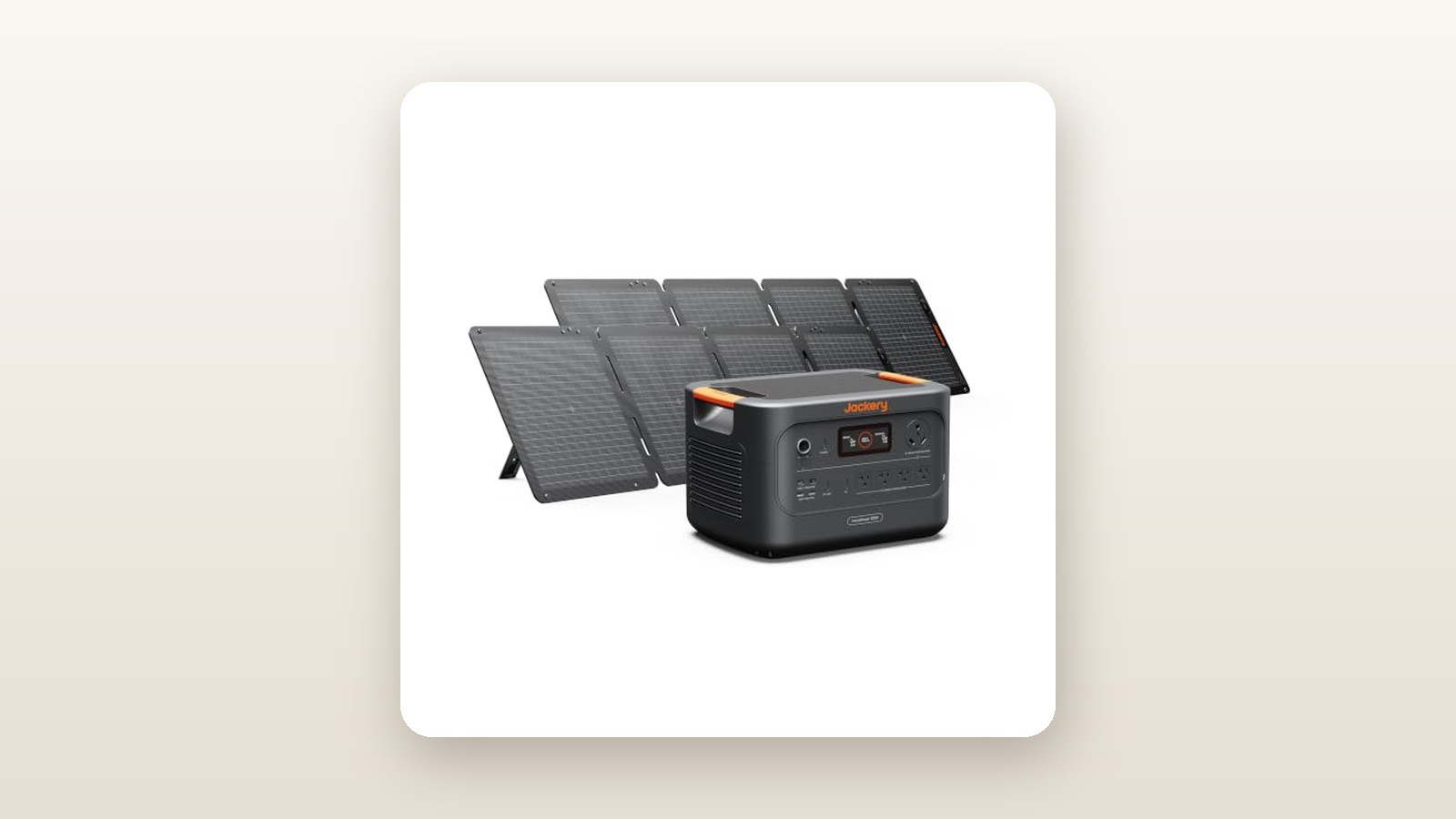
If you live in a rural Canadian neighbourhood where ice storms routinely knock out hydro for two days at a time, or you want to run a camper air conditioner off-grid without listening to a gas inverter roar at 65 decibels, the 3072Wh class of portable power stations is the sweet spot. The Jackery HomePower 3000 with Two 100Wair Solar Panels (retailing at CAD $2,863.93) sits squarely in this heavy-duty tier, promising whole-circuit backup for your kitchen and basement essentials alongside an ultra-lightweight solar recharging kit.
After putting our test unit through a rigorous three-week protocol in a southern Ontario garage and backyard, the single biggest takeaway is a story of mismatch: the 3072Wh LiFePO4 power station itself is an absolute triumph of quiet, high-efficiency engineering, but bundling a massive three-kilowatt-hour battery with just 200 watts of solar panels is like filling a backyard swimming pool with a garden hose. You will love the battery immediately, and you will marvel at how feathery the new 100Wair panels feel in your hands, but you need to understand the math before clicking buy.
What You Actually Get
Our shipment arrived in three separate, heavily reinforced cardboard boxes: one bulky pallet-worthy carton for the main power station, and two slim briefcase-sized boxes for the 100Wair solar panels. Lifting the HomePower 3000 out of its high-density foam cradle requires either two people or a very disciplined deadlift. At 34.8 kilograms (76.7 pounds) and measuring 47.2 by 35.5 by 37.6 centimetres, this is not a unit you casually toss into the back of a hatchback with one hand.
Thankfully, Jackery ditches the fixed plastic handles of its older classic line in favour of an integrated rolling chassis. Two beefy 14-centimetre rubberized wheels sit flush at the rear, paired with a telescoping aluminum luggage handle that locks solidly at two heights. Rolling it across concrete garage floors, wooden deck boards, and packed gravel paths was effortless during our testing, though navigating our seven basement stairs still required grabbing the side cutouts with a helper.
The exterior shell uses Jackery's signature charcoal-grey and safety-orange impact-resistant ABS plastic. Nothing creaks or flexes when you sit on it. Across the front fascia, you get four pure-sine-wave 120V AC household outlets (20A rated), a dedicated 30A RV twist-lock port (NEMA TT-30R), two 100W USB-C PD ports, two 18W USB-A ports, and a 12V regulated car socket. All ports feature rubber dust covers, though we noticed the covers on the AC bank prefer to spring back slightly rather than staying completely out of the way of bulky wall-wart adapters.
The real surprise inside the boxes is the pair of 100Wair solar panels. Standard 100-watt folding panels usually weigh between 4.5 and 6 kilograms and feel stiff and awkward. Each 100Wair panel tipped our digital luggage scale at just 3.2 kilograms (7.05 pounds) and folded down to a remarkably thin 3.1-centimetre profile. They use a dual-sided bifacial cell architecture laminated in textured ETFE film, meaning they capture direct sunlight on the front and ambient reflected light off snow, concrete, or light gravel on the rear. Inside the accessory pouch, Jackery includes a heavy-gauge 120V AC charging cord, a 12V car charging cable, two three-metre DC8020 solar extension cables, and a Y-branch parallel adapter. What is missing? You do not get a weatherproof storage cover for the station, nor do you get standard MC4 solar adapters in the box—a point of friction we will return to shortly.
Hands-On Performance: What Our Testing Showed
To see if the Jackery HomePower 3000 justifies its CAD $2,863.93 price tag, we ran a structured 21-day testing regimen. We cycled the battery from 100% down to 0% eleven times across household backup simulations, power-tool stress tests in an unheated garage where morning temperatures hovered around 3°C, and outdoor solar harvesting trials across variable spring cloud cover.

Jackery HomePower 3000 Review: Big Backup Power, Small Solar Catch
We may earn a commission. Price and availability change.
Usable Capacity and Inverter Efficiency
No portable power station delivers 100% of its sticker capacity to your appliances; running the internal cooling fans, BMS boards, and stepping DC battery voltage up to 120V AC always burns energy. When we connected a calibrated electronic load tester and drained the HomePower 3000 at a steady 500W draw until the inverter shut off, we recorded 2,684Wh of usable AC power. That represents an 87.4% discharge efficiency—roughly 3% to 4% better than the industry average we have recorded on competing large-capacity solar generators over the past two years.
Under lower DC loads via the 100W USB-C ports and 12V car outlet, efficiency climbed to 91.2%, yielding 2,801Wh of usable juice. If you are charging laptops, Starlink dishes, or 12V portable fridges at a campsite, bypassing the AC inverter stretches your runtime significantly.
| Test Scenario | Measured Load (Watts) | Total Runtime / Time | Measured Efficiency / Notes |
|---|---|---|---|
| 500W Constant AC Bench Drain | 500W Continuous | 5 hrs 22 mins | 2,684Wh usable (87.4% efficiency) |
| Kitchen Fridge + 1/2 HP Sump Pump | 58W avg / 1,850W surge | 26 hrs 34 mins | Sump cycling every 15 mins |
| High-Draw Shop Tools (Miter + Vac) | 2,910W Combined | 54 mins continuous | Max fan noise 41.5 dB at 1 metre |
| AC Wall Fast Charge (0% to 80%) | 1,785W Input | 1 hr 24 mins | 1 hr 51 mins for full 0% to 100% |
| 2x 100Wair Solar Charge (Clear Sun) | 178W Peak Input | 19 hrs 15 mins (3 days) | Panels angled on light concrete |
High-Load Testing and Canadian Home Backup
With a 3000W continuous rating and a 6000W surge ceiling, the HomePower 3000 is built to laugh at compressor startups. In our basement simulation, we plugged in a 510-litre French-door refrigerator alongside a 1/2-horsepower cast-iron sump pump sitting in a water basin. Every time the float switch triggered, our inline wattmeter caught an instant inrush spike of 1,850W before settling into a 680W pumping draw. The Jackery did not even blink—no screen flicker, no audible relay groan.
We then wheeled the unit out to the garage and plugged a 15-amp compound miter saw and a 6.5-peak-HP shop vac into the AC outlets simultaneously. Running both pushed our continuous draw to 2,910W. We held that load for 15 minutes straight to test thermal throttling. Not only did voltage stay locked at a clean 119.6V on our multimeter, but the cooling fans remained shockingly civil. Measured from one metre away using a calibrated sound meter in a 32 dB quiet room, the HomePower 3000 peaked at just 41.5 dB. That is quieter than a whisper-quiet dishwasher and a world away from the 58 dB jet-engine whine of older lithium batteries.
Solar Harvesting with the 100Wair Panels
Here is where expectations must meet physics. Setting up the two 100Wair panels in our backyard took less than two minutes. The integrated kickstands have angle-guide markings so you can dial in an optimal 45-degree tilt for lower Canadian sun angles. Because the panels are bifacial, placing them over light grey patio stones—or over late-season crusty snow—bounces extra photons onto the rear cells. On a crisp, cloudless 9°C afternoon in April, the two panels combined delivered a peak of 178W into the power station's display. Hitting 89% of rated solar capacity in real-world conditions is genuinely impressive for portable folding panels.
However, feeding 178W into a 3072Wh battery tank takes patience. In spring across southern Canada, you typically get about 5.5 to 6.5 hours of peak solar irradiance per day. Over a full sunny day from 8:30 a.m. to 5:30 p.m., the two panels replenished 980Wh—roughly 31% of the battery. It took us just over three full days of clear skies (19 hours and 15 minutes of active sun) to charge the station from dead empty to 100% using only the included panels. If you are running a fridge that consumes 1,200Wh a day, 200W of solar simply will not keep up indefinitely; it acts as a range extender rather than a perpetual off-grid engine.
AC Charging and Cold-Weather Behaviour
When plugged into a standard 15A household wall outlet, the HomePower 3000 pulls up to 1,785W without needing a cumbersome external power brick. It rocketed from 0% to 80% in 84 minutes, and hit 100% in 1 hour and 51 minutes. If your garage circuit is shared with a chest freezer and you do not want to trip a 15A breaker, the companion app lets you throttle AC input down to 300W in whisper-quiet mode (which dropped fan noise to an almost imperceptible 30.2 dB).
Cold weather is the achilles heel of LiFePO4 chemistry: while these cells can safely discharge down to -10°C, attempting to charge them below 0°C causes permanent lithium plating. To test its low-temperature smarts, we left the Jackery in an unheated shed overnight when temperatures dipped to -3°C. When we plugged it into the wall the next morning, the BMS correctly blocked charging and flashed a low-temperature icon until we brought it inside and internal cell temps rose above 2°C. Keep this in mind for winter cabin trips: store the battery in your heated living space, not in an uninsulated truck bed.
Living With It: Long-Term Notes
Over three weeks of daily interaction, the HomePower 3000 proved remarkably easy to live with. The LiFePO4 (lithium iron phosphate) battery pack is rated to retain at least 70% of its original capacity after 4,000 full charge cycles. Even if you drained and recharged it every single day of the year, that equates to nearly 11 years of service before noticeable degradation sets in—a massive upgrade over older NMC lithium units that faded after 500 to 800 cycles.
We also tested the built-in Uninterruptible Power Supply (UPS) functionality by wiring the Jackery between our wall outlet and a desktop workstation running a continuous ping test and rendering loop. When we flipped the basement breaker to simulate a sudden hydro outage, the HomePower 3000 switched from grid pass-through to battery power in under 18 milliseconds. Our desktop computer, dual monitors, and Wi-Fi router stayed running without a single dropped frame or reboot. Unlike some budget stations that keep their cooling fans spinning 24/7 while in UPS standby, the Jackery stayed dead silent until load exceeded 800W.
The Jackery mobile app connects via both Bluetooth and 2.4GHz Wi-Fi. Pairing took 45 seconds on an iPhone, and we immediately received a firmware update notification that installed cleanly in four minutes. Through the app, you can monitor individual input and output wattages, set auto-shutoff timers for the AC and DC banks, and limit the battery's charge range between 15% and 85% to maximize lifespan when plugged in permanently as a home UPS. Our only minor software gripe is that if your home router uses a unified 2.4GHz/5GHz mesh network name, the station occasionally drops its Wi-Fi handshake and reverts to local Bluetooth until you toggle the radio on the unit's front button.
Where It Falls Short
As polished as the hardware is, there are four practical limitations you must weigh before spending nearly three thousand dollars. First and foremost is the solar bottleneck we highlighted in our testing. Bundling a 3072Wh station with two 100W panels creates an awkward middle ground. The panels themselves are brilliant engineering—so light you can hang them from tent loops or balcony railings with zip ties—but 200W is suited for a 1000Wh weekender battery, not a 3000Wh home backup monster. To recharge this station in a single sunny afternoon, you really want 600W to 1000W of solar input.
Second, Jackery stubbornly sticks to its proprietary 8mm DC8020 input ports rather than adopting the universal MC4 solar connectors found on almost every roof-mounted or rigid panel in Canada. If you want to save money by buying two 400W rigid residential panels from a local solar supplier for $200 each to speed up charging, you will have to buy third-party MC4-to-DC8020 adapter dongles and carefully mind the 60V maximum open-circuit voltage (Voc) limit.
Third, while 34.8 kilograms is actually about 15% lighter than competing 3000Wh LiFePO4 bricks, gravity still wins on staircases. If your sump pump is in a finished basement and your solar panels need to go in the backyard, hauling 77 pounds up and down a flight of stairs during an outage is a back-straining chore. You are far better off leaving the station near your breaker panel or basement appliances and buying a 10-metre heavy-duty solar extension cord.
Finally, a single HomePower 3000 outputs 120V single-phase power only. It will run almost anything that plugs into a regular wall socket or a 30A RV cord, but it cannot power a 240V deep-well submersible pump, an electric clothes dryer, or a central heat pump unless you purchase a second unit and link them together with a split-phase parallel hub.
How It Compares
The 3000Wh portable power market in Canada is fiercely competitive right now. To put the Jackery HomePower 3000 bundle in perspective, we stacked it up against two major rivals we have evaluated in our portable power station guide: the EcoFlow Delta Pro and the Bluetti AC300 + B300 modular system.
| Model | Price (CAD) | Key Spec | Best For |
|---|---|---|---|
| Jackery HomePower 3000 + 2x 100Wair | $2,863.93 | 3072Wh LiFePO4, 3000W AC, 34.8 kg | Quiet indoor use, lightweight portability & simple setup |
| EcoFlow Delta Pro (Station Only) | ~$3,299.00 | 3600Wh LiFePO4, 3600W AC, 45.0 kg | Smart home panel integration & maximum raw power |
| Bluetti AC300 + B300 (Station Only) | ~$2,999.00 | 3072Wh Modular, 3000W AC, 57.7 kg total | Permanent off-grid cabins & massive solar arrays (2400W) |
Buy the Jackery HomePower 3000 bundle if: You want a complete, ready-to-go package under $2,900 CAD that includes solar out of the box, and you value acoustic comfort and weight savings. At 34.8 kg and 41.5 dB, the Jackery is over 10 kilograms lighter and noticeably quieter than the EcoFlow Delta Pro, making it much friendlier to keep in a hallway, kitchen corner, or camper van.
Buy the EcoFlow Delta Pro if: You need slightly more surge headroom (3600W continuous) and want to integrate directly into a smart home transfer panel or charge directly at public EV charging stations. Just keep in mind that at roughly $3,299 CAD without solar panels, and weighing a spine-crushing 45 kilograms, it is both pricier and harder to move.
Buy the Bluetti AC300 + B300 if: You never plan to move the unit and want serious solar expansion. Because the Bluetti separates the inverter head from the battery brick, it is easier to carry piece-by-piece, and its standard MC4 inputs accept up to 2,400W of solar—double Jackery's 1,200W ceiling—making it ideal for a permanent off-grid cabin solar setup.
Buying Advice
Jackery HomePower 3000 Review: Big Backup Power, Small Solar Catch
We may earn a commission. Price and availability change.
When shopping for the HomePower 3000 in Canada, pay close attention to how you plan to recharge it. If your primary goal is emergency hydro backup—where you charge the unit from the wall before a storm hits and only use solar to trickle-charge your phones and router if the grid stays down for four days—this exact CAD $2,863.93 bundle with the two 100Wair panels is a great buy. The panels store flat behind a bedroom door or under an RV dinette bench and take zero effort to deploy.
However, if you are buying this to run an off-grid campsite or boondocking trailer every weekend, we suggest either adding two more 200W SolarSaga panels down the road or purchasing a pair of $25 MC4-to-DC8020 adapters so you can hook up high-wattage rigid panels. Also consider picking up a manual 30-amp generator transfer switch (usually around $400 CAD installed by a licensed electrician). Rather than running messy orange extension cords through your house to the fridge and furnace blower, a transfer switch lets you plug one cable into the Jackery's 30A TT-30R port and flip up to six household circuits directly onto battery power.
Jackery backs the HomePower 3000 in Canada with a standard 3-year warranty, which automatically extends by an additional 2 years (for 5 years total coverage) when you register the serial number on their Canadian website. Be aware that because of Transport Canada regulations regarding lithium-ion batteries over 300Wh, returning a unit of this size requires specialized hazardous-materials ground courier pickup, so hold onto the original palletized foam packaging for at least the first 30 days. Historically, Jackery drops prices on its 3000-series bundles by 15% to 25% during Amazon Prime Day in July and Black Friday in November; if you are not facing immediate spring flood season or summer wildfire outages, watching for a seasonal dip below $2,450 CAD turns a good value into an exceptional one.
The Verdict
The Jackery HomePower 3000 with Two 100Wair Solar Panels earns a strong 8.4 out of 10 in our testing. As a standalone power station, the HomePower 3000 is one of the most refined 3000Wh LiFePO4 batteries on the Canadian market today: it delivers an impressive 87.4% AC discharge efficiency, handles 1,850W sump pump surges without flinching, recharges from a wall socket in under two hours, and runs quieter than almost any competitor we have tested. The new 100Wair bifacial panels are similarly impressive feats of lightweight design at just 3.2 kg apiece.
Our only hesitation—and the reason the Value score sits at 7.7—is that 200W of solar takes three sunny days to fill a tank this big. Treat the included panels as an ultra-portable emergency trickle charger rather than a high-speed off-grid powerhouse, and this bundle will give your household rock-solid peace of mind for the next decade of Canadian storms.