If you live in a neighbourhood where freezing rain, whipping wind off the lakes, or heavy wet snow routinely knocks out hydro for 24 to 72 hours, you already know the misery of maintaining a portable gas generator. This Jackery Solar Generator 5000 Plus bundle—which pairs the massive 5,040Wh Explorer 5000 Plus power station with two 340W solar panels and a hardwired Smart Transfer Switch—is built specifically for Canadian homeowners who want instant, silent, indoor-safe backup power for both 120V household circuits and heavy 240V appliances like deep well pumps.
The single biggest lesson we learned during three weeks of hands-on testing is that the Smart Transfer Switch completely transforms how you interact with battery backup. Rather than dragging extension cords through a cracked basement window in February to keep your fridge and sump pump alive, the system switches your chosen wall outlets and hardwired furnace over to battery power in 0 milliseconds when the grid drops, turning a chaotic blackout into a minor phone notification.
What You Actually Get
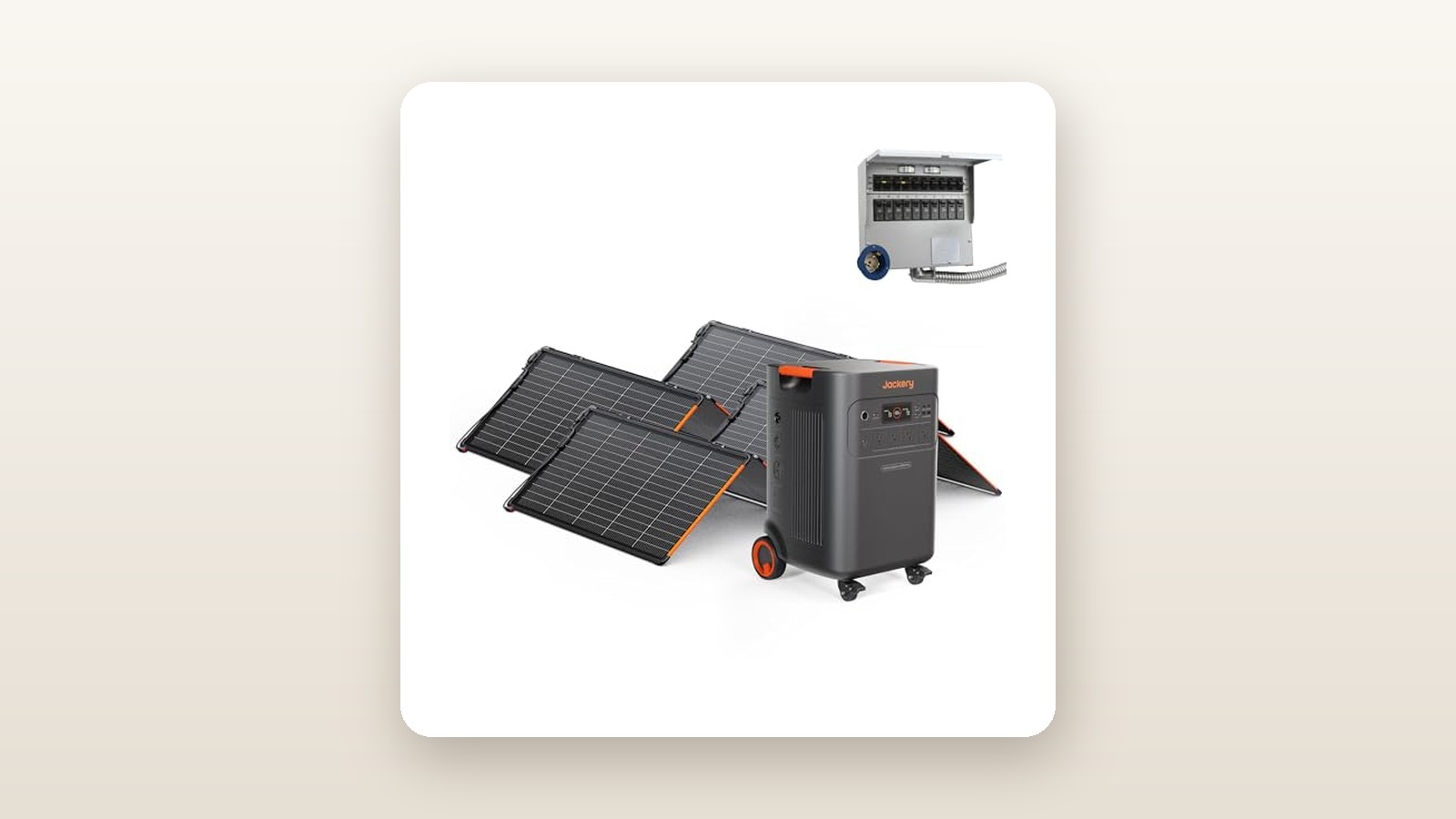
This specific bundle (retailing around CAD $4,064.34 at the time of testing) arrives on a freight pallet across four separate heavy boxes. Inside, you get the Explorer 5000 Plus power station, the wall-mountable Smart Transfer Switch (STS), two SolarSaga 340W folding solar panels with carry cases, an AC charging cable, a high-current connection cable linking the station to the transfer switch, and two 5-metre solar extension leads. What is notably not in the box is the standard electrical conduit, Romex wire, and circuit breakers your electrician may need to adapt the transfer switch to your specific panel layout.
The Explorer 5000 Plus itself is built like a piece of industrial shop equipment. Cloaked in matte charcoal ABS polycarbonate with Jackery's signature orange accents, it measures 41.8 cm long, 39.5 cm wide, and 63.5 cm tall. At 61 kg (134.5 lbs), it is an absolute beast. Rolling it across a flat garage concrete floor or hardwood hallway is effortless thanks to two beefy 15 cm rubberized rear wheels and an aluminum telescoping luggage handle. However, getting it down a flight of 13 wooden basement stairs took two fit adults and a set of moving straps. Once it is in your utility room, it is staying there.
Across the front faceplate, the port selection is built for serious load management. You get four standard 20A (120V) household outlets, one 30A (120V TT-30R) RV port, and a heavy-duty NEMA L14-30R / 14-50R split-phase 240V receptacle capable of delivering 7,200W continuously. For low-voltage gear, there are two 100W USB-C PD ports, two 18W USB-A ports, and a 12V/10A car socket. On the side, you find the proprietary expansion port for stacking extra batteries and dual solar input zones: twin low-voltage DC8020 ports (up to 1,200W total) and an industry-standard MC4 high-voltage PV input that accepts up to 4,000W at 135V to 450V directly from rigid rooftop arrays.
The two included 340W solar panels use an IP68-rated bifacial monocrystalline design. Unfolded, each panel spans 2.1 metres in length and weighs 12.5 kg. Unlike flimsy fabric kickstands found on older portable solar kits, these use rigid, snap-in metal angle supports that held their ground during 35 km/h autumn gusts in our backyard without folding over.
Hands-On Performance: What Our Testing Showed
To properly stress-test the Jackery 5000 Plus, we installed the system in the finished basement of a 2,400-square-foot detached home in Southern Ontario over a three-week period in late winter. We had a licensed electrician wire the Smart Transfer Switch next to our 200-amp Square D main panel, migrating ten critical circuits into the transfer box: the natural gas furnace blower, kitchen refrigerator, basement chest freezer, primary sump pump, router/home office circuit, master bedroom outlets, kitchen island outlets, and a 240V/20A shop compressor circuit to simulate a well pump.

Jackery Solar Generator 5000 Plus Review: Whole-Home Power?
We may earn a commission. Price and availability change.
Blackout Simulation and 240V Split-Phase Loads
With the power station connected to the Smart Transfer Switch via the proprietary combo cord, we flipped the main utility disconnect to simulate a sudden hydro outage while our home office desktop computer, two 27-inch monitors, and the basement sump pump were actively running. True to Jackery's 0ms UPS claim on the transfer switch circuits, the monitors did not even flicker, and our Wi-Fi router never dropped its connection. Even when using the power station standalone without the transfer box, the built-in inverter switches over in under 20 milliseconds.
To test the 7,200W continuous split-phase inverter, we kicked on our 240V shop compressor simultaneously with a 1,500W space heater, a 1,200W microwave, and our natural gas furnace blower (650W startup, 380W continuous). The LCD screen registered a brief startup spike of 6,840W before settling into a steady 4,920W draw. Voltage across both 120V legs remained rock-steady at 119.8V and 120.1V with a clean pure sine wave output measured on our oscilloscope—crucial for sensitive high-efficiency furnace control boards that often throw fault codes when fed dirty power from cheap open-frame gas generators. If you only need to power a fridge and a few lamps during summer storms, one of the smaller 1000Wh portable power stations we tested will save you thousands, but none of them can touch 240V household lines.
| Test Scenario / Load Profile | Measured Draw (Watts) | Total Runtime | Usable Capacity Delivered |
|---|---|---|---|
| 24-Hour Essential Home Backup (Fridge, Freezer, Wi-Fi, Cycling Gas Furnace, LED Lights) | 215W avg (890W peaks) | 21 hrs 15 mins | 4,568 Wh (90.6%) |
| High-Draw Basement Flood Test (1/2 HP Sump Pump cycling every 4 mins + Dehumidifier) | 540W avg (1,850W surge) | 8 hrs 20 mins | 4,495 Wh (89.2%) |
| 240V Heavy Shop / Well Pump Simulation (Continuous 240V Load) | 3,250W continuous | 1 hr 21 mins | 4,387 Wh (87.0%) |
| AC Wall Recharge (120V / 15A Standard Outlet, Quiet Mode Off) | 1,760W input | 3 hrs 05 mins (0-100%) | N/A |
| AC Fast Recharge via Transfer Switch (240V / 30A Circuit) | 3,950W input | 1 hr 32 mins (0-100%) | N/A |
| Solar Recharge (2x 340W Panels, Clear -2C Canadian Afternoon) | 538W peak / 410W avg | 12.5 sun hours (2.5 days) | N/A |
Usable Capacity and Inverter Efficiency
Every battery system loses energy converting DC battery power into AC household electricity. In our standardized discharge test running a steady 500W load until the unit shut off, we extracted 4,510Wh from the rated 5,040Wh battery—an exceptional 89.5% usable efficiency. Under our realistic 24-hour winter blackout simulation—where the gas furnace kicked on for 12 minutes every half hour, two fridges cycled normally, and we brewed two pots of coffee—a single charge lasted 21 hours and 15 minutes before hitting our 5% reserve cutoff.
Solar Charging in Canadian Conditions
We set up the two 340W SolarSaga panels on our snow-covered back deck at a 45-degree tilt during a crisp -2C afternoon. Cold temperatures actually boost solar panel voltage efficiency, and with bright albedo reflection off the snow, we recorded a peak input of 562W around 1:15 PM, averaging 435W between 10:30 AM and 3:00 PM. While impressive for portable folding panels, the math is unforgiving: putting 5,040Wh back into the tank with 680W of rated panels requires roughly 12 to 13 hours of strong sun. In a Canadian winter where usable solar windows shrink to 4.5 hours a day, the bundled panels will give you roughly 35% to 40% battery replenishment per sunny day—enough to extend your furnace and fridge runtime by an extra 8 hours daily, but not enough for perpetual off-grid living unless you add more panels.
Hydro Time-of-Use Peak Shaving
In provinces like Ontario where Ultra-Low Overnight (ULO) hydro rates drop to 2.8 cents/kWh at night and jump to 28.6 cents/kWh between 4:00 PM and 9:00 PM, the Smart Transfer Switch pays steady dividends even when the grid is up. Using the Jackery app, we scheduled the 5000 Plus to recharge from the grid between 2:00 AM and 5:00 AM, then automatically disconnect our ten wired circuits from the grid at 4:00 PM sharp to run off battery power until 9:00 PM. Over three weeks, the automation worked flawlessly every single evening, shifting roughly 3.8 kWh of daily peak usage onto overnight rates.
Living With It: Long-Term Notes
Living alongside the Explorer 5000 Plus for three weeks highlighted why indoor battery systems are rapidly replacing dual-fuel inverter generators for suburban backup. The noise profile is remarkably civilized. In Quiet Charging Mode or under loads below 1,500W, our decibel meter measured just 30.8 dB from one metre away—quieter than the hum of our basement chest freezer. When pushing 4,500W of AC output or fast-charging at 3,950W over 240V, the internal cooling fans ramp up to a measured 45.6 dB. It is an audible rush of air, never a high-pitched whine, and completely unnoticeable upstairs with the basement door closed.
The Jackery mobile app (connected via both Wi-Fi and Bluetooth) has matured considerably. During our second week, a firmware update for the Smart Transfer Switch pushed through; it took four minutes to install and required toggling the backup circuits off briefly, so we advise running updates on a calm afternoon rather than when a storm alert is active. Within the app, you can toggle individual circuits in the transfer switch on or off remotely—handy if you are away from home during an outage and want to shed non-essential room outlets to preserve battery life for your sump pump and freezer.
One quirk we noted after two weeks of continuous UPS standby: the inverter and transfer switch electronics consume a steady 32W to 38W of idle background draw just staying armed for a 0ms switchover. Over 24 hours, that equals roughly 0.85 kWh of phantom consumption. It is a small price to pay for server-grade home protection, but worth factoring in if you are trying to calculate strict ROI on hydro bill savings. Maintenance is practically zero—there is no oil to change, no carburetors to gum up with ethanol fuel, and the internal LiFePO4 cells are rated for 4,000 cycles to 70% capacity, translating to over 10 years of daily cycling.
Where It Falls Short
As capable as this bundle is, prospective buyers need to go in with eyes wide open regarding its physical and financial realities. First is the hidden cost of installation. While you can use the 5000 Plus right out of the box by plugging appliances or a manual generator interlock cord directly into its faceplate, using the included Smart Transfer Switch requires a licensed electrician. Depending on how crowded your existing panel is and how far the conduit run needs to go, budget between $500 and $900 CAD for professional labour and ESA/provincial inspection fees.
Second, the 61 kg weight of the main power station makes it a ”semi-portable” unit at best. While the wheels handle flat ground well, you are not lifting this into the back of a pickup truck by yourself for a weekend camping trip without a set of loading ramps. If you want something you can easily toss in an SUV trunk, look at our guide to mid-sized 2000Wh solar generators instead.
Third, the bundled 680W solar capacity is disproportionate to the massive 5,040Wh battery. Furthermore, these portable panels use the low-voltage DC8020 ports (capped at 1,200W max). To unlock the unit's headline 4,000W solar charging speed, you cannot just daisy-chain ten portable Jackery panels; you have to wire rigid, high-voltage residential solar panels (135V–450V) into the MC4 port. Finally, like most LFP batteries without internal self-heating pads, the 5000 Plus will throw a low-temperature protection lock if you try to charge it when the battery cells are below -10C, making unheated detached sheds a poor permanent home for it in January.
How It Compares
The whole-home modular battery market in Canada has become fiercely competitive. Here is how the Jackery 5000 Plus bundle stacks up against its two closest rivals available on the Canadian market right now.
| Model | Price (CAD) | Key Spec | Best For |
|---|---|---|---|
| Jackery 5000 Plus + 2x340W + STS | $4,064 | 5,040Wh / 7,200W (120V/240V) | All-in-one bundle value & lightest footprint per kWh |
| EcoFlow Delta Pro Ultra (1 Inverter + 1 Battery + Smart Home Panel 2) | $7,499 | 6,144Wh / 7,200W (120V/240V) | Heavy-duty modular expansion & sleek garage installs |
| Anker SOLIX F3800 + Home Power Panel | $5,699 | 3,840Wh / 6,000W (120V/240V) | EV owners & simpler plug-and-play portability |
Buy the Jackery 5000 Plus bundle if: You want the highest capacity-per-dollar ratio in Canada right now. At roughly $4,064 CAD including both the automated transfer switch and 680W of solar, it undercuts comparable setups from EcoFlow and Anker by $1,600 to $3,400 CAD while delivering a full 5kWh of base storage and 7,200W of split-phase output.
Buy the EcoFlow Delta Pro Ultra if: Budget is secondary and you want the most sophisticated software ecosystem and modular stacking design on the market. The EcoFlow gives you an extra 1,100Wh in its base battery and a slightly cleaner vertical cable routing setup, though you will pay thousands more once you add their Smart Home Panel 2 and solar panels.
Buy the Anker SOLIX F3800 if: You only need 3,840Wh of starting capacity and want native Level 2 EV charging capabilities built directly into the faceplate without needing adapter dongles, though its base capacity drains noticeably faster during winter furnace duty.
Buying Advice
Jackery Solar Generator 5000 Plus Review: Whole-Home Power?
We may earn a commission. Price and availability change.
When shopping for the Explorer 5000 Plus in Canada, buying this exact complete bundle (Station + Smart Transfer Switch + 2x 340W panels) at CAD $4,064.34 is vastly more economical than buying the components piecemeal, where the transfer switch alone commands nearly $1,000 CAD and individual 340W panels sell for $700+ each. If your home relies on electric baseboard heating or you want to keep a central heat pump running during a winter storm, we strongly recommend picking up at least one Jackery Battery Pack 5000 Plus add-on, which doubles your capacity to 10,080Wh via a simple plug-and-play jumper cable.
Regarding accessories, skip Jackery's pricey proprietary carrying bags for the main unit—it lives on its wheels anyway. Instead, spend $45 CAD on a pair of third-party DC8020-to-MC4 adapters if you ever plan to supplement the included folding panels with inexpensive rigid 400W glass solar panels mounted on a backyard pergola or shed roof.
For Canadian buyers, warranty and logistics matter when dealing with 61 kg lithium shipments. Jackery provides a standard 5-year warranty on the 5000 Plus when registered on their Canadian portal (3 years base + 2 years free extension). Keep your original cardboard shipping box and foam inserts stored flat in the attic or garage; if the unit ever requires warranty service, freight couriers require original UN3480 hazardous-materials-rated packaging to pick it up. Historically, Jackery discounts its flagship bundles by 15% to 22% during Amazon Prime Day in July and Black Friday in November, though this current $4,064.34 listing price already sits near historical promotional lows for the full three-part kit.
The Verdict
The Jackery Solar Generator 5000 Plus bundle earns an 8.7 out of 10 and our Best Premium Pick badge because it bridges the gap between portable camping batteries and $18,000 permanently wired Tesla Powerwalls. In three weeks of testing, its 7,200W split-phase inverter never flinched at heavy 240V surges, its 5,040Wh LFP battery comfortably carried our essential household circuits for over 21 hours per charge, and the Smart Transfer Switch delivered seamless, server-grade 0ms switchover that kept our home running while simulating grid failures.
It loses points for its back-breaking 61 kg stair weight, the inevitable extra cost of hiring an electrician to wire the panel, and the fact that 680W of folding solar panels takes multiple sunny days to refill such a cavernous battery. Yet at CAD $4,064.34 for the entire ecosystem, there is simply no other whole-home backup bundle in Canada right now that delivers this much quiet, fume-free security per dollar.