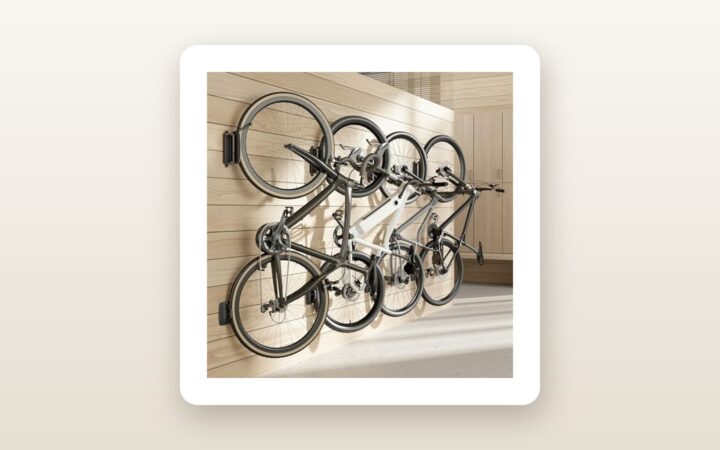
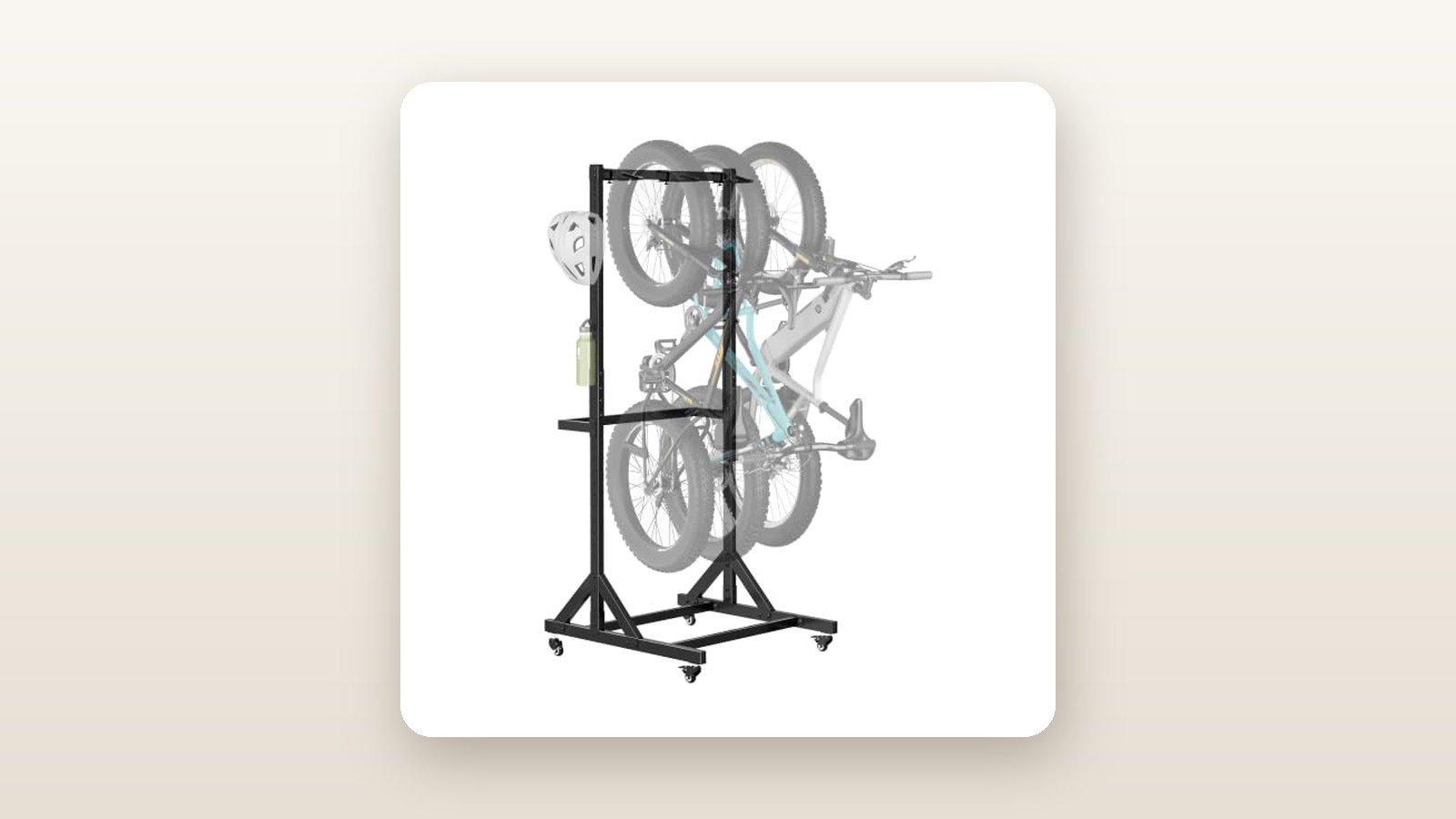
If your Canadian garage currently looks like a tangled crime scene of aluminum frames, winter tires, and hockey bags, you already know the misery of standard floor-standing bike racks. Most horizontal wheel slots barely hold a road bike upright before the whole row dominoes into your car door, and wall-mounted hooks require locating timber studs behind finished drywall or tearing into a carefully sealed vapour barrier. The monTEK Rolling 3-Bike Rack Garage stand is built specifically for cyclists with tight floor space and wide tires—up to a massive 4.5 inches—who want vertical high-density storage on a frame that rolls out of the way when the snowblower needs to come out.
The single biggest thing we learned during three weeks of testing this $295.27 CAD rack in a packed suburban Ontario garage is that caster quality and base geometry make or break a mobile vertical stand. Plenty of cheap racks claim to hold three bikes, but they flex alarmingly the moment you try to roll 60 kilograms of mountain and fat bikes across a concrete expansion joint. By pairing a wide 84-centimetre footprint with industrial 76-millimetre polyurethane casters, the monTEK turns three awkward bicycles into a single compact rolling cart that takes up less than nine square feet of floor space.
What You Actually Get
Our monTEK Rolling 3-Bike Rack arrived in a dense, heavily taped cardboard carton measuring 96 by 38 by 19 centimetres and tipping our digital shipping scale at 22.8 kilograms. Opening the box revealed a refreshingly organized layout: thick square-tube carbon steel uprights, base rails, three oversized wheel cradles, and a blister pack of M8 hex bolts, nylon locknuts, and split washers. Unlike cheaper racks that toss loose steel tubes into a plastic bag to clang together across the Pacific, monTEK separates the structural layers with closed-cell foam sheets. Not a single piece of our test unit showed chipped paint or bare metal out of the box.
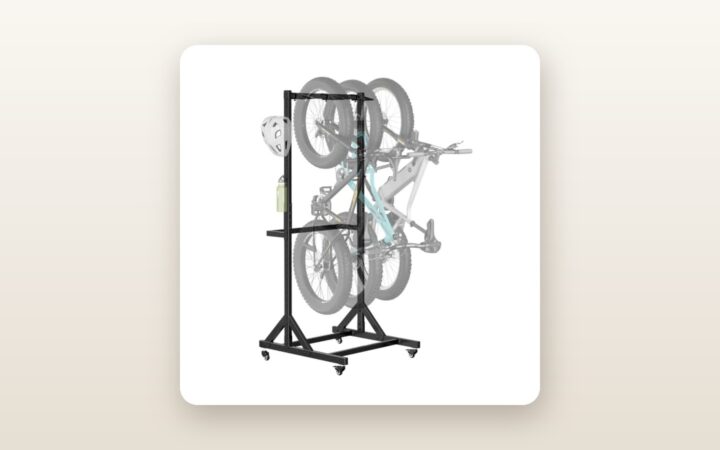
The frame itself is constructed from 1.8-millimetre-thick square steel tubing finished in a finely textured matte black powder coat. In a Canadian climate where bikes come home dripping with briny road slush from November through April, that finish matters tremendously. We inspected the weld beads around the main base gussets and the vertical upright joints; they are continuous, uniform robotic welds rather than spot-tacked corners. Assembled, the rack stands 178 centimetres tall, spans 92 centimetres wide, and extends 84 centimetres deep, with a bare curb weight of 21.4 kilograms.
Inside the hardware kit, you get the four 3-inch (76 mm) swivel casters—each equipped with a step-on metal brake lever—along with three vinyl-dipped upper J-hooks, three lower wheel chutes, and two stamped-steel assembly wrenches plus an L-shaped Allen key. What is not in the box is a proper ratchet, which you will definitely want to supply yourself. Using a 13-millimetre socket on a cordless impact driver and a matching box wrench, one tester assembled the entire unit in 28 minutes on the garage floor. Using only the flimsy stamped tools included in the package would easily double that build time and leave your knuckles sore.
Hands-On Performance: What Our Testing Showed
To put the monTEK rack through a realistic Canadian torture test, we stationed it inside a single-car detached garage in southern Ontario with a 1970s poured-concrete floor complete with expansion seams, road-salt pitting, and a two-degree drainage slope toward the driveway. Over 21 days, we cycled a rotating fleet of bicycles on and off the stand daily: a 28.5-kilogram fat-tire electric commuter running 26 x 4.0-inch knobby rubber, a 14.2-kilogram full-suspension trail bike with 29 x 2.6-inch tires and 800-millimetre handlebars, a 13.8-kilogram studded winter hardtail, and a 9.4-kilogram carbon gravel bike. If you also haul your bikes to the trailhead, you might want to check out our guide to heavy-duty hitch bike racks for SUVs to complement your indoor setup.
monTEK Rolling 3-Bike Garage Rack Review: Built for Fat Tires
We may earn a commission. Price and availability change.
Fat-Tire Compatibility and Hook Geometry
The headline spec on the monTEK listing is its 4.5-inch tire width capacity, and we verified this immediately with digital callipers. The internal clear width of both the upper tire troughs and the lower rear-wheel stabilisers measures 11.8 centimetres (4.64 inches). When we slotted our 4.0-inch fat-tire e-bike into the centre position, there was still nearly 8 millimetres of breathing room on either side of the aggressive side lugs. We then borrowed a neighbour's dedicated snow fat bike shod with 26 x 4.6-inch Surly Lou tires inflated to 12 PSI; it settled into the cradle with just a whisper of sidewall rub and zero structural binding. By comparison, most vertical racks cap out at 2.8 or 3.2 inches, forcing fat-bike owners to deflate their tires just to park them.
The upper J-hooks are coated in a 3-millimetre-thick pliable PVC dip that grips carbon and aluminum rims without scratching anodized finishes or peeling rim decals. Each hook can be bolted into multiple vertical height positions along the top crossbeam, allowing you to stagger adjacent bikes by 15 centimetres vertically. That stagger is critical: when we loaded three mountain bikes with wide 780-to-800-millimetre handlebars side by side, the alternating hook heights allowed the brake levers and dropper-post remotes to overlap cleanly in mid-air without clashing.
Loading Ergonomics and the 30 kg E-Bike Reality
Let us be completely candid about vertical bike storage: gravity is not on your side when you own a heavy bicycle. While the monTEK frame is rated for 30 kilograms per station (90 kilograms total), deadlifting a 28.5-kilogram e-bike up to chest height to hook the front wheel is a recipe for a tweaked lower back if you use poor form. During our first week, we perfected the roll-and-pivot method that makes this rack manageable for average riders.
First, lock all four caster brakes so the rack cannot skate away from you. Second, remove the e-bike battery if possible, which instantly drops our test bike from 28.5 kilograms down to 24.7 kilograms. Third, squeeze the rear brake lever, pull back on the handlebars to pop a stationary wheelie, and walk the bike forward on its back tire right into the lower cradle. From there, you only have to pivot the front wheel forward 30 centimetres to drop it into the upper hook—almost zero vertical lifting required. Using a digital luggage scale strapped to the stem, we measured the peak upward pull force required using this pivot method at just 11.4 kilograms, compared to lifting the entire 24.7-kilogram mass off the ground.
Rolling Stability Over Garage Slabs and Salt Slush
A freestanding rack loaded with three expensive bikes has a naturally high centre of gravity, which made us initially skeptical about rolling it across rough terrain. With all three bays occupied—totalling 56.5 kilograms of bicycles plus the 21.4-kilogram rack for a combined moving mass of 77.9 kilograms—we unlocked the casters and pushed the unit across the garage floor, over the 14-millimetre rubber garage door threshold, and out onto an interlocking brick driveway to wash the frames.
Because the 84-centimetre base extends evenly both in front of and behind the main vertical uprights, the load sits dead-centre inside the wheel footprint. We measured the lateral tipping threshold using a pull scale at the top of the 178-centimetre frame: it took 18.6 kilograms of horizontal side-pull force before the opposite casters even began to unweight. In everyday pushing and manoeuvring around car bumpers, the rack never once felt tippy. The 76-millimetre polyurethane casters rolled at a quiet 52 dB over painted concrete and cleared a 12-millimetre expansion joint without hanging up, provided we pushed from the lower vertical uprights rather than yanking on a bicycle frame.
| Test Metric | Measured Result | Test Condition / Notes |
|---|---|---|
| Actual Maximum Tire Slot Width | 11.8 cm (4.64 in) | Measured with callipers inside upper and lower steel cradles |
| Total Footprint Occupied | 8.3 sq. ft. (0.77 sq. m) | 92 cm x 84 cm base; 105 cm depth including overhanging handlebars |
| Assembly Time | 28 minutes | Single tester using a 13 mm socket on a cordless impact driver |
| Loaded Push Force (Smooth Concrete) | 4.8 kgf | Rack loaded with 3 bikes (56.5 kg payload) across painted floor |
| Caster Roll Noise Level | 52 dBA | Measured at 1 metre distance rolling at walking speed |
| Frame Deflection Under Max Load | 4.2 mm | Vertical bow at centre of top bar with 68 kg total test load |
Canadian garages also suffer from spring meltwater and high basement humidity. To test corrosion resistance, we sprayed the lower base rails and caster yokes with a 5-percent saline solution—mimicking Ontario highway salt spray—every second day for two weeks and left it in an unheated garage fluctuating between -4°C and +9°C. After 14 days, the black powder-coated steel tubes showed zero oxidation. Two of the zinc-plated bolt heads on the bottom rail developed a faint chalky film that wiped away with a rag and a drop of chain lube. If you are overhauling your entire space before winter hits, pair this rack with some of the best overhead garage storage racks we have tested to get seasonal bins off the slab too.
Living With It: Long-Term Notes
After the initial novelty wore off and the monTEK rack became part of our daily routine, several practical nuances emerged. The biggest quality-of-life win is floor hygiene. When bikes are parked horizontally in traditional floor slots, sweeping up dried mud, road grit, and pine needles requires pulling every single bike out onto the driveway first. With the monTEK, we simply clicked up the four caster brakes with the toe of a boot, rolled the entire three-bike fleet two metres to the left, swept and hosed down the concrete corner, and rolled them right back into place in under 90 seconds.
Over three weeks of repeated loading and unloading, we checked every fastener for loosening. Because monTEK supplies nylon-insert locknuts (nylocs) rather than plain hex nuts, none of the structural joints backed off due to vibration from rolling across the concrete slab. However, we did notice one small quirk with the upper J-hooks: if you leave them mounted with the factory wing-nut style pins for tool-free lateral sliding, the hook can twist slightly by 5 to 10 degrees as you guide a heavy 4-inch tire into the slot. Snugging those upper brackets down firmly with a wrench once you have dialed in your spacing for your specific bikes eliminates that play completely.
Maintenance is virtually nonexistent—there are no apps, batteries, or moving gears to fail—aside from giving the caster swivel bearings a two-second blast of silicone spray before winter to repel salty puddle water. One minor annoyance worth noting for road cyclists with deep-section carbon aero wheels (50 mm depth or greater): while the upper hook curvature is generous enough to accommodate a fat tire, the steel hook shaft comes close to the spokes on ultra-deep road rims if you angle the bike crookedly during dismount. Taking two extra seconds to lift straight up prevents any spoke contact.
Where It Falls Short
No garage storage solution is magic, and the monTEK Rolling 3-Bike Rack has four real-world limitations you should weigh before spending nearly $300 CAD. First and foremost is the fender conflict. One of our test riders commutes year-round on a hybrid equipped with full-length, rigid SKS chromoplastic mudguards that wrap almost all the way down to the bottom of the rear wheel. When you hang that bike vertically on the monTEK, the bottom tip of the rear fender hits the horizontal steel cross-brace of the lower wheel chute before the rubber tire actually touches the cradle. You either have to let the bike hang with weight resting against the plastic fender—which will eventually crack it in sub-zero garage temperatures—or leave that station for fender-free mountain and road bikes.
Second, while the rack is rock-solid with diamond-frame bikes, certain heavy step-through cruiser e-bikes with ultra-long wheelbases (over 125 centimetres) and swept-back Dutch handlebars sit awkwardly. Because the upper hook grabs the front wheel and the lower chute cradles the rear wheel at a fixed vertical geometry, a bike with a very long wheelbase pushes its rear tire low in the bottom chute, causing the handlebars to jut forward past the 84-centimetre base footprint by nearly 30 centimetres.
Third, the included assembly tools are borderline throwaway items. To keep a 78-kilogram loaded rolling cart rigid, those M8 base bolts need roughly 22 to 25 Nm of torque. The thin, stamped sheet-metal wrenches in the box flex and round off their own jaws well before you reach proper tightness. Budget 15 minutes to grab a real 13 mm socket and combination wrench from your toolbox—or check out our guide to essential portable bike repair stands and home tool kits if you are building out a workshop from scratch.
Finally, at $295.27 CAD, this is a serious investment for bicycle storage. You can buy three heavy-duty vinyl-coated screw-in wall hooks at Canadian Tire for under $25 CAD total. Of course, those hooks require drilling into studs and offer zero mobility, which brings us directly to how the monTEK stacks up against the broader market.
How It Compares
To put the monTEK's price and capabilities into perspective for Canadian shoppers, we compared it against two widely available alternatives on Amazon.ca and in local bike shops: the Rad Cycle Products Pro Bicycle Gravity Stand (a popular budget wall-leaning option) and the Feedback Sports Rakk XL (a modular floor-slot stand designed specifically for plus and fat tires).
| Model | Price (CAD) | Key Spec | Best For |
|---|---|---|---|
| monTEK Rolling 3-Bike Rack Garage | $295.27 | 3 bikes (90 kg total), up to 4.5-in tires, 4 locking casters | Multi-bike garages needing fat-tire support and easy rolling mobility |
| Rad Cycle Pro Gravity Bike Stand | $98.50 | 2 bikes (36 kg total), horizontal frame arms, leans against wall | Apartment dwellers storing two lightweight road or hybrid bikes |
| Feedback Sports Rakk XL (x3 units) | $255.00 ($85 ea.) | 1 bike per stand, 3.0 to 5.0-in tires, horizontal floor parking | Riders who refuse to lift heavy fat e-bikes vertically |
Buy the monTEK Rolling 3-Bike Rack if: You own two or three bikes—especially mountain bikes, winter commuters, or fat bikes up to 4.5 inches—and want to reclaim half your garage floor space while keeping the ability to roll the entire fleet out of the way in seconds. It is vastly sturdier than gravity stands and takes up half the floor depth of horizontal wheel stands.
Buy the Rad Cycle Pro Gravity Stand if: You are on a strict sub-$100 CAD budget, only own two lightweight road or gravel bikes with flat top tubes, and have an empty stretch of flat drywall to lean the rack against. Skip it if you own full-suspension mountain bikes with sloped frames or anything over 18 kilograms.
Buy three Feedback Sports Rakk XL stands if: You have plenty of floor depth (a full two-car garage or basement workshop) and own 30-kilogram fat-tire e-bikes that you cannot physically pivot up into a vertical position. You will sacrifice floor space and rolling mobility, but you only have to roll the tire onto the ground-level spring arm.
Buying Advice
monTEK Rolling 3-Bike Garage Rack Review: Built for Fat Tires
We may earn a commission. Price and availability change.
When ordering the monTEK Rolling 3-Bike Rack on Amazon.ca, verify that you are selecting the 3-bike fat-tire configuration (ASIN B0GX5XG5DH) rated for 4.5-inch tires, as monTEK also produces narrower multi-bike variants with smaller wire wheel slots that max out around 2.5 inches. If you own even one plus-sized mountain bike or plan to buy a winter fat bike down the road, the 4.5-inch cradle width is well worth the small price premium because the V-shaped bottom of the cradle still holds skinny 28 mm road tires upright without wobbling.
As for accessories, you do not need to buy anything extra to make the rack work, save for a handful of reusable silicone gear ties or Velcro straps ($12 CAD for a pack of six). Wrapping a quick strap around the rear wheel and the lower steel cradle is a great habit if you frequently roll the rack across uneven driveway pavers, as it keeps the bikes from bouncing during transit. A cheap 90-by-100-centimetre ribbed rubber boot mat placed underneath the rack is also a smart $20 CAD addition during Canadian winters to catch melting salty slush before it runs across your garage floor.
In Canada, the rack ships via standard Amazon fulfilment, meaning you get the standard 30-day return window—though keep the original box intact until you finish assembling and testing your bikes on it, as repacking 21 kilograms of steel tubing without the factory carton is a headache. monTEK backs the frame with a 1-year limited warranty against structural weld defects and missing hardware. Price-wise, heavy steel garage organizers like this typically hover between $280 and $310 CAD through the spring cycling peak, with promotional coupons or Prime Day / Black Friday dips occasionally bringing the checkout price down into the $245 to $260 CAD range.
The Verdict
The monTEK Rolling 3-Bike Rack Garage solves two of the most frustrating problems in Canadian bike storage at once: it accommodates genuine 4.5-inch winter fat tires without forcing you to deflate them, and it packs three bulky bicycles into an 8.3-square-foot vertical footprint without putting a single lag bolt into your garage wall studs. Across three weeks of daily abuse with heavy e-bikes, wide-bar trail bikes, and simulated road salt, the 21.4-kilogram steel frame and 76-millimetre locking casters proved vastly more rigid and rollable than cheaper tubular racks we have used in the past.
It is not flawless—riders with full-length rigid commuter fenders will run into clearance issues on the lower cradles, and you still need proper pivot technique to load a heavy e-bike vertically—which keeps it just shy of a 9-plus rating. Still, at an overall score of 8.6 out of 10, the monTEK is the most capable freestanding mobile bike rack you can wheel into a cramped Canadian garage in 2026.