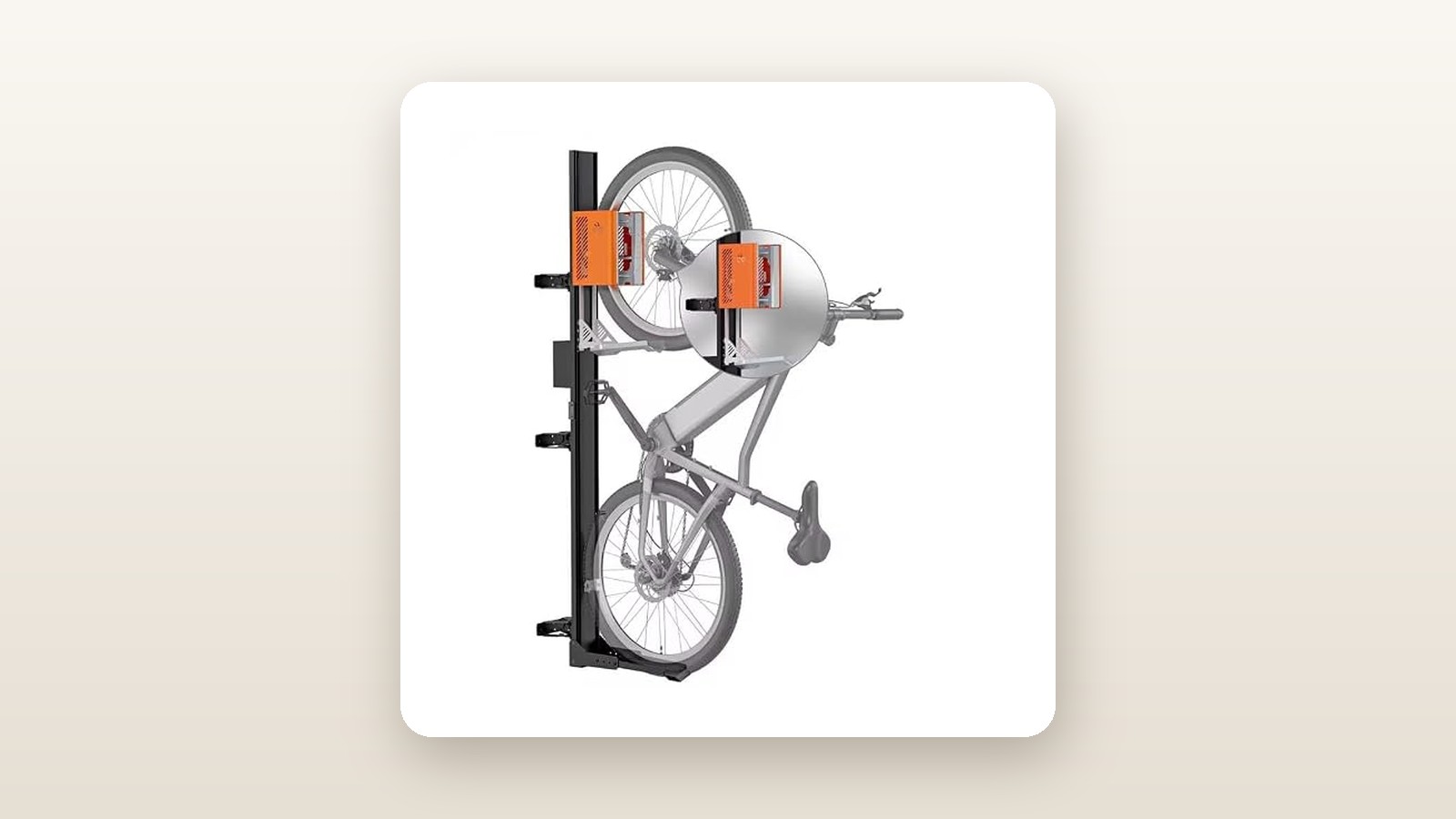
If you own a modern electric commuter bike or a long-travel enduro rig, you already know that hanging it on a standard garage wall hook is a fast track to a lower back injury. Deadlifting 28 kilograms of awkward aluminum and battery cells to shoulder height while trying to thread a narrow steel hook between your spokes and disc rotor is miserable work. The monTEK Swivel Automatic Lift Bike Rack is built specifically for cyclists with heavy rides up to 32.2 kg (71 lbs) who want vertical, space-saving wall storage without the overhead deadlift or the tangle of ropes found on ceiling pulley hoists.
The single biggest thing we learned during three weeks of testing this unit in a cramped, single-car suburban garage in Mississauga is that mounting height accuracy dictates everything. Because the internal gas-strut mechanism relies on you pivoting the bicycle back onto its rear wheel and rolling the front tire straight into the lowered cradle, setting the track even 5 centimetres too high forces you to lift the frame anyway. Get that measurement spot-on during installation, however, and this $297.91 CAD rack turns a dreaded post-ride chore into a ten-second, one-handed glide.
What You Actually Get
Our monTEK unit arrived in a dense, 148 cm long cardboard carton weighing just shy of 9.6 kg (21.2 lbs) total shipping weight. Lifting the components out of the protective foam blocks, the first impression is one of industrial heft. Unlike flimsy sheet-metal hooks you find at big-box hardware stores, the main spine and pivoting wheel cradle are fabricated from thick, powder-coated carbon steel paired with an extruded aluminum glide channel. Out of the box, the assembled rack weighs 8.4 kg (18.5 lbs) and measures 142 cm (55.9 inches) in vertical length, projecting 16.5 cm off the wall when folded flat and extending out to 68.5 cm when the cradle arm is deployed to hold a front wheel.
The finish is a matte black, slightly textured powder coat that feels grippy even when wearing damp cycling gloves. We inspected the welds around the main swivel hinge pin—the critical stress point where up to 32.2 kg of cantilevered mass pivots left and right—and found clean, continuous bead welds with zero slag or thin paint coverage. Inside the main vertical column sits the heart of the unit: a heavy-duty, nitrogen-charged mechanical gas strut coupled to a high-density nylon roller shuttle. Despite the word "Automatic" in the Amazon listing title, there is no electric motor, power brick, or lithium battery in the box; the lift is purely mechanical, which we actually prefer for an unheated Canadian garage where winter temperatures drop to -20°C and ruin cheap electronics.
Included in the hardware kit are six heavy 8 mm hex lag bolts with flat washers for wood studs, six masonry expansion anchors for poured concrete or block walls, a separate rear-wheel wall bumper tray to keep dirty rear tires off your drywall, and a cardboard drilling template. What you do not get in the box is an integrated security lock loop, nor do you get a stud finder, a 13 mm socket wrench, or the 6 mm masonry drill bit required if you are anchoring into a basement foundation wall. Because the unit mounts to a single vertical stud line, portability is essentially zero once installed, though you can unbolt it in about ten minutes if you move house.
Hands-On Performance: What Our Testing Showed
To put the monTEK Swivel Automatic Lift Bike Rack through a realistic Canadian torture test, we mounted it in a standard 3.05-metre-wide (10-foot) single-car garage alongside a mid-size SUV. Over 21 days in late winter, we cycled four distinctly different bicycles through the rack at least twice daily, exposing the mechanism to melting road slush, rock salt grit, and fluctuating garage humidity between 45% and 78%. Because it uses zero electricity, it adds $0.00 to your monthly hydro bill—a nice perk compared to motorized ceiling winches.

monTEK Swivel Automatic Lift Bike Rack Review: Effortless E-Bike Storage
We may earn a commission. Price and availability change.
Installation and Stud Alignment
Installing the rack took us 38 minutes from opening the box to hanging the first bike. The mounting bracket features slotted holes spaced directly down the central spine, meaning you only need to locate a single 38 x 89 mm (2x4) wood wall stud rather than bridging across two studs on 40.6 cm (16-inch) centres. Using a magnetic stud finder, we marked the centre of our pine stud, taped up the paper template, and pre-drilled pilot holes. The crucial step here is measuring your primary bike's wheelbase. For our medium-frame commuter e-bike with a 182 cm total length, we set the bottom of the main track at 43 cm off the concrete floor. If you own multiple bikes with drastically different wheelbases, you have to mount the rack to suit the longest frame, which means shorter bikes will sit slightly higher off the ground when lowered.
The Gas-Strut Lift Action with Heavy E-Bikes
Loading a heavy bike onto the monTEK feels counterintuitive for the first two tries, then becomes muscle memory. First, you pull the empty wheel cradle down the vertical track until it clicks into its bottom lock position near the floor; pulling the empty arm down requires about 12.5 kg (27.5 lbs) of downward hand force against the gas strut. Next, you roll your bike up to the wall, squeeze the rear brake lever, pull back on the handlebars to pop a slight wheelie on the rear tire, and roll the front wheel straight into the U-shaped cradle.
Once the front tire settles into the cradle, you push forward slightly on the handlebars to disengage the bottom safety catch. Immediately, the internal gas strut takes over, smoothly lifting the front wheel upward along the 142 cm track. With our heaviest test rig—a 29.8 kg (65.7 lb) cargo-style commuter e-bike with the battery left installed—we measured the manual upward guiding force required at the handlebars using a digital luggage scale. Instead of lifting nearly 30 kg, we only had to guide it with 3.8 kg (8.4 lbs) of upward hand pressure as the strut carried the load to the top stop. If you want to compare this mechanical approach to overhead hoist setups, check out our guide to the best garage ceiling bike hoists we tested earlier this season.
Swivel Clearance and Tight Garage Parking
Once the bike is hoisted vertically, the whole track assembly pivots up to 160 degrees left or right on its wall bracket. In our 3.05-metre-wide garage, hanging a bike straight out from the wall eats up 112 cm of horizontal depth, making it impossible to open the driver's door of our SUV. Swivelling the monTEK rack until the handlebars nearly touched the drywall reduced the outward protrusion from the wall to just 41 cm (16.1 inches). A spring-loaded detent pin at the top hinge softly holds the rack at centre, 45-degree, or full-swivel positions so the bike does not swing back Out into your car door while you are pulling into the garage.
| Test Bicycle Type | Measured Bike Weight | Tire Width | Hand Force Required to Lift | Wall Projection (Swivelled Flat) |
|---|---|---|---|---|
| Commuter E-Bike (Battery In) | 29.8 kg (65.7 lbs) | 5.6 cm (2.2 in) | 3.8 kg (8.4 lbs) | 44.5 cm (17.5 in) |
| Full-Suspension Trail MTB | 15.4 kg (34.0 lbs) | 6.6 cm (2.6 in) | 0.9 kg (2.0 lbs) | 41.0 cm (16.1 in) |
| Steel Winter Gravel Commuter | 12.7 kg (28.0 lbs) | 4.2 cm (1.65 in) | 0.0 kg (Self-lifts) | 36.8 cm (14.5 in) |
| Carbon Aero Road Bike | 7.9 kg (17.4 lbs) | 2.8 cm (1.1 in) | Requires 4.5 kg pull down to unload | 34.2 cm (13.5 in) |
Tire Compatibility and Fender Safety
Because the cradle grips only the front rubber tire tread at two points—roughly at the 4 o'clock and 8 o'clock positions on the wheel—nothing ever contacts your frame paint, carbon rims, or hydraulic brake lines. Our commuter e-bike runs full-length aluminum mudguards with metal stays that usually clash with traditional frame or rim hooks; on the monTEK, the front fender cleared the cradle arms with 4.5 cm to spare. We tested tire widths ranging from 28 mm road slicks up to 2.8-inch knobby mountain bike tires. Everything up to 3.0 inches dropped in cleanly, while a 3.2-inch plus-sized tire required a firm shove to wedge between the tubular steel side rails.
Living With It: Long-Term Notes
Over three weeks of daily loading and unloading, the monTEK rack remained rock-solid on our wood stud with zero play developing in the hinge pins. Operational noise is minimal; we measured the sliding shuttle at 51.4 dBA from one metre away, which is a quiet mechanical whoosh followed by a muted metallic click when the bottom latch engages. You could easily hang a bike at midnight against a shared townhouse garage wall without waking anyone sleeping on the other side of the drywall.
Living with it in Canadian winter and spring conditions did reveal one maintenance requirement. When you hang a wet, slush-covered bike vertically, dirty salted meltwater drips down from the front tire directly onto the lower portion of the aluminum glide channel and the plastic rear-wheel bumper tray. After ten days of wet rides, dried salt crust inside the channel made the roller carriage feel slightly gritty during the last 15 cm of travel. Wiping the track out with a damp microfibre cloth and applying a two-second spritz of dry PTFE silicone spray restored the factory-smooth glide immediately. Do not use heavy wet grease or WD-40 inside the channel, as that will trap grit and sawdust against the nylon rollers.
There are no apps, firmware updates, or consumables to worry about, though you should periodically check the six 8 mm lag bolts after the first month of seasonal temperature swings as wood studs expand and contract.
Where It Falls Short
While the monTEK excels with heavy bikes, its strong gas strut is actually a liability if you ride lightweight road or gravel machinery. Because the single internal piston is calibrated to counterbalance a 32.2 kg (71 lb) e-bike, there is no tension adjustment dial. When we loaded our 7.9 kg (17.4 lb) carbon road bike onto the cradle, it zipped to the top of the track almost too fast—you have to keep a firm hand on the stem so it does not topple the wheel upward rapidly. Worse, when it came time to take the road bike down, the bike lacked the mass to help push the carriage down; we had to grab the front wheel and yank downward with nearly 5 kg of force while steadying the frame, which felt awkward and defeated the purpose of an easy-load rack.
Second, fat-bike riders are out of luck. In many parts of Canada, a winter commuter means a fat bike running 4.0-inch to 4.8-inch studded tires. The monTEK cradle arms have an interior width cap of 8.1 cm (3.2 inches), so a true fat tire simply sits on top of the steel bars rather than nesting securely inside them. If you need winter fat-tire storage, look at our roundup of heavy-duty hitch and wall racks for fat bikes.
Finally, the vertical height tuning is unforgiving for multi-bike households. If you set the mounting height for a long-wheelbase mountain bike (say, 126 cm wheelbase) and then try to load a compact 20-inch folding e-bike or a child's 24-inch bike, the cradle at its lowest point will sit too high off the floor for the smaller bike's front wheel to roll into while its rear wheel is on the ground. Each rack really needs to be dedicated to one specific bike size.
How It Compares
At $297.91 CAD, the monTEK Swivel Automatic Lift sits at the premium end of single-bike wall storage, though it undercuts the big-name pioneer in this niche while offering higher weight capacity. Here is how it stacks up against two widely available alternatives on the Canadian market.
| Model | Price (CAD) | Key Spec | Best For |
|---|---|---|---|
| monTEK Swivel Automatic Lift | $297.91 | 32.2 kg (71 lb) max, 160° swivel + gas lift | Heavy e-bikes in tight garages |
| Steadyrack eBike Rack | $149.99 | 35 kg (77 lb) max, 160° swivel, no lift assist | Riders able to wheelie-push bikes up manually |
| Park Tool Deluxe Wall Mount (BH-1) | $45.00 | 25 kg (55 lb) est., fixed hook, no swivel | Budget storage for light road/hybrid bikes |
Buy the monTEK Swivel Automatic Lift if: You own an e-bike or downhill rig weighing between 16 kg and 32 kg, you want it tucked flat against the wall, and you have knee, shoulder, or back issues that make manually rolling or lifting a bike up a wall impossible.
Buy the Steadyrack eBike Rack if: You love the zero-frame-contact cradle and 160-degree swivel concept, want to save roughly $150 CAD per bike, and have the upper-body strength to tip your bike onto its rear wheel and manually push it up the wall arc without gas-strut assistance. You can read more about non-assisted hangers in our garage wall bike storage comparison.
Buying Advice
monTEK Swivel Automatic Lift Bike Rack Review: Effortless E-Bike Storage
We may earn a commission. Price and availability change.
The monTEK Swivel Automatic Lift Bike Rack (ASIN B0HC3J2S1Q) is sold as a single-unit configuration finished in matte black. If you are outfitting a garage for two e-bikes, we strongly recommend staggering the mounting heights by about 15 to 20 cm on adjacent studs (typically spaced 40.6 cm apart in Canadian residential framing) so that the handlebars and pedals do not collide when you swivel both racks flat toward the same side of the wall.
In terms of accessories, you do not need to buy extra mounting hardware unless you are dealing with an older home with plaster-over-brick walls or metal studs—in which case, spend $25 CAD at your local hardware store for two lengths of 19 mm (3/4-inch) exterior-grade plywood to span across three wall studs as a French cleat backer board, and bolt the monTEK onto that. If you store expensive bikes inside a detached garage, consider pairing this rack with a heavy-duty hardened steel wall anchor bolted into the concrete floor below, as the rack itself can be unbolted with a standard socket wrench if a thief gets inside.
Purchasing through Amazon.ca gives you the standard 30-day return window, which is handy if you inspect your garage walls and realize your electrical panel or garage door tracks block the required 160-degree swing arc. At its current listing price of $297.91 CAD, it is priced competitively against imported hydraulic lifts that often cost north of $380 CAD after shipping and duties. During major seasonal sales like Amazon Prime Day in July or Black Friday in November, we typically see specialized garage storage hardware in this tier receive 15% to 20% clip-on coupons, dropping the effective street price closer to the $240–$255 CAD mark.
The Verdict
The monTEK Swivel Automatic Lift Bike Rack solves a genuine physical problem for Canadian cyclists riding heavy modern e-bikes and full-suspension mountain bikes. By combining a sealed, zero-maintenance gas strut with a wide-arc swivel hinge, it takes nearly 90% of the deadweight out of storing a 30 kg bicycle while shrinking its parked footprint so you can still fit an SUV inside a standard single-car garage in winter. While the $297.91 CAD price tag is steep for a single bike, and the potent spring tension is overkill for featherweight carbon road bikes under 11 kg, the heavy-gauge steel build quality and effortless roll-in cradle justify the investment if it saves your lower back after every ride. For heavy e-bike owners short on floor space, it earns a decisive 8.4 out of 10.