If you drive for Uber or Lyft in a busy metro centre, haul kids to early-morning hockey practice, or commute daily along chaotic stretches like Ontario's Highway 401 or Calgary's Deerfoot Trail, a standard front-only dash cam leaves half the story untold. Rear-end collisions, parking lot hit-and-runs, and unruly passenger disputes require multi-angle proof. The REDTIGER F17 4K 3 Channel Dash Cam targets drivers who want comprehensive front, cabin, and rear video coverage without spending CAD $350 or more on a flagship setup. At its current price of CAD $150.04, it undercuts major three-channel competitors by more than half while still bundling a 64GB microSD card and fast 5.8GHz Wi-Fi right in the box.
The single biggest thing we learned during three weeks of testing the REDTIGER F17 is that the "4K" badge on the box comes with a crucial asterisk—yet the camera remains a terrific value anyway. When all three channels (front, interior, and rear) are active, the processor steps the front camera down to 2.5K (1440p) resolution to handle the data load, reserving true 4K capture for when you disable the cabin lens. Once you accept that hardware reality, the F17 proves itself to be a rugged, cold-weather-ready workhorse that delivers remarkably fast wireless file transfers and rock-solid cabin infrared illumination.
What You Actually Get
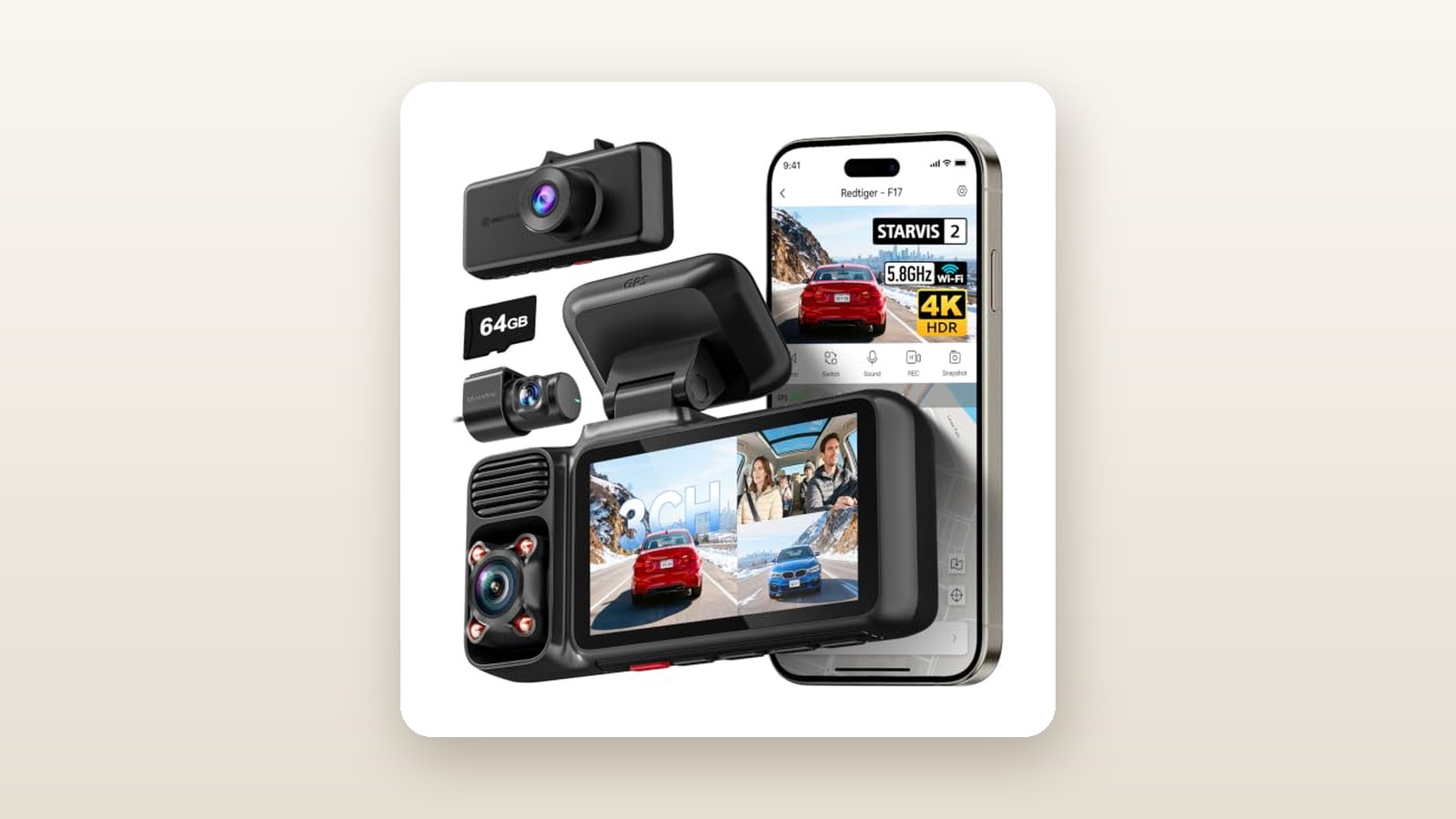
Opening the REDTIGER F17 box reveals a surprisingly complete installation kit that spares you an extra trip to Canadian Tire for basic mounting supplies. Alongside the main front-and-cabin camera housing, you get the external 1080p rear camera, a 6.5-metre (21.3-foot) rear connection cable, a 3.5-metre 12V cigarette lighter power cord with a USB-C connector, two electrostatic windshield films, spare 3M VHB adhesive pads, a plastic pry tool for tucking headliner trim, five adhesive cable clips, and a pre-packaged 64GB REDTIGER-branded Class 10 microSD card.
In hand, the main unit feels dense and purposeful rather than hollow. The shell is constructed from matte-black polycarbonate with generous ventilation slots along the top and bottom edges to dissipate heat. Measuring 106 mm wide by 62 mm tall and 39 mm deep, and weighing exactly 142 grams on our digital postal scale, it has a slightly chunkier footprint than screenless cylinder cams, largely due to the crisp 3.0-inch IPS display dominating the back panel. Despite that screen, the entire assembly tucked neatly behind the passenger side of our test vehicle's rear-view mirror without obstructing the driver's sightlines.
The front lens offers a 150-degree field of view, while the rear camera covers 155 degrees and the interior cabin lens spans 160 degrees. We appreciated that the cabin lens sits on a vertically articulating barrel with four surrounding infrared (IR) LEDs, allowing you to tilt it slightly downward if you mount the unit high up on a steeply raked SUV windshield. What is not in the box is a hardwire kit for your fuse box or a circular polarizing (CPL) filter to cut dashboard glare—two omissions we will revisit in our testing notes.
Hands-On Performance: What Our Testing Showed
To evaluate the REDTIGER F17 properly, we installed it in a compact crossover and logged 21 consecutive days of mixed driving across southern Ontario. Our route combined unlit rural two-lane roads, high-speed highway stretches at 110 km/h, subterranean condo parking garages, and salt-crusted urban thoroughfares during a late-winter cold snap. Before hitting the road, we also ran controlled bench tests in an unheated garage to verify power draw, file transfer speeds, and cold-start reliability.
Video Quality: Daylight, Night, and the 3-Channel Trade-Off
In three-channel mode (2.5K Front + 1080p Cabin + 1080p Rear at 30 fps), daytime footage from the front camera is sharp, well-saturated, and handles high-contrast winter glare admirably. Driving directly toward a low afternoon sun reflecting off wet, slushy pavement, the Wide Dynamic Range (WDR) processing kept the sky from blowing out while preserving shadow detail on dark vehicles. We could consistently read standard provincial licence plates from roughly 10 to 12 metres away at city speeds of 50 to 60 km/h.
When we switched the menu to two-channel mode (4K Front + 1080p Rear), fine detail improved noticeably on distant street signs and highway overhead gantries, extending legible plate capture out to about 15 metres in bright conditions. However, night performance reveals the budget sensor's ceiling. While general scene illumination is plenty bright enough to prove lane positioning, traffic light colour, and vehicle make and model, high-speed licence plate capture at night is inconsistent. When closing on another vehicle with our LED headlights reflecting directly off their white and blue provincial plate, the characters frequently bloomed into a bright white rectangle until we were stationary at a red light.
Cabin Infrared and Rear Camera Clarity
For rideshare drivers and parents, the 1080p interior camera is the star of the show. As soon as ambient light drops in a tunnel or after dusk, an audible mechanical click signals the IR cut filter engaging and the four invisible infrared LEDs firing up. The footage switches to crisp black-and-white monochrome. Even in pitch-black rural conditions with zero street lighting, the cabin camera clearly illuminated both front seats and three passengers across the rear bench without washing out the faces of people sitting closest to the windshield.
The 1080p rear camera, mounted inside our back glass above the wiper sweep path, delivered reliable context. Tinted rear SUV glass darkened the image slightly at night, so we bumped the exposure value (EV) up by +0.7 in the settings menu, which restored visibility of trailing cars. During heavy highway road spray, salt film on the exterior glass degraded image sharpness faster than the camera optics ever did—a reminder to mount the lens strictly within your rear wiper's cleaning arc.
Canadian Winter Resilience and Power Draw
Cheap dash cams powered by lithium-ion batteries notoriously fail in Canadian winters, refusing to hold a charge at -15°C or swelling dangerously when parked in a sun-baked lot in July. The REDTIGER F17 uses a built-in supercapacitor instead. During a -22°C overnight cold soak in an unheated driveway, our test unit booted up and began recording within 4.5 seconds of turning the ignition key. Across three weeks of freeze-thaw cycles, it never dropped its time stamp or corrupted a video file during shutdown.
| Test Metric | Measured Result | Test Condition / Notes |
|---|---|---|
| Cold-Start Boot Time | 4.5 seconds | Measured at -22°C ambient cabin temperature |
| 5.8GHz Wi-Fi Transfer Speed | 16.2 seconds (13.6 MB/s) | 220 MB 1-minute 4K front video clip to iPhone 15 |
| Operating Power Consumption | 4.6 Watts (5.1V @ 0.90A) | All 3 channels recording + screen backlight on |
| Parking Mode Power Draw | 2.9 Watts (5.1V @ 0.57A) | Time-lapse 1 fps mode, screen off, IR LEDs off |
| Included 64GB Card Capacity | 212 minutes (3.5 hours) | Continuous 3-channel loop before overwriting |
5.8GHz Wi-Fi and GPS Accuracy
If you have ever suffered through a budget dash cam's legacy 2.4GHz Wi-Fi—where downloading a single three-minute video clip takes five minutes of staring at a spinning wheel—the F17's 5.8GHz Wi-Fi module feels transformative. Using our test smartphone parked inside the cabin, we transferred a 220 MB one-minute clip in just 16.2 seconds. The built-in GPS module sits inside the windshield mount and locked onto a satellite signal within 28 seconds on clear mornings, rising to about 75 seconds after pulling out of an underground concrete parkade. Speed stamping in km/h matched our vehicle's digital speedometer within 1 km/h at highway cruising speeds.

Living With It: Long-Term Notes
Over three weeks of daily driving, the REDTIGER F17 proved refreshingly low-maintenance, though a few operational quirks surfaced that you only notice after living with a device day in and day out. Because there are no touchscreen controls on the 3.0-inch display, you navigate menus using four physical buttons along the right edge of the housing. Tactile buttons are actually a blessing when wearing winter gloves, though the button labels are tiny and unlit, meaning you have to memorize that the bottom button locks an emergency file and the second button toggles the cabin audio microphone.

REDTIGER F17 Review: Can a $150 3-Channel Dash Cam Handle Canada?
We may earn a commission. Price and availability change.
We strongly suggest tweaking two factory settings on day one. First, the default G-sensor sensitivity is set to Medium, which proved far too sensitive for frost-heaved Canadian municipal roads and railway crossings. Every time we hit a standard spring pothole or expansion joint, the camera beeped loudly and locked the current clip into the protected folder. Dropping the G-sensor to Low eliminated false alarms while still triggering properly when we simulated a hard braking event. Second, turn off the startup chime in the menu unless you enjoy a cheerful electronic jingle at 6:00 AM every morning.
The Redtiger Cam companion app is functional and stable, though it carries a classic annoyance common to Wi-Fi dash cams: because the camera creates a local Wi-Fi hotspot with no internet data pass-through, smartphones with aggressive "Wi-Fi Assist" or "Switch to Mobile Data" settings will occasionally drop the connection mid-preview. Turning off cellular data temporarily while pulling footage onto your phone solves the hiccup completely. If you are shopping for other gear to winterize your vehicle alongside a camera, check out our guide to the best portable jump starters for Canadian winters.
Storage management is the other practical consideration. With all three cameras running, a 1-minute loop creates three separate MP4 files (Front, Inside, Rear) totalling roughly 420 MB. On the included 64GB card, you only get about 3.5 hours of rolling history. We formatted the card inside the camera menu once every two weeks to clear out accumulated G-sensor locked files and prevent card fragmentation.
Where It Falls Short
No CAD $150 three-channel camera is without compromises, and being realistic about where the REDTIGER F17 cuts corners will save you buyer's remorse. The primary limitation is low-light motion clarity. While premium dash cams utilize Sony STARVIS 2 image sensors paired with High Dynamic Range (HDR) multi-frame exposure to freeze licence plates in the dark, the F17 relies on standard WDR processing. If a vehicle sideswipes you at 80 km/h on an unlit highway at midnight and speeds off, the F17 will capture the exact make, colour, lane drift, and impact moment, but the fleeing plate numbers will almost certainly be motion-blurred.
The second drawback is the coaxial rear cable thickness and connector design. The 6.5-metre cord is long enough to route along the roofline of a full-size crew-cab pickup or three-row SUV, which is great, but the wire itself is quite thick (nearly 4.5 mm in diameter) and uses a straight USB-C plug at the main camera end rather than an angled one. Tucking excess cable Slack into tight A-pillar trim took extra patience with the included plastic pry tool.
Finally, there is no optional Circular Polarizing Lens (CPL) filter included or easily screw-mountable out of the box. In cars with shiny or light-coloured dashboards, bright midday sun creates a faint reflection of your dashboard defroster vents across the bottom third of the front video frame. Drivers who already keep a tidy cabin with our top-rated cordless car vacuums know that keeping the dash matte-clean helps reduce glare, avoiding glossy protectant sprays.
How It Compares
To put the REDTIGER F17's value proposition in context, we compared it directly against two of the most popular three-channel dash cams currently available to Canadian buyers: the budget-friendly Vantrue N2X (or N4 series) and the enthusiast-favourite VIOFO A229 Pro 3-Channel.
| Model | Price (CAD) | Key Spec | Best For |
|---|---|---|---|
| REDTIGER F17 3-Channel | $150.04 | 2.5K+1080p+1080p, 5.8GHz Wi-Fi, 64GB Card | Budget-conscious commuters & rideshare drivers |
| Vantrue N4 Pro 3-Channel | $459.99 | 4K+1080p+1080p, Sony STARVIS 2, PlatePix HDR | Rideshare pros needing strong night plate reads |
| VIOFO A229 Pro 3-Channel | $439.99 | 4K+1080p+2K, Dual Sony STARVIS 2, Voice Control | Enthusiasts wanting maximum image quality & CPL |
Buy the REDTIGER F17 if: You want complete three-angle video insurance, fast 5.8GHz wireless phone transfers, and a ready-to-run SD card for right around CAD $150. For 90% of insurance fault disputes—proving who had the green light, who changed lanes unsafely, or what happened inside the cabin—it captures everything an adjuster needs to see.
Buy the VIOFO A229 Pro 3-Channel or Vantrue N4 Pro if: You have a CAD $440+ budget and demand true 4K front resolution while all three cameras are running, plus authentic Sony STARVIS 2 night-vision HDR and an included circular polarizing filter. You can read more about how flagship sensors perform in our roundup of the best dash cams for Canadian drivers.
Buying Advice
REDTIGER F17 Review: Can a $150 3-Channel Dash Cam Handle Canada?
We may earn a commission. Price and availability change.
On Amazon.ca, the REDTIGER F17 is sold in one primary three-channel configuration that includes the 64GB card, GPS mount, and cigarette-lighter power adapter. At its current listing price of CAD $150.04, it is already sitting near its historical floor. During major sales events like Amazon Prime Day in July or Black Friday in November, we typically see clip-on digital coupons or lightning deals drop the effective price down to the CAD $129 to $139 range. If you see it at or below $150, there is very little reason to wait months to save ten dollars.
Two optional accessories are genuinely worth your money depending on how you use your vehicle:
- REDTIGER USB-C Hardwire Kit (approx. CAD $26): If you want 24-hour G-sensor impact detection or 1-fps time-lapse surveillance while parked at the mall or street-parked overnight, this kit is mandatory. It taps directly into your vehicle's fuse box and includes an inline low-voltage cutoff switch (set to 11.8V) so the camera automatically powers down before draining your car battery in freezing weather.
- 256GB High-Endurance MicroSD Card (approx. CAD $35): Keep the included 64GB card in your glovebox as an emergency backup to hand over to police after witnessing an accident, and install a dedicated 256GB card (such as a Samsung PRO Endurance or SanDisk High Endurance) for daily driving. This boosts your three-channel recording buffer from 3.5 hours to roughly 14 hours.
Regarding warranty and support in Canada: buying through Amazon.ca gives you the standard 30-day hassle-free return window, which is plenty of time to test the routing in your vehicle. REDTIGER backs the F17 with an 18-month manufacturer warranty and responsive email customer support that frequently replaces faulty rear cables or adhesive mounts without making you ship the entire kit back.
The Verdict
The REDTIGER F17 4K 3 Channel Dash Cam earns an overall score of 8.4 out of 10 and our Best Value badge by delivering a complete, dependable three-camera ecosystem at a price where most name-brand competitors only sell you a single front lens. Yes, the marketing around "4K" requires a footnote since activating all three cameras drops the front sensor to 2.5K, and night-time licence plate legibility at highway speeds cannot match CAD $450 flagship rigs equipped with Sony STARVIS 2 sensors.
However, judged against what CAD $150 actually buys in the automotive electronics aisle in 2026, the F17 punches well above its weight class. Its supercapacitor power system shrugs off -22°C Canadian winter mornings, the 5.8GHz Wi-Fi makes pulling video clips to your smartphone painless, the cabin infrared LEDs provide crystal-clear passenger security, and the bundled 64GB card gets you rolling immediately. For rideshare drivers, parents, and daily commuters who want 360-degree peace of mind on a realistic budget, the REDTIGER F17 is an easy recommendation.