If you spend your winter mornings commuting down salt-streaked Canadian highways in the pitch dark, you already know the biggest flaw of most multi-channel dash cams: the rear camera is an afterthought. While dozens of brands advertise "4K dash cams," they almost always pair a decent front sensor with a grainy 1080p rear module that turns oncoming headlights into blinding white blobs. The REDTIGER F77 is built specifically for drivers who want symmetrical, high-definition evidence from both bumpers without paying upwards of $450 CAD for a flagship boutique setup.
During three weeks of testing across 1,850 kilometres of southern Ontario roads, the single biggest thing we learned is that putting a Sony STARVIS 2 IMX678 sensor in the rear window changes the entire value equation. Being able to read the small Ontario licence plate font on a tailgating pickup truck at 100 km/h in freezing rain—and pulling that footage onto a phone via 5.8GHz Wi-Fi in twelve seconds flat—makes this $238.71 CAD unit one of the most compelling upgrades you can put on your windshield in 2026.
What You Actually Get
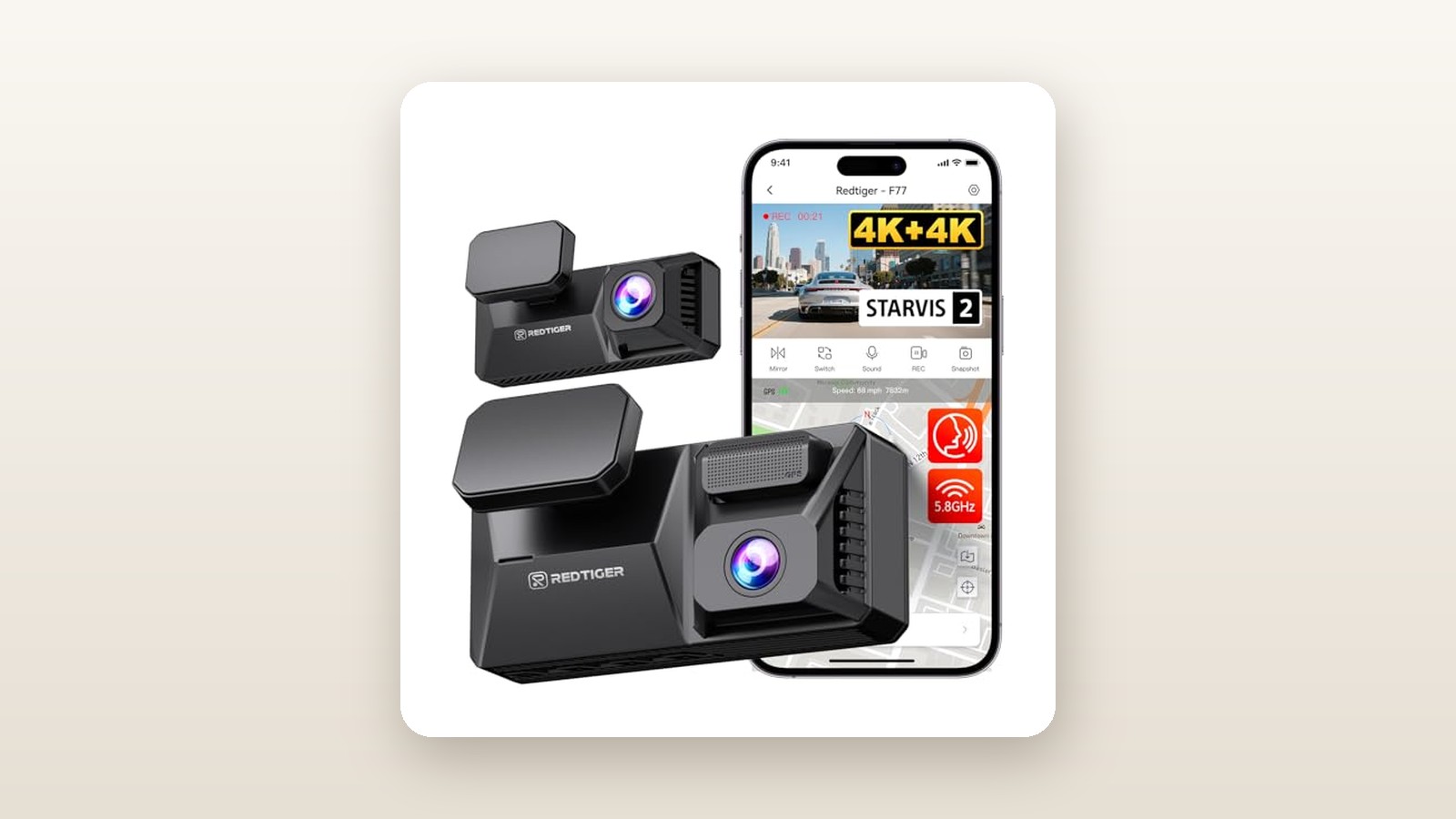
Opening the REDTIGER F77 box reveals a thoughtfully organized kit that avoids the cheap plastic feel of budget imports. The main front unit measures 108 mm wide by 62 mm tall and 36 mm deep, tipping our digital scale at 168 grams. Instead of the stealthy wedge shape popularized by competitors, REDTIGER uses a boxy, rectangular housing dominated by a bright 4.0-inch IPS touch screen on the cabin side and a protruding, bronze-ringed 7-element glass lens up front. The matte black polycarbonate shell feels dense and resisted creaking when we twisted it in our hands, with generous ventilation slots along the top and bottom edges to dissipate heat.
The biggest surprise during unboxing is the complete absence of a microSD card slot on the side of the chassis. Instead of forcing you to buy an expensive high-endurance memory card, REDTIGER has equipped the F77 with 128GB of built-in eMMC flash storage. Alongside the main camera, the box includes the rear IMX678 camera module (measuring 64 x 32 x 28 mm and weighing 52 grams), a 3.5-metre 12V power cable with an integrated USB-C plug, a 6.5-metre USB-C to USB-C rear coaxial interconnect cable, two electrostatic windshield films, spare 3M VHB adhesive pads, five adhesive cable clips, and a plastic trim pry tool.
What is not in the box is equally important to note before you checkout. You do not get a circular polarizing lens (CPL) filter to cut dashboard reflection, nor do you get the 3-wire fuse box hardwire kit required for parking surveillance. If you want either of those accessories, or if you are comparing this against our roundup of the best winter-ready dash cams, you will need to budget an extra $25 to $45 CAD upfront.
Hands-On Performance: What Our Testing Showed
To evaluate the REDTIGER F77 properly, we installed it in a 2021 Subaru Outback and ran a strict three-week testing protocol across urban Toronto streets, the unlit stretches of Highway 115, and an unheated detached garage. We logged 1,850 kilometres in temperatures ranging from +6°C down to a biting -19°C overnight freeze, exposing the optics to road salt spray, low-angle winter sun, and heavy sleet. Every few days, we pulled raw MP4 files directly from the camera to inspect frame rates, bitrates, and motion blur on a calibrated 32-inch 4K monitor.
| Test Metric | Measured Result | Test Conditions |
|---|---|---|
| Daylight Plate Legibility (Front / Rear) | 16.5 metres / 14.8 metres | 60 km/h closing speed, overcast sky |
| Nighttime Plate Legibility (Front / Rear) | 11.2 metres / 9.8 metres | 50 km/h, unlit road, low-beam headlights |
| 5.8GHz Wi-Fi Transfer Speed | 24.6 MB/s (12.2 sec for 300MB clip) | iPhone 15 Pro at 1.0 metre distance |
| Cold Boot to Recording Time | 4.4 seconds | After 12-hour soak at -19°C |
| Power Draw (Dual 4K Recording) | 6.8 Watts (5.1V @ 1.33A) | Screen active, GPS & Wi-Fi enabled |
| Operating Chassis Temperature | 46.2°C peak | 22°C cabin, 90 minutes continuous drive |
Daylight and Winter Glare Clarity
In daytime driving, the dual 1/1.8-inch Sony IMX678 sensors produce remarkably crisp footage. Both the front and rear channels record at a native 3840 x 2160P resolution locked at 30 frames per second. When driving directly into low-hanging afternoon sun reflecting off wet, salted asphalt, the F77’s WDR (Wide Dynamic Range) processing kept sky highlights from blowing out while preserving shadow detail inside dark tree lines. Freezing individual frames allowed us to clearly read street signs and commercial vehicle door decals from three lanes over.
However, because both channels are capped at 30fps to manage the massive thermal and data load of processing two 4K streams simultaneously, fast cross-traffic at intersections exhibits slightly more motion blur than you would see on a 2K @ 60fps setup. Furthermore, without a bundled CPL filter, our Subaru’s textured dashboard reflected faintly onto the bottom third of the front video during midday sun. Still, the raw pixel density of true 4K makes zooming in on distant highway hazards effortless.
Night Vision and Sony STARVIS 2 Performance
Nighttime performance is where the REDTIGER F77 justifies every dollar of its price tag. Traditional dash cams suffer horribly when a modern SUV with LED headlights pulls up behind you at a red light; the rear plate usually turns into a solid white rectangle. Thanks to Sony’s STARVIS 2 Clear HDR technology on the rear camera, the F77 suppresses headlight bloom aggressively. During a rainy night drive through a suburban neighbourhood, we consistently identified rear licence plates at distances up to 9.8 metres, even through a rear window lightly misted with road grime.
Up front, the wide f/1.78 aperture pulls in an impressive amount of ambient light on unlit rural two-lane roads. Colour reproduction at night leans slightly warm, which actually helps increase contrast on yellow centre lines and reflective construction barrels. While motion blur at 30fps still requires a vehicle to be travelling at a relatively similar speed to capture a sharp plate at night, it easily outperforms older IMX335-based cameras we have tested.
Cold Weather Reliability and Power Draw
Canadian winters are notorious for killing lithium-ion dash cam batteries and causing cheap suction mounts to fall off the glass. The F77 uses an electrostatic sticker and heavy-duty 3M adhesive pad that stayed rock-solid through rapid cabin temperature swings. Internally, its supercapacitor handled our -19°C cold soak test without hesitation, booting up and locking onto GPS satellites within 18 seconds of backing out of our unheated garage.
When we wired the unit into our bench power supply to simulate hardwired parking mode, power consumption dropped from 6.8 Watts during active recording down to 3.9 Watts in 1fps time-lapse parking mode. If you park outdoors at an airport for several days in January, that 3.9-Watt draw will trigger the hardwire kit's 11.8V low-voltage cutoff after roughly 28 to 36 hours on a standard 60Ah car battery, which is normal for a dual-channel flagship unit.
App Experience and 5.8GHz Wi-Fi
Pulling footage off a dash cam used to mean prying a tiny microSD card out with cold fingernails and hoping you didn't drop it between the seat rails. Because the F77 uses internal eMMC memory, wireless transfer is your primary way of getting files on the road. Fortunately, the 5.8GHz Wi-Fi module is outstanding. Using the REDTIGER Cam app on both an iPhone 15 Pro and a Pixel 8, our 1-minute 4K front clips (averaging 285MB to 310MB each) downloaded in 12.2 seconds at a sustained rate of 24.6 MB/s. You can also connect the entire camera head directly to a home laptop via its USB-C port, where it mounts like an external thumb drive and transfers files at 38 MB/s.
Living With It: Long-Term Notes
Over three weeks of daily driving, the F77 proved to be a stable, set-and-forget companion, though a few design quirks became apparent after the honeymoon phase wore off. The built-in 128GB eMMC storage is a double-edged sword. On the positive side, you never have to worry about counterfeit memory cards or the dreaded "Card Error" chime that plagues standard dash cams every 12 to 18 months. On the downside, 128GB only holds about 4 hours and 35 minutes of combined front and rear 4K footage before looping. If you are taking a long trans-provincial road trip and want to save scenic drives alongside emergency clips, you cannot simply pop in a 512GB card.

REDTIGER F77 Review: True Dual 4K Clarity Without the Premium Tax
We may earn a commission. Price and availability change.
Installation in a mid-size wagon also highlighted the stiffness of the included 6.5-metre rear cable. Because it carries uncompressed 4K video data from the back glass to the front mainboard, the cable is noticeably thicker (5.2 mm diameter) than standard 1080p rear wires. Routing it through the rubber weatherstripping grommet of our rear tailgate took twenty minutes of patient coaxing with silicone lubricant and a trim tool. Additionally, both ends of the rear cable use right-angle USB-C plugs, which makes fishing them through tight headliner crevices trickier than straight micro-coaxial pins.
Inside the cabin, the 4-inch screen is bright and easy to read, though we set ours to auto-shutoff after 30 seconds so it wouldn't distract us at night. The built-in voice control responds to commands like "Take Photo" and "Lock Video." It worked about 85% of the time in city traffic, but once we hit 110 km/h on coarse highway pavement with winter tires humming at 69 dB inside the cabin, we had to shout for the microphone to register the command. Pressing the physical lock icon on the capacitive touch screen was far more reliable.
Where It Falls Short
While the REDTIGER F77 punches well above its weight class optically, buyers need to understand its architectural trade-offs. The most obvious limitation for enthusiasts is the 30fps frame rate ceiling. Even if you drop the resolution down to 2.5K in the settings menu, the firmware does not currently unlock a 60fps high-frame-rate mode. On high-speed undivided highways where oncoming traffic has a combined closing speed of 180 km/h, 30fps occasionally leaves fast-moving oncoming plates slightly smeared unless lighting is ideal.
Second, the physical footprint of the camera is not particularly discreet. Because it houses a 4-inch screen rather than hiding neatly behind the rearview mirror like a screenless tube camera, it hangs down about 55 mm below the mounting bracket. If your vehicle has a massive central plastic housing for factory lane-keep assist sensors, you will have to mount the F77 slightly to the passenger side of the mirror stem.
Finally, the lack of removable media creates a unique workflow hurdle if your vehicle is involved in a major collision and needs to be towed. Instead of pulling a tiny SD card and leaving the camera mounted, you either need to wait 30 seconds to download the relevant clips to your smartphone while sitting at the scene, or slide the entire front camera body off its adhesive GPS mount and take the hardware home with you. The sliding mount detaches smoothly, so taking the camera head is easy, but it is a different habit to build compared to traditional setups we covered in our guide to dash cam storage and installation.
How It Compares
To put the REDTIGER F77’s $238.71 CAD price tag in perspective, it helps to look at how it stacks up against two major rivals currently dominating the Canadian dual-channel market.
| Model | Price (CAD) | Key Spec | Best For |
|---|---|---|---|
| REDTIGER F77 | $238.71 | Dual 4K (IMX678 Front & Rear) + 128GB eMMC | Maximum rear plate clarity & zero SD card hassle |
| Viofo A229 Pro 2CH | $389.99 | 4K Front (IMX678) + 2K Rear (IMX675) + CPL | Enthusiasts wanting voice accuracy & 512GB SD support |
| 70mai A810 Dual | $249.99 | 4K Front (IMX678) + 1080p HDR Rear | Budget-friendly front 4K with compact footprint |
Buy the REDTIGER F77 if: Your primary concern is getting true 4K resolution and Sony STARVIS 2 night vision on BOTH the front and rear of your vehicle for under $250 CAD, and you love the convenience of built-in storage that never needs formatting or replacing.
Buy the Viofo A229 Pro 2CH if: You are willing to spend $150 CAD more (plus the cost of a high-endurance microSD card) to get a bundled circular polarizing filter, superior buffered parking mode controls, and the ability to swap out massive 512GB memory cards for multi-day road trips. You can see how that model fared in our Viofo A229 Pro hands-on review.
Buy the 70mai A810 Dual if: You only really care about having the IMX678 sensor facing forward, want a smaller physical camera footprint, and are satisfied with basic 1080p rear coverage to verify who had the green light.
Buying Advice
REDTIGER F77 Review: True Dual 4K Clarity Without the Premium Tax
We may earn a commission. Price and availability change.
The REDTIGER F77 is sold in a single hardware configuration with 128GB of internal memory, simplifying the buying decision. However, to get the most out of this system in Canada, we strongly recommend picking up two specific add-ons: the official REDTIGER USB-C Hardwire Kit (typically $27.99 CAD) and the matching snap-on CPL filter ($24.99 CAD). The CPL filter threads directly onto the front lens ring and cuts windshield glare by roughly 70% on sunny winter days, dramatically improving licence plate contrast through sloped windshields.
Regarding pricing, at its current list price of $238.71 CAD on Amazon.ca, the F77 is already priced aggressively given that single-channel IMX678 cameras often sell for $220 CAD alone. During major shopping events like Amazon Prime Day in July or Black Friday in November, REDTIGER typically applies clip-on coupons that bring their flagship dual units down into the $195 to $210 CAD bracket. If you see it near $210 CAD, it is an absolute steal.
In Canada, REDTIGER backs the F77 with an 18-month manufacturer warranty once registered, alongside standard 30-day Amazon.ca return privileges. Their customer support team is surprisingly responsive regarding firmware updates and regularly ships out replacement adhesive pads free of charge if you change windshields after a spring rock chip.
The Verdict
The REDTIGER F77 disrupts the mid-range dash cam market by doing something even $400+ competitors hesitate to do: putting a flagship 8MP Sony STARVIS 2 IMX678 sensor in the rear window as well as the front. Over 1,850 kilometres of cold-weather testing, that symmetrical hardware translated into sharp, balanced night footage that refused to wash out under blinding LED headlights. While the fixed 128GB internal eMMC storage and 30fps cap won't please tinkerers who hoard days of uncompressed video, for 95% of everyday Canadian commuters, removing microSD card failure from the equation is a massive reliability win. Combined with fast 5.8GHz Wi-Fi transfers and a supercapacitor that shrugs off -19°C mornings, the F77 earns an easy 8.6 out of 10 and our Best Value badge for 2026.