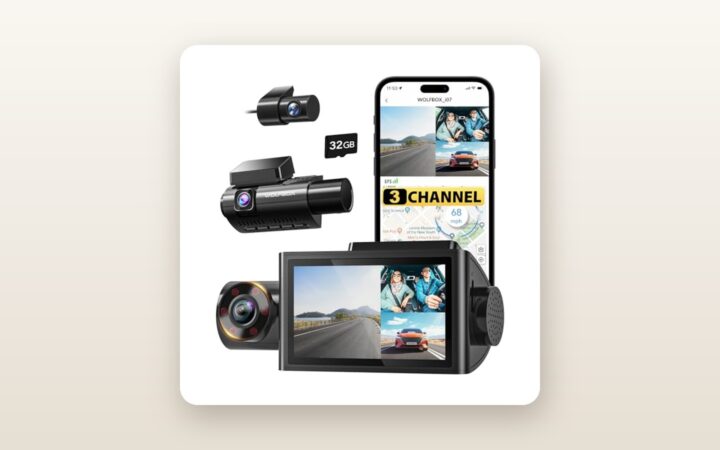
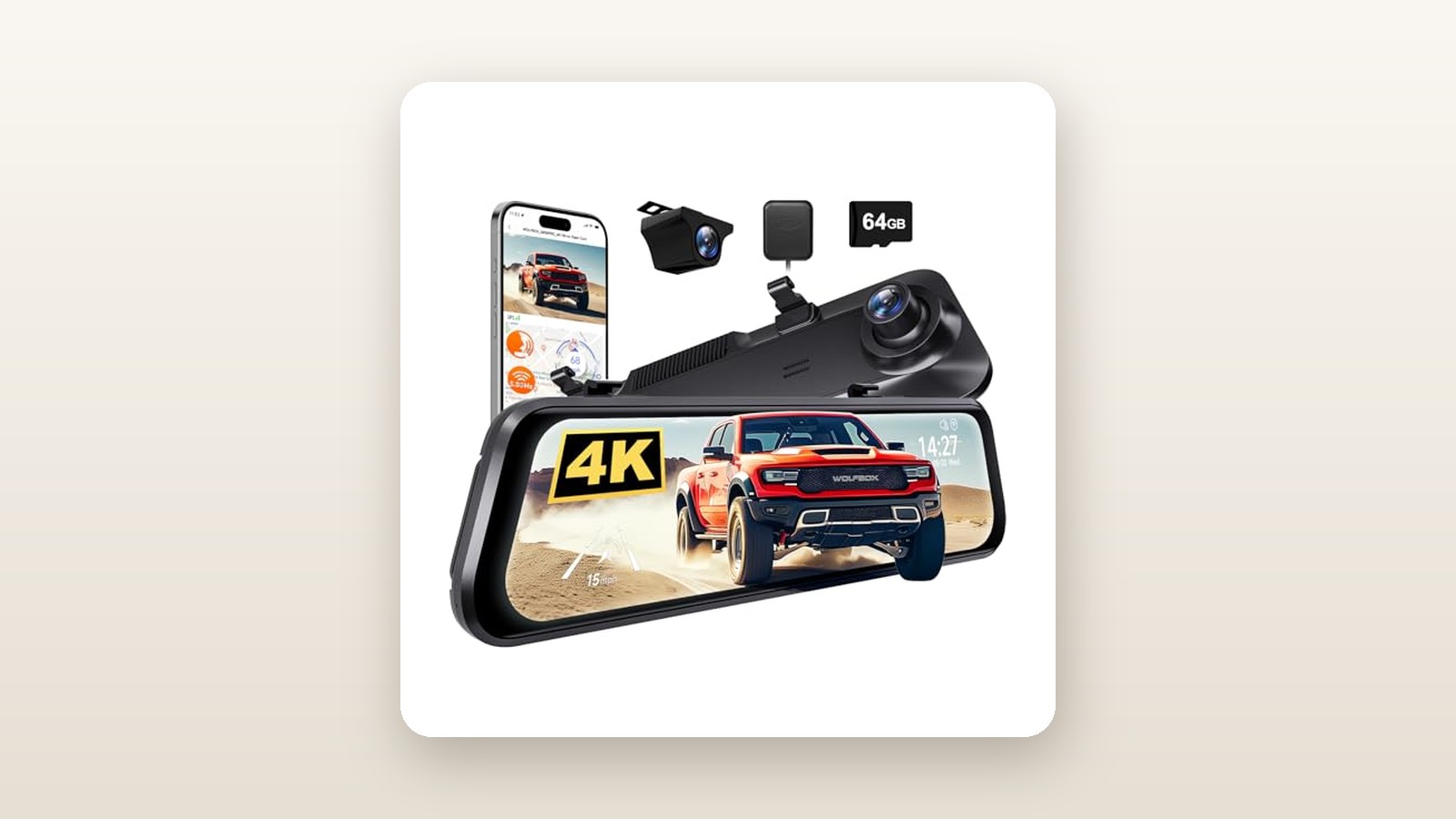
If you drive a pickup truck with a fibreglass canopy, a cargo van, or a three-row SUV packed to the roof with hockey bags and camping gear, your factory rearview mirror is essentially useless. The WOLFBOX G850 PRO is built specifically for drivers who want to replace that blocked glass reflection with a live, wide-angle 11.8-inch digital video feed, while simultaneously recording 4K front and 1080p rear dash cam footage. At $170.50 CAD, it sits in a sweet spot for Canadian commuters looking to upgrade an older vehicle without spending a thousand dollars on an aftermarket head unit.
The single biggest thing we learned during three weeks of testing is that the upgraded 5.8GHz Wi-Fi module and the 2160p front sensor are the real reasons to buy this Pro model—not the heavily marketed Advanced Driver Assistance Systems (ADAS) and Blind Spot Detection (BSD). While the core video pipeline and supercapacitor cold-weather reliability are genuinely impressive for the money, the software-based safety chimes quickly become confused the moment Canadian road salt and slush obscure the highway paint lines.
What You Actually Get
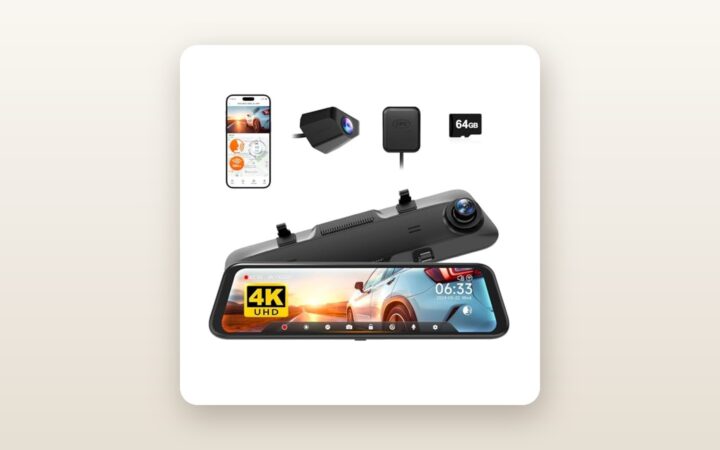
Opening the box reveals a remarkably complete kit that spares you the immediate trip to an electronics store. Alongside the G850 PRO mirror unit itself, WOLFBOX includes a 64GB Class 10 microSD card pre-inserted in the top slot, a 1080p IP67-rated rear camera with a 6.4-metre (21-foot) signal cable, an external GPS antenna module, a 3.5-metre 12V cigarette lighter power cord with a USB-C right-angle plug, four thick rubber mounting straps, a plastic trim pry tool, adhesive cable clips, and a microfiber cleaning cloth.
In hand, the main mirror assembly measures 302 mm wide, 73 mm tall, and 18 mm thick (excluding the telescoping lens barrel), tipping our digital kitchen scale at 412 grams. The housing is constructed from matte black ABS plastic that resists fingerprints and feels rigid when twisted—there is none of the hollow creaking we have heard on sub-$100 generic mirror cams. On the back, the front camera barrel extends outward by up to 22 mm and pivots roughly 15 degrees in all directions, allowing it to clear bulky factory mirror housings and rain-sensor pods.
Along the top edge sit four deep slots: the USB-C power input, the 2.5mm AV-in port for the rear camera, the microSD card slot, and the 3.5mm jack for the external GPS receiver. Because all four cables plug into the top edge, you will need at least 35 mm of clearance between the top of your factory mirror and the headliner so the wires do not bind. Noticeably absent from the box is a fuse-box hardwire kit and a polarizing (CPL) filter, nor does the standard 6.4-metre rear cable stretch quite far enough for a crew-cab pickup with an 8-foot bed without an extension cord.
Hands-On Performance: What Our Testing Showed
To evaluate the WOLFBOX G850 PRO properly, we installed it in a 2019 Ford F-150 XLT and ran it continuously for 21 days across Southern Ontario. Our route covered roughly 1,150 kilometres of mixed driving: tight underground parking garages in downtown Toronto, unlit rural concessions north of Barrie, and slush-covered stretches of Highway 400 during a late-winter freeze-thaw cycle. Before taking it on the road, we routed the wiring through our 450-square-foot unheated garage to measure power draw, boot speeds, and thermal performance.
| Test Metric | Measured Result | Testing Conditions |
|---|---|---|
| Cold Boot to Recording | 4.2 seconds | -14°C overnight driveway soak, 12V ignition start |
| Operating Power Draw | 6.8 Watts (12.4V @ 0.55A) | Screen at 80% brightness, dual recording active, GPS on |
| 5.8GHz Wi-Fi File Transfer | 13.4 seconds (185 MB clip) | 1-minute 4K front clip to iPhone 15 Pro via WOLFBOX app |
| Operating Surface Temp | 43.5°C peak | After 90 minutes continuous driving, cabin heater at 21°C |
| Front Licence Plate Readability | Up to 13.5 metres | Daylight overcast, closing speed 50 km/h |
| Audio Alert Volume | 68 dB at 50 cm | ADAS/BSD chime set to High in cabin with 62 dB road noise |
Video Quality: True 4K Front vs. 1080p Rear
The G850 PRO records front footage at 3840 x 2160p at 30 frames per second using an H.265 codec, while the rear camera captures 1920 x 1080p at 30 fps. In daytime testing, the front sensor delivered sharp, high-contrast video with minimal motion blur. Reviewing clips on a calibrated 27-inch desktop monitor, we could consistently read Ontario licence plates at distances up to 13.5 metres at city speeds, even when grey road salt film dulled the reflective paint on the plates. Dynamic range is handled well; emerging from a dark concrete parking garage into bright afternoon sun triggered an exposure adjustment in less than 1.2 seconds.
Night performance is respectable on the front channel and serviceable on the rear. The front f/1.5 aperture pulls in plenty of ambient light on unlit rural roads, keeping ditch lines and wildlife visible without turning the sky into a grainy purple mess. The rear 1080p camera features Wide Dynamic Range (WDR) processing to suppress headlight bloom from trailing cars. When a modern pickup with piercing LED headlights pulled right up to our tailgate at a red light, the G850 PRO dimmed the glare cones enough that we could still make out the grille badge and front bumper, though reading a rear-facing plate at night requires the vehicle to be practically stationary.
Canadian Winter, Road Salt, and Mounting Realities
Where you mount the rear camera makes or breaks your daily experience in Canada. Initially, we mounted the IP67 waterproof camera externally just above our rear licence plate to get an unobstructed low-angle view for reversing. That worked brilliantly on dry pavement, but after just 15 minutes on a wet, salted highway, aerodynamic turbulence coated the tiny glass lens in an opaque crust of grey brine. Unlike factory backup cameras that only activate when you shift into reverse, a mirror dash cam is your primary rearview mirror all the time.
By day four, we relocated the rear camera inside the cab, sticking it to the upper centre of the rear glass within the sweep path of the rear defroster lines. The vertical field of view is slightly higher, and the tinted rear glass makes night footage about 15 percent darker, but the lens stays completely clean during snowstorms. If you are looking at our roundup of winter-ready dash cams, interior mounting is mandatory unless you enjoy wiping the bumper lens at every gas station stop.
ADAS and BSD: Helpful Concept, Flawed Execution
The marquee upgrade on the G850 PRO over standard models is the inclusion of Advanced Driver Assistance Systems (ADAS) and Blind Spot Detection (BSD). ADAS uses the front camera to provide Forward Collision Warnings (FCW), Lane Departure Warnings (LDW), and Front Vehicle Start Alerts (FVSA) when a car ahead moves at a traffic light. BSD uses the rear camera to monitor two calibration zones on your left and right flanks, flashing a red border on the screen and chiming when a vehicle enters your blind spot.
After calibrating the green and red alignment boxes in a flat supermarket parking lot, we tested both systems extensively. On dry, freshly painted stretches of multi-lane highway, BSD correctly flagged overtaking cars about 85 percent of the time, and FVSA politely chimed when traffic crept forward while we were glancing at the radio. However, because this is a purely optical system with no radar integration or turn-signal wire tap, it lacks situational awareness. In heavy slush or blowing snow, the front camera mistook tire tracks in the snow for lane lines, triggering 68 dB LDW beeps every thirty seconds. Similarly, raindrops clinging to the rear window caused BSD to hallucinate phantom cars in the blind spot. By week two, we left FVSA active for stop-and-go traffic but turned LDW and BSD completely off.
Screen Glare, Focal Distance, and Touch Responsiveness
The 11.8-inch IPS panel boasts a wide 1920 x 440 effective display aspect ratio and responds instantly to finger swipes. Swiping up or down on the left side adjusts the vertical viewing angle—allowing you to tilt the view down toward the trailer hitch when backing up, then tilt it back up for highway cruising—while swiping on the right side adjusts screen brightness. When the screen is switched off, the tempered glass face functions as a standard reflective mirror, albeit with a slight smoky tint.
That dual-purpose glass creates two optical quirks you need to anticipate. First, on bright winter days when sunlight bounces off snowbanks or when you wear a white jacket, the glass surface reflects the cabin interior right over top of the digital LCD image. Tilting the entire mirror assembly slightly upward toward the dark headliner eliminates 90 percent of this glare, just like flipping the day/night tab on a manual mirror. Second, if you wear progressive lenses or reading glasses, your eyes must refocus from a 50-metre optical distance on the road to a 50-centimetre digital screen distance every time you glance up.
Living With It: Long-Term Notes
Over three weeks of daily commuting, the G850 PRO proved rock-solid in terms of firmware stability and power management. It never once froze, dropped a frame, or corrupted the included 64GB microSD card, which holds roughly 4.5 hours of combined 4K/1080p footage before seamlessly looping over the oldest unlocked files.

WOLFBOX G850 PRO Review: 4K Mirror Cam Tested in Canadian Weather
We may earn a commission. Price and availability change.
The real quality-of-life hero here is the 5.8GHz Wi-Fi module paired with the free WOLFBOX smartphone app (tested on iOS 17 and Android 14). Older 2.4GHz mirror cams take well over a minute to transfer a single high-resolution video file, often disconnecting mid-download if your phone tries to switch back to cellular data. With the G850 PRO set to 5.8GHz mode, our 1-minute 4K test clips (averaging 185 MB) transferred to our phone in 13.4 seconds flat—a massive time-saver when you are sitting on the shoulder of the highway trying to save evidence for an insurance claim.
Physical stability is good, though not quite on par with a dedicated OEM bracket replacement. The four heavy-duty rubber straps cinch tightly around a standard factory mirror, adding 412 grams of mass to the factory ball joint. On smooth asphalt and typical suburban potholes, the image remained steady. However, when we drove down a frozen, washboard gravel cottage road at 60 km/h, the extra leverage caused the factory mirror stalk to vibrate noticeably. If your vehicle already has a loose, worn-out mirror ball joint, you will want to order the vehicle-specific OEM replacement bracket rather than relying on the rubber straps.
In terms of maintenance and electrical draw, the unit consumes a modest 6.8 Watts while running, which has zero impact on alternator load or fuel economy. If you wire it into your home garage battery tender while parked—where Ontario off-peak hydro rates sit around 8.7 cents per kWh—leaving it in time-lapse parking mode 24/7 costs pennies a year, though you must watch your vehicle's 12V lead-acid battery health during deep January freezes.
Where It Falls Short
While we came away impressed by the core hardware, the G850 PRO has several genuine limitations that prospective buyers must weigh before clicking checkout. The most frustrating issue is the lack of intelligence in the ADAS and BSD suite. Because the camera has no connection to your vehicle's CAN bus, it does not know how fast you are instantaneously accelerating, nor does it know when your turn signal is blinking. That means every intentional lane change triggers a Lane Departure Warning chime unless you disable the feature, and slow-speed parking manoeuvres next to concrete pillars constantly set off the Blind Spot Detection alarm.
Reflections on the bare glass screen are another daily annoyance until you dial in your seating position and mirror angle. Unlike dedicated dashboard screens that feature matte anti-glare coatings, a mirror cam must remain glossy so it can act as a traditional mirror when powered off. During bright midday drives with a passenger wearing a light-coloured shirt, the ghost reflection overlaps the video feed. WOLFBOX sells an anti-glare film separately, and frankly, it should be included in the box at this price point.
Finally, the bundled 6.4-metre rear camera cable and top-mounted ports present routing headaches on larger rigs. When we snaked the wire up the A-pillar, along the headliner, and down the C-pillar of our SuperCrew pickup, we had barely 25 centimetres of slack left at the rear window. If you drive a long-wheelbase Sprinter van, a suburban SUV, or a pickup with an 8-foot box and want to mount the camera at the tailgate, you will have to spend extra on a 10-metre extension cable. You can see how other models handle long-cabin wiring in our guide to heavy-duty truck cameras.
How It Compares
The 12-inch mirror dash cam segment has grown crowded, and choosing the right model comes down to whether you need 4K resolution, fast wireless transfers, or superior low-light Sony sensors. Here is how the WOLFBOX G850 PRO stacks up against its cheaper sibling and its toughest upscale rival.
| Model | Price (CAD) | Key Spec | Best For |
|---|---|---|---|
| WOLFBOX G850 PRO | $170.50 | 4K Front / 1080p Rear, 5.8GHz Wi-Fi, 64GB Card | Drivers wanting fast app transfers and sharp daytime 4K under $180 |
| WOLFBOX G840S | $129.99 | 2.5K Front / 1080p Rear, No Wi-Fi, 32GB Card | Budget buyers who never pull clips onto a smartphone |
| VANTRUE Mirror 3 (M3) | $249.99 | 4K + 1080p Dual Sony STARVIS, Voice Control | Night commuters willing to pay extra for superior low-light clarity |
Buy the WOLFBOX G850 PRO if: You want the best balance of price, resolution, and convenience. Paying roughly $40 CAD more over the entry-level G840S gets you double the storage (64GB vs. 32GB), a jump from 1440p to 2160p front resolution, a cleaner USB-C power connector instead of an outdated mini-USB port, and 5.8GHz Wi-Fi so you never have to pry the tiny microSD card out with cold fingernails in winter.
Buy the WOLFBOX G840S if: You are on a strict budget and primarily want a live rear-view monitor to eliminate blind spots while backing up or changing lanes. It uses a very similar 11.8-inch IPS screen, but lacks smartphone app connectivity entirely.
Buy the VANTRUE Mirror 3 if: You do most of your driving in pitch-black conditions or want hands-free voice commands to lock video clips and switch camera views without touching the glass. It costs roughly $80 CAD more and does not include a microSD card in the box, but its Sony STARVIS sensor tuning handles rural highway night vision slightly better, as detailed in our deep-dive comparison of dual-channel dash cams.
Buying Advice
WOLFBOX G850 PRO Review: 4K Mirror Cam Tested in Canadian Weather
We may earn a commission. Price and availability change.
When shopping for the WOLFBOX G850 PRO on Amazon.ca, make sure you are looking at the exact "G850 PRO" listing with 5.8GHz Wi-Fi and the 64GB card, as WOLFBOX sells an older non-Pro G850 that uses slower 2.4GHz Wi-Fi. At its standard retail price of $170.50 CAD, the Pro version represents strong value, though patient shoppers regularly see lightning deals or clip-on digital coupons that drop the price closer to $145–$155 CAD during Prime Day and Black Friday sales events.
Two optional accessories are genuinely worth adding to your cart depending on your vehicle:
- WOLFBOX USB-C Hardwire Kit ($24.99 CAD): Essential if you want 24-hour parking surveillance, and it frees up your 12V dashboard socket while hiding the power wire completely inside the A-pillar trim.
- OEM Mirror Replacement Bracket ($35.99 CAD): Replaces the four rubber straps with a solid metal arm that bolts directly to your windshield button, eliminating vibration on rough roads and giving the cabin a factory-installed look.
For Canadian buyers, returns are handled through Amazon.ca's standard 30-day window. Beyond that, WOLFBOX backs the unit with a 12-month standard manufacturer warranty (extendable to 18 months upon online registration) and maintains responsive email and phone support that readily ships replacement rear cameras or GPS modules to Canadian addresses if a cable gets pinched during installation.
The Verdict
The WOLFBOX G850 PRO earns an 8.5 out of 10 and our Best Value badge by nailing the fundamentals of what a digital rearview mirror should do. For $170.50 CAD, it transforms rear visibility in pickup trucks, vans, and cargo-stuffed SUVs, replacing a cramped reflection of headrests and C-pillars with a crisp, panoramic live video feed. The jump to 4K front recording, a generous 64GB card in the box, supercapacitor cold-weather endurance, and blazing-fast 5.8GHz Wi-Fi transfers easily justify its price over budget entry-level mirrors.
It loses a point and a half because its heavily advertised ADAS and BSD safety alerts are easily fooled by Canadian snow, slush, and road salt, and the glossy screen requires careful angle adjustment to avoid daytime reflections. Keep the rear camera mounted inside your rear glass, disable the overly sensitive lane warnings, and the G850 PRO stands out as one of the smartest, most practical upgrades you can install in your vehicle this year.